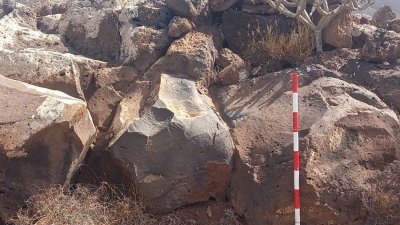
The Cabildo of Lanzarote, through its Historical Heritage Service, has denounced a serious attack against one of the rock engravings of the Piedra del Majo, in the Zonzamas site, one of the most relevant art stations of our island past.
In this site, the representations known as Podomorphs stand out, present only on the islands of Lanzarote and Fuerteventura and documented for the first time in 1982 in the Revista del Museo Canario.
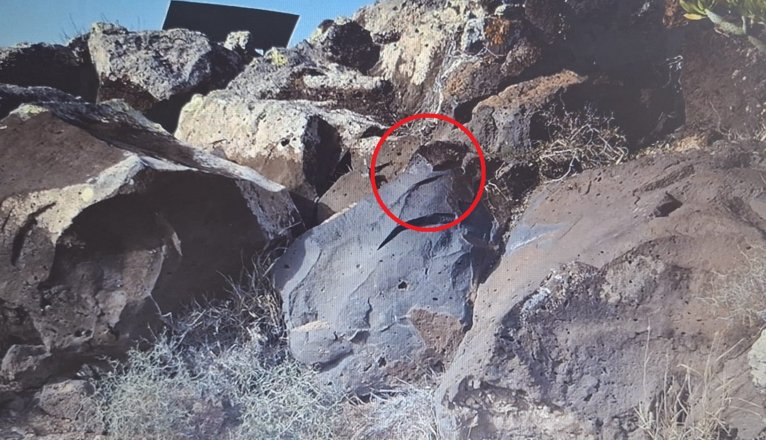
The serious events have consisted of an aggression against the physical support of one of these engravings, which has caused the fracture of the stone and generated several flakes and fragments. The remains have been collected by the Heritage Service and are in custody in the facilities that the Island Council has enabled to preserve the archaeological funds of the island.
The discovery has been possible thanks to the continuous and programmed rounds carried out by the guards of the Heritage Service in the different archaeological sites and in other elements of the island's heritage. At the moment, the identity of those responsible is unknown, but the island institution has filed the corresponding complaint and has requested the collaboration of other administrations and the Seprona of the Civil Guard for their identification.
This attack occurred a few days after the Heritage Service began to promote new protection measures for this type of highly fragile spaces. The location, richness and nature of these rock manifestations makes it especially difficult to control access to them, so the institution recalls the importance of citizen involvement in their preservation.
"An irreparable damage to our history"
The president of the Cabildo of Lanzarote and head of the Heritage Area, Oswaldo Betancort, has expressed his strong condemnation of these events. "We cannot allow such a valuable part of our history and identity to be destroyed by vandalism and disrespectful acts. These engravings are a unique legacy, not only for Lanzarote, but for humanity as a whole, and we must protect them firmly."
Betancort has stressed the importance of citizen involvement in the preservation of heritage. "The care of our heritage is not only the responsibility of the institutions, but a collective commitment. We need all citizens to be aware of its fragility and act as allies in its protection."
The Cabildo recalls that rock engravings and the rest of the pre-colonial heritage constitute a cultural legacy of incalculable value that enriches the heritage of all humanity. Its conservation is fundamental, and the awareness on the part of the whole society is key to prevent this type of attacks from happening again.



Add La Voz de Lanzarote as a preferred Google source.
Stay informed with the latest current news.