
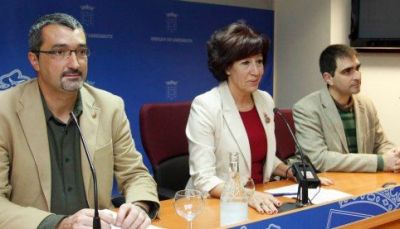
The Minister of Social Welfare of the Government of the Canary Islands, Inés Rojas de León, accompanied by her counterpart in the Cabildo of Lanzarote, Marciano Acuña Betancort, and the general director of Dependency, Childhood and Family, José Moreno, presented this Friday in Lanzarote the Canary Family Foster Care Program.
With this program, the General Directorate of Dependency, Childhood and Family intends to invite families who are willing to take in a child in a situation of helplessness so that the minors feel "the warmth, attention, education and care they need". In Lanzarote, there are already four families participating in this program, although two of them are still in the process of receiving the minors.
In this way, the admission of minors to a reception center will also be avoided. The regional minister explained that "the Government of the Canary Islands has been carrying out several programs aimed at promoting the foster care of minors under the guardianship of the Government and who reside in centers, so that they are taken in by a family through this Canary Family Foster Care Program".
Regarding the children cared for in the Minors' Centers on the island, Acuña explained that at the moment "there are 46 minors cared for by excellent teams of professionals, in the care network and protection centers in Lanzarote". So far this year, according to the councilor, "two discharges have occurred".
In addition, he specified that in 2012, 38 accompanied minors and 29 unaccompanied foreign minors were cared for, the latter mainly from Africa. The councilor also reported that with respect to 2011, there has been a decrease of 53.9 percent in the care of unaccompanied foreign minors, determined because in 2012 fewer boats arrived on the island, going from 63 in 2011 to 29 in the past year.
To promote the temporary reception of these minors, the Ministry of Social Welfare of the Government of the Canary Islands, with the support of the Cabildo of Lanzarote on the island, has launched a campaign under the slogans "Would you teach him to learn"', "Would you teach him to play?" and "Would you teach him to grow?". Thus, it invites families to take in these minors so that they can improve "their present life and have a better opportunity for future life".
Data on foster care in families
Likewise, both the general director of Dependency, Childhood and Family and the Minister of Social Welfare have reported that in recent years, the Canary Islands has registered a positive trend marked by the reduction in the number of minors under guardianship residing in centers and homes and the increase in the number of minors in foster care in families.
In 2007, there were 2,507 minors in foster care, and in 2011 there are 171 fewer minors. In addition, there has been a decrease in residential foster care in the Canary Islands, going from 1,211 in 2007 to 1,007 in 2011. Likewise, there has been an increase in foster care in families, which has gone from 1,296 in 2007 compared to 1,322 in 2011.
"This program has already begun to bear its first fruits, and an 80 percent reduction in admissions to centers and homes for minors from 0 to 3 years of age has been achieved, since one of the main lines of this program is that from the moment the declaration of helplessness is issued, the child does not go to live in a center but is taken in directly by a family", explained the minister.
Interested families on the island should call 012 where they will be told the procedure to temporarily take in a child. To do this, they will have to attend information meetings in which they will be clarified what are the commitments that lead them to the foster care of a minor.


