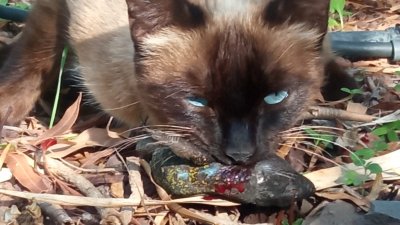
The Association for the Conservation of Biodiversity (ACBC), the Spanish Ornithological Society (SEO)/BirdLife, the Tenerife Association of Friends of Nature (ATAN), the Canary Islands Ornithology and Natural History Group (GOHNIC) and the Association for the Conservation of the Natural Heritage of Teno “Abeque” request the Government of the Canary Islands to urgently approve a protocol for the implementation of feline colonies.
The environmental and conservation organizations ask the Ministry of Agriculture, Livestock, Fisheries and Food Sovereignty, in collaboration with the Ministry of Ecological Transition and Energy, to urgently approve a framework protocol for the implementation of feline colonies and the management of feral cats by the city councils and island councils, so that their impact on protected species can be minimized.
The groups state that, after the approval of Law 7/2023, of March 28, on the protection of the rights and well-being of animals, colonies and feeding points for cats that do not comply with said regulations have begun to proliferate. “Likewise, the new municipal ordinances relating to this issue, in most cases, do not contemplate measures relating to the conservation of biodiversity that is affected by these bad practices,” they add.
La Graciosa
As the most recent example, they cite the flagrant case that occurred this summer in La Graciosa, a protected natural space included in the Natura 2000 network where, between July 25 and 28, a campaign was carried out to capture, sterilize and return (CER) cats.
This campaign was promoted by the Animal Welfare area of the Lanzarote City Council with the participation of the Teguise City Council, Ports of the Canary Islands, the public company of the Canary Islands Government GESPLAN, the Official College of Veterinarians of the Canary Islands, the University of Las Palmas de Gran Canaria and several animal protection organizations.
In the opinion of the signatory organizations, once captured, they should have been transferred to suitable facilities in Lanzarote as the only effective action to avoid damage to numerous species classified as threatened, as indicated by Law 7/2023 itself, in its article 42.7, which clearly establishes that cats must be relocated when they have a negative impact on biodiversity conditions in protected natural spaces and in the Natura 2000 Network spaces, or a negative impact on protected fauna.
They point out that all these actions are being carried out with a strong investment of public money by the island councils and city councils, “institutions that must promote the general interest, so it cannot be tolerated in any way that they harm wildlife, both in urban, rural or natural areas.”
“We must not forget that the majority of reptiles and birds that inhabit the natural spaces of the archipelago, rural areas and in many parks and gardens of our neighborhoods and cities are protected by state legislation (Canary Islands Catalog of Protected Species, in the List of Wild Species under Special Protection Regime and Spanish Catalog of Threatened Species) and by the main European directives on biodiversity conservation (Birds Directive and Habitats Directive),” they specify.
Compliance with the Law
The environmental groups have highlighted that "these situations could have been avoided if the Government of the Canary Islands had complied with article 40 of the aforementioned Law, which mandates that the autonomous communities generate framework protocols with the minimum procedures and requirements that serve as a reference for the implementation of feline colony management programs in municipal terms."
These protocols must develop, among other points, the criteria for the definition of feline colony management procedures to minimize the negative effects of cats that inhabit said colonies on the biodiversity surrounding them.



Add La Voz de Lanzarote as a preferred Google source.
Stay informed with the latest current news.