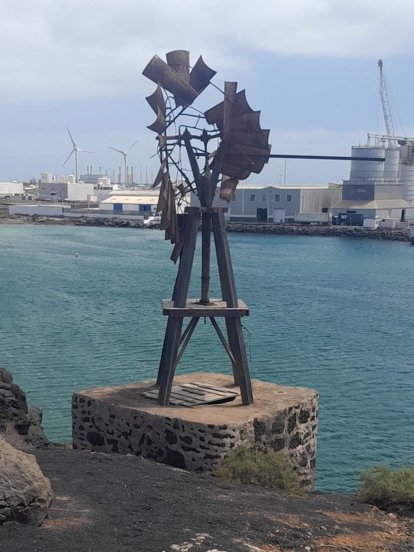
Technicians and operators from the specialized company Cierres Enrollables - Puertas Automáticas Lanzarote (CEPAL) began on August 20 the restoration work of the old salt mill located next to the Castle of San José.
The company was awarded a public tender by the Art, Culture and Tourism Centers that will involve the restoration of an infrastructure that generated a "decaying image" in the vicinity of the emblematic Fortress of Hunger due to its advanced state of deterioration. "We cannot turn our backs on our history," said the Entity's counselor, Ángel Vázquez.
"We have the commitment and responsibility to protect and preserve our ethnographic heritage so that our sons and daughters can learn about the history of Arrecife; so that they can discover the traditional ways of life of their ancestors and how the sea and salt transformed the coast into what is today the capital of the island," he continues.
Broadly speaking, the works will consist of the restoration of the usable materials and the exact reproduction of the elements considered unrecoverable.
Specifically, the mill will be dismantled to analyze the condition of the elements. In parallel, new stainless steel blades will be built and the rest of the infrastructure pieces, such as the rotor, the weather vane system and the connecting rod-crank transmission system, among others. In addition, the "Y" support piece will be made for the crankshaft coupling; the support pillars will be checked to ensure their stability and the new mill will be assembled.
The works, with a budget of 80,000 euros, will have a duration of six months.
About the mill
The activity of extracting sea salt in that area of the capital's coastline began in the mid-19th century. The mill pumped water to the salt flats that were north of the Castle of San José.
The passage of time and the emergence of new ways of life led to the neglect of the salt industry, with this mill remaining standing as one of the last vestiges in the area of what was once the island's main economic activity.
The years and the proximity to the sea have accelerated the deterioration of an element that was already restored by the Cabildo of Lanzarote in the 90s, but that is again very damaged and at risk of collapsing.


Add La Voz de Lanzarote as a preferred Google source.
Stay informed with the latest current news.