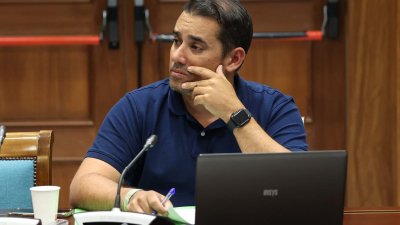
The deputy for Nueva Canarias-Bloque Canarista (NC-BC), Yoné Caraballo, has expressed his "displeasure at the lack of sanctioning mechanisms" in the Parliament of the Canary Islands following the incident in the Health commission, when the director of the Canary Islands Health Service (SCS), Adasat Goya, referred to his medical condition during the pandemic. The parliamentarian considers that these allusions violated his fundamental rights and were an attempt to discredit his political work by exposing personal data.
A report prepared by Parliament's legal services, at the request of the Bureau following Caraballo's request for protection, concludes that Goya's intervention was "totally inappropriate," "irrelevant and unnecessary" for the debate being held and "potentially damaging" to the deputy's honor. The document also dismisses the possibility that these statements could be protected by freedom of expression, as argued by the director of the SCS, and recalls that the status of a public representative does not oblige any deputy to renounce their right to privacy.
Despite this, the report clarifies that Parliament lacks the powers to sanction or reprimand the director of the SCS, given that he is not a member of the Chamber. Nor can it grant formal protection to the deputy, as the management of the debate corresponded to the presidency of the commission, which at that time did not consider it necessary to call the witness to order. This regulatory gap has been criticized by Caraballo, who considers it "unacceptable" that there are no mechanisms to respond to such situations in the parliamentary sphere
Faced with this limitation, Caraballo has announced that he is considering filing a complaint with the Spanish Data Protection Agency (AEPD) and undertaking other complementary legal actions to determine responsibility for the disclosure of personal information without consent. "No one, and certainly not a high-ranking public official, can use health data to attack a deputy in parliament," stressed the parliamentarian, who insisted that this case transcends the personal and constitutes "a matter of democratic principles, institutional respect, and the protection of fundamental rights."



Add La Voz de Lanzarote as a preferred Google source.
Stay informed with the latest current news.