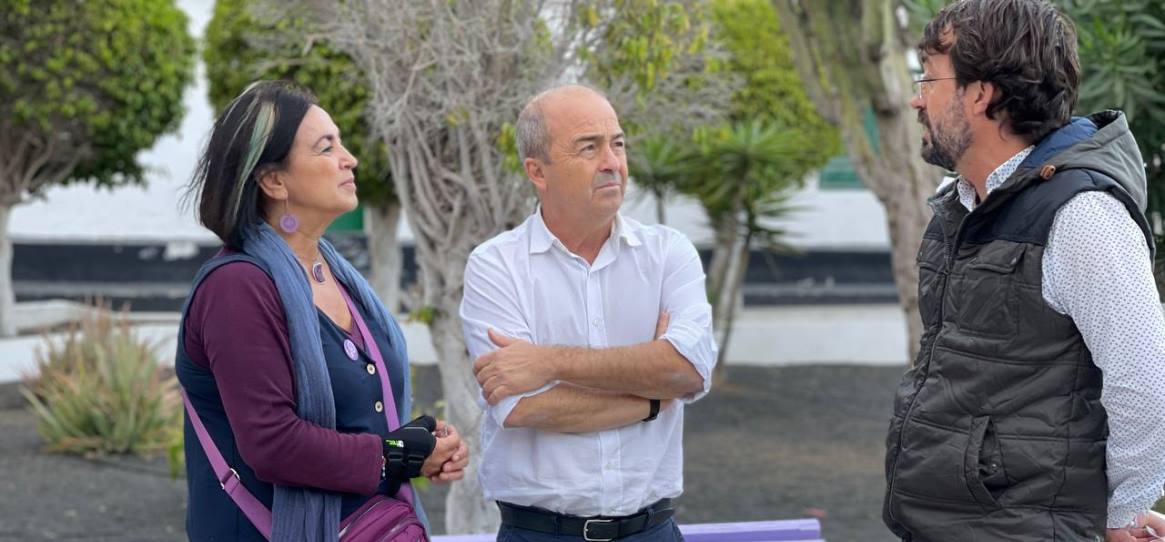
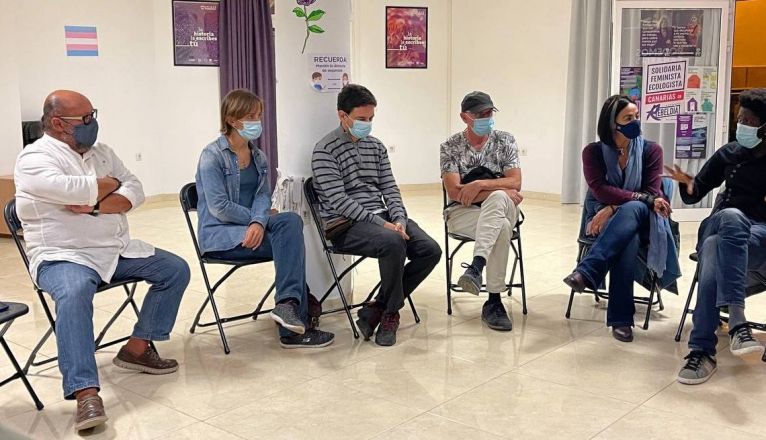
The Sí Podemos Canarias Parliamentary Group has met during Friday and Saturday with different public officials of the coalition in Lanzarote and with citizen groups and associations of the island to gauge the demands and claims in order to transfer them to the debate in the Parliament of the Canary Islands through various initiatives.
Better water management, the recovery of the primary sector, more children's parks, leisure spaces for the adolescent population, better infrastructure to have decent educational centers, "that are not barracks", and a Health system according to the 21st century, strengthening primary care and mental health care, especially child and youth care, and the reception of migrants, are some of those demands that the Parliamentary Group will turn into initiatives for debate in the Regional Chamber.
Community gardens and water points
"The models of ecological and community agriculture that we have seen in Tías demonstrate that another productive model, based on the primary sector, is possible," said the president of the parliamentary group and deputy for the island, María del Río.
For this reason, the Councilor for Social Services of Tías, Nicolás Saavedra, has valued the community gardens, which "born as a participatory experience have developed to the point that cooperatives have been created", and the 'Reflota Project', an initiative in which people have formed as a cooperative with the aim of working, but without any economic benefit, which demonstrates "that you can create employment, create landscape and create social economy."
The regional deputy Francisco Déniz delved into this aspect by recalling that "we must achieve food sovereignty and not depend so much on the outside, betting on 'kilometer 0' products". For her part, the general director of Cultural Heritage of the Government of the Canary Islands, Nona Perera, highlighted in this sense that one of the objectives of
her department is to "recover and put into use the water points" both those from the aboriginal era and those referring to the past century and that have served, given the aridity of the island, to collect rainwater vital for the cultivation of cereals and pastures.
"Everything that is betting on training and job creation in the primary sector will serve to enable generational change, as well as achieve incomes that demonstrate to people that they can live off the land," Déniz insisted.
Change of productive model
In this regard, the island councilor Jorge Peñas has said that "we propose an island of Lanzarote with a change in its productive model, in green energy generation, and circular economy, turning our eyes back to the countryside and the sea, ending the monoculture of tourism that consumes territory."
Sí Podemos Canarias has been committed for years, as Del Río recalled, mentioning several parliamentary initiatives, to a productive model that favors the primary sector and in which its main engine, tourism, abandons "the predatory model of the territory" on which it has been based for decades, and bets on a "sustainable model, which respects the environment and our landscapes, and respects the cultural identity of the island, is what our colleagues in the Cabildo de Lanzarote demand with
respect to the charcones"
The general coordinator of Podemos Canarias and general director of Youth of the Government of the Pact of the Flowers, has highlighted that "both in the Government of the Canary Islands and in other institutions, as well as where we are in the opposition, we put our grain of sand to improve people's lives."
For this reason, she has assured that in the Canary Islands Budgets for 2022, which are currently being processed in the Regional Chamber, the parliamentary group "will try to ensure that the items that Lanzarote needs are reflected" and, as general director of Youth, she has recalled that on the island they are working so that "those young people who are most vulnerable have an opportunity."
We need a new productive model, a new economic fabric and a much more sustainable society, and youth must be part of that change," she concluded.
Regarding improving the reception of migrants and addressing the migratory crisis that affects the Archipelago in general and Lanzarote in particular, the Sí Podemos Canarias Parliamentary Group has met with the Association Pro Human Rights of the Canary Islands (APDHC), where its general coordinator, Mamadou Niang, told them about the activities they carry out, especially those related to the implementation of free legal advice to guide and support migrants.
Del Río and Déniz pledged to present specific initiatives on the situation of migrants in Lanzarote to the Regional Chamber and even invite its members to participate in parliamentary committees to explain the work that APDHC is carrying out on the island.
Add La Voz de Lanzarote as a preferred Google source.
Stay informed with the latest current news.