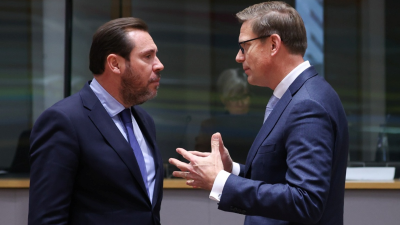
The Minister of Transport and Sustainable Mobility, Óscar Puente, defended today in Brussels the need to increase European funds to improve the resilience of transport infrastructures against extreme weather events, such as the floods recorded in València by the DANA or those suffered in Central Europe.
“These phenomena are already part of our reality and we must face them with determination and foresight. It is not enough to rebuild what has been destroyed; we must prepare ourselves better,” the minister said during the meeting of the Council of Transport Ministers of the European Union, which was held today in Brussels.
Thus, Óscar Puente has conveyed to his European counterparts the importance of ensuring sufficient funding from the European Union to ensure that infrastructures are adapted to withstand the consequences of global warming, ensuring that the next Multiannual Financial Framework allocates adequate resources for this purpose.
Thus, during his speech, he pointed out that this need must be at the center of the European Union's political priorities because “not acting or not investing is much more expensive.” And, as he has argued, the funds allocated to resilience will serve to save lives and resources, since everything that is invested in rebuilding cannot be used to grow.
“We must start now to include in the budgets the needs for the construction of resilient infrastructures and for this we need financing. We must adapt the infrastructures so that they withstand extreme climatic phenomena, which will increase costs, and the Commission has to take this into account,” the minister explained upon his arrival at the Council meeting.
In this sense, and apart from the irretrievable human and social losses, the minister pointed out that in Spain there has been an exponential increase in economic losses due to extreme weather events which, in 2023 alone, amounted to 7,000 million euros.
In addition to ensuring adequate funding, the minister argued that "it is also essential to provide professionals in the sector with the necessary training to react quickly and effectively to the challenges of climate change."
To channel this, the Government of Spain proposes as an urgent priority to integrate climate variables into the design, construction, management and maintenance of infrastructures and establish mechanisms for the exchange of information between Member States, since sharing experiences and learning will allow progress faster and more efficiently.
Start of the new European Commission and bilateral meeting
In addition to the debate on improving the resilience of infrastructures in the European Union, this Council of EU ministers served to welcome the new Commissioner for Sustainable Transport and Tourism, the Greek Apostolos Tzitzikostas.
Minister Óscar Puente held a first meeting with the new commissioner yesterday, in which they addressed priorities of common interest for Spain and the European Union in terms of transport for the new European legislature 2024-2029. In addition, the minister conveyed to the new commissioner the importance of having his support to avoid delays and to complete the cross-border sections between Spain and France of the Atlantic and Mediterranean Corridors of the TEN-T.
In this sense, upon his arrival at the EU Council meeting, the minister highlighted "the importance of transport infrastructures being connected at the borders so that Europe can be understood as a connected entity."
“We have been demanding for some time to promote cross-border connections with France, especially by rail, to allow the fluid traffic of trains, both passenger and freight, through France to the center of Europe. France assures that the connections will be in 2042 and, from our point of view, it is unacceptable. So, in this Council we are going to address the need to accelerate the construction processes of these infrastructures and these cross-border connections,” he said.
During the Council, other relevant issues are debated, such as the Declaration presented by Spain, Italy and Portugal on the need to improve the application of the ETS Directive, related to the control of emissions in the maritime sector, to avoid traffic diversions to third countries that are already occurring.
“We are firmly committed to decarbonization, but we do believe that real monitoring and future projections must be made to see the possibilities of traffic loss and anticipate with measures that guarantee that the ports of southern Europe will not be harmed for the benefit of the ports of North Africa,” the minister explained.
This Council of EU Transport Ministers also addresses the improvement of the regulatory framework for passenger rights and incentives for multimodal travel. In both cases, Óscar Puente has indicated Spain's support, “although with certain reservations, since we would have liked more ambition, but we hope that they will be improved in the subsequent inter-institutional dialogue with the European Parliament.”
Finally, the minister has also pointed out our country's support for the Directive on deprivation of the right to drive, which closes the advanced road safety package, largely during the Spanish Presidency, and for the modification of the regulation of air passenger rights, in order to clarify its content to avoid ambiguities, improve these rights and achieve its uniform application throughout Europe.



Add La Voz de Lanzarote as a preferred Google source.
Stay informed with the latest current news.