
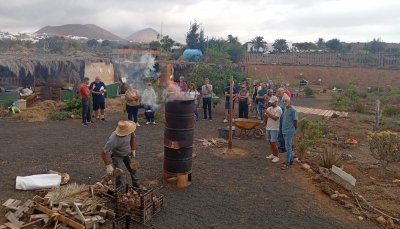
More than 30 people participated last Friday in a workshop on the production of phosphites organized by the Office of Agroecology and Rural Development of the Tías City Council, located in the sociocultural center of Mácher. This activity was carried out in line with the municipal strategy of promoting the creation of community and the use of local resources.
"From the Tías Town Hall, we continue to support agriculture that respects our land and intelligently uses local resources. This workshop is an example of how training and collaboration between residents, experts, and the administration can generate new opportunities for the rural environment," says the first deputy mayor and Councilor for Agriculture, Nicolás Saavedra.
The meeting was led by Paco Reyes, a farmer and communicator with more than thirty years of experience in agroecology, based in La Palma, who shared theoretical and practical knowledge about the preparation and correct use of these compounds for three hours. The objective of this conference was to expand on the application of agricultural techniques that respect the environment.
Phosphites: A Sustainable Tool for Agriculture
According to Reyes, phosphites are chemical compounds used in agriculture as fungicides, bactericides, and biostimulants. Their application helps induce the natural resistance of plants to pathogens and stress situations, offering a more harmless and environmentally friendly alternative than conventional products.
Thanks to its use, it is possible to improve the health and productivity of orchards and fruit trees, obtaining higher quality food without compromising the sustainability of the environment.
The City Council appreciates the involvement and commitment of experts such as Paco Reyes and Nito Delgado in disseminating agroecological knowledge, whose work significantly contributes to the improvement of local agricultural production and the care of the environment.


