
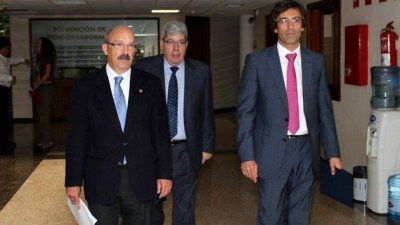
The content of the minutes that Pedro San Ginés kept hidden for three years reflects "breaches that may open the door to reversing the contract with Canal Gestión". That is what the former spokesman for Podemos in the Cabildo, Carlos Meca, maintains, who has just managed to access those documents thanks to the intervention of the Transparency Commissioner, who has upheld the complaint he filed against San Ginés for not providing him with that information.
"It is something that we have to analyze, to see to what extent the series of breaches of the contract that we have found by Canal Gestión may give the Consortium the right to demand that the management of the water be recovered for public hands," he has advanced, specifying that they still need to study those minutes in more depth, given that they are more than 200 pages.
"At first glance, we have already understood Pedro San Ginés's determination to keep it hidden," Meca pointed out, who after having been able to read its content denounces that the former president was "lying to the population for three years about the reality of Canal Gestión's compliance with the contract." Thus, although the former councilor recalls that it was "an open secret that Canal was breaching the contract," he affirms that with these minutes they have been able to "confirm it."
"Something very strange was happening"
"Supposedly millionaire investments were being made on the island and the level of losses continued to not decrease. Something very strange was happening", Meca recalled, who in the past term presented a motion in the Cabildo on this issue. "We asked for an audit to be carried out on these investments and of course the motion was not approved by the government group," he questioned.
Now, after having access to the minutes, Carlos Meca maintains that San Ginés was fully aware of these breaches, because they were put on the table in the monitoring commission. "Even a few months ago, the Consortium financially sanctioned Canal for breach of contract," Meca revealed, emphasizing that it was also a "serious breach, which is how the Consortium's own manager classified it."
"And all this without us knowing anything, hidden by Pedro San Ginés for years", he denounced. "There may have been people who, when they saw that Canal took over the management of the water, may have been happy, because we already saw how it was managed in its day and how the public company Inalsa was embezzled, but now we have been able to verify that the wolf was put in charge of guarding the chickens," added the former councilor.
It started operating without regulations and then they breached them
The complete sequence of the minutes also reflects that during the first two years this commission, which was created to ensure compliance with the contract, practically did not meet. In fact, since it was signed in 2013 until June 2015, only five meetings had been held and they had not even approved a regulation. And when it was finally approved, they established that the meetings would be held "at least once every two months and whenever it is deemed convenient to social interests," but they continued to not comply with these deadlines, maintaining an average of only three annual meetings until 2018.
In addition to this irregularity in the operation of the commission, the initial composition also did not coincide with what was established in the regulation approved later, since the only public official present at the first meetings was Pedro San Ginés. It was after Podemos began requesting the minutes when the number of members of the Commission increased. To do this, San Ginés decided to appoint two other public officials from Coalición Canaria: the mayor of Teguise, Oswaldo Betancort, as the main member, and the former mayor of Haría, Marci Acuña, as the alternate, although in the case of Betancort he never attended those meetings.
What also changed over time was the tone and content, since the minutes of the first ones barely occupy one or two pages and there is no sign of a demanding tone towards the company, despite the fact that the data that was put on the table later reflects that the investment plan was already being breached. It was after the dismissal of Gerardo Díaz as manager of Canal Gestión Lanzarote -after being arrested and charged with the payment and receipt of bribes-, when the tension between San Ginés and the company in those meetings began to increase, even imposing sanctions. However, the former president kept them hidden and publicly continued to defend that Canal had been "a blessing" for Lanzarote.
More than 200,000 euros annually without known destination
The other change in the composition of this body also came in the first year, since the external lawyer Ignacio Calatayud attended the first meetings. In fact, that is another point that remains to be clarified, since the contract with Canal established that this company would pay 200,000 euros annually for the operation of that monitoring and control commission of the contract.
For this reason, in addition to the minutes, Podemos requested in the past term the list of expenses charged to that commission, but San Ginés also refused to hand them over. Precisely this motivated a second complaint from Carlos Meca before the Transparency Commissioner, although that one has not yet been resolved and more than three years later he still has not received that information.
However, what the Cabildo did acknowledge in a written response is that part of that money had gone to Ignacio Calatayud and his brother. And although he later refused to give the figures, the criminal case for the seizure of the Montaña Roja desalination plant allowed at least two of those payments to be known, when the investigating judge asked the former manager of Canal if Calatayud worked for this company while advising San Ginés on the illegal seizure of the desalination plant, which was later handed over to Canal Gestión.
Payments from Canal to Cataluyud to "advise" the Consortium
In that statement, Gerardo Díaz confirmed that the company had paid more than 77,000 euros for direct "advice" to Canal, in addition to another 40,000 euros in just eight months for advising the Consortium in the commission that was supposed to monitor compliance with the contract. In addition, Canal Gestión also hired his brother, Carlos Calatayud, to whom he paid another 9,600 euros, also for advising the Consortium. "What is paid to these lawyers who intervene in the commission is deducted from the payments that we have to make to the Consortium," Gerardo Díaz declared in the Courts.
In the case of Calatayud, he stopped attending those meetings, coinciding with the scandal over the seizure of the Montaña Roja desalination plant, which among other things highlighted that he worked for both parties, and that he advised San Ginés to adopt measures that ended up benefiting Canal, since they handed over the seized plants to this company that had him hired.
And Gerardo Díaz also stopped attending, after Canal de Isabel II decided to dismiss him as manager shortly after his arrest and indictment, in a measure that Pedro San Ginés publicly opposed, who even asked the company to revoke that dismissal. The other change was the entry into the monitoring commission of Echedey Eugenio, after San Ginés delegated to him the presidency of the Consortium, while Eugenia Torres attended those meetings as a lawyer.
"Demonstrate that they are not governing as CC governed"
"The Cabildo now has a responsibility and that is to demonstrate that they are not governing as Coalición Canaria governed. And the issue of water is a key issue, first because of how the award was made and then because we are seeing that it is not complying with the contract," Meca has now demanded.
Thus, he points out that the first thing is to carry out the review of the award that the Justice ordered, in a sentence that considered it proven that the specifications were altered "for the benefit of Canal." "We were already able to confirm in the investigation commission that was created in the Cabildo that what occurred was a rigged process and that Pedro San Ginés benefited Canal Gestión in the award of that contract, with the alteration of the specifications, with that deception that they offer us more investments but at the same time they reduced the amount of the fees they had to pay, which was a quid pro quo," he recalled.
But in addition, in light of these minutes to which he has now had access, and beyond the intention that Canal de Isabel II has expressed to leave Lanzarote, Meca considers that the possibility of demanding the termination should be studied. "Establishing new controls to prevent what happened with Inalsa from happening again, I think it is time for the Cabildo to start considering recovering the management of water in Lanzarote," Meca defended.
Add La Voz de Lanzarote as a preferred Google source.
Stay informed with the latest current news.