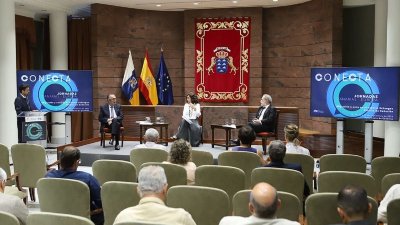
The Minister of Finance and Relations with the European Union (EU) of the Government of the Canary Islands, Matilde Asián, has advocated in the third session of this Wednesday of the 'Conecta Canarias-Europa Days' for a Cohesion Policy of the EU "with more attention to the regions", and recalled that the "specificities" of the outermost territories "are not duly included in the European regulatory framework." Therefore, she considers it necessary to "defend them" in the face of the doubts that have arisen in some sectors about the usefulness of current cohesion policies.
For Matilde Asián it is important to emphasize that "we are immersed in a change of programming for the period 2014-2020", which concludes at the "end of the 2023 financial year", and now we are starting the "new 2021-2027 programming." We must also work thinking about "what will happen after 2027." She explained that "the European budgetary framework manages "a total of 1,216 billion", of which "around 427,000 million are now cohesion policy, hence its importance", warned the regional minister.
The president of the Economic and Social Council of the Canary Islands, José Carlos Francisco, lamented at this same debate table, moderated by the journalist Mayer Trujillo, that "barely 50% of the available European funds" have been executed and has emphasized "a bureaucracy that begins in Europe and that, when it arrives in the Canary Islands, we complicate it even more." And he asked: "Why are we the last in execution?"
For José Luis Rivero Ceballos, professor of Applied Economics at the University of La Laguna, the third speaker at the table 'The future of the Canary Islands' in the new cohesion period, the problem of execution is based on "established hindrances", its origin "is detected" and "we will have to see if it is corrected in the future or not." However, he has not considered it "as alarming as it seems." In his opinion, the low execution in the European Social Fund section is striking.
The opening of this third session of the Conecta Canarias-Europa Days was in charge of the second vice president of the Parliament of the Canary Islands, Gustavo Matos, who thanked the president of the Chamber, Astrid Pérez, for "having given continuity to the work that began in the IX Legislature to try to put European issues at the top of the agenda of this parliament. It is no coincidence that this institution has a room called Europe. That means that for the Canary Islands the European Union is part of an ideology. It means a space of freedom, security and guarantee of rights, freedoms, growth and solidarity."
Matos, who chaired the Conference of European Regional Legislative Assemblies (Calre) in 2019 and was re-elected in 2020, recalled that "the Canary Islands are better known than we think in Europe and our problems are understood and understood. We are one of the most pro-European territories in the EU, and that is something we have to value."
Through videoconference, Pedro de Faria e Castro, member of the Committee on Territorial Cohesion Policy and Budget of the EU of the European Committee of the Regions and rapporteur of the Opinion on the Outermost Regions (ORs), spoke. In his speech he remarked that "the European cohesion policy is essential to create the conditions that allow all European citizens to access the benefits of the EU's action." Regarding the preparation of the new financial framework from 2027, De Faria pointed out that regions such as the Canary Islands and the Azores "should worry about two aspects: the allocation of the financial resources necessary to achieve territorial cohesion, and the creation of real development paths for all European regions, taking into account the particularities of each territory."
María del Pilar Almeida Trujillo, deputy director of European Funds Management of the General Directorate of Planning and Budget of the Government of the Canary Islands, spoke about the operational programs and their level of execution in the Canary Islands. The evolution of GDP per capita was the title of the talk by José Miguel González Hernández, economist and director of consulting at Corporación 5. Carlos Portugués Carrillo, expert in European affairs, also spoke to address the differentiated application of the cohesion policy in the Canary Islands as an outermost region.
The program for this Thursday, September 21
The last session of the 'Conecta Canarias-Europa Days' will begin this Thursday, September 21 with the intervention of Alicia Vanoostende, deputy and president of the Committee on European Affairs and Foreign Action of the Parliament of the Canary Islands, and the MEP of the European Popular Party Gabriel Mato. Next, the panel discussion Priorities for the Canary Islands will begin, with Dunnia Rosa Rodríguez Viera, director of the Canarian Employment Service; Marisol Izquierdo López, director of Innovation University of Las Palmas de Gran Canaria, and Enrique Rodríguez de Azero, president of the Canarian Association of Renewable Energies.
The penultimate activity of this day will be the debate table of deputies from all parliamentary groups, moderated by the journalist Marta Modino, who will present their diagnosis regarding the situation of the cohesion policy in the EU and its impact on the Canary Islands, as well as their demands and proposals for the future. The farewell to the first edition of the 'Conecta Canarias-Europa Days' will be in charge of the president of the Parliament of the Canary Islands, Astrid Pérez.



Add La Voz de Lanzarote as a preferred Google source.
Stay informed with the latest current news.