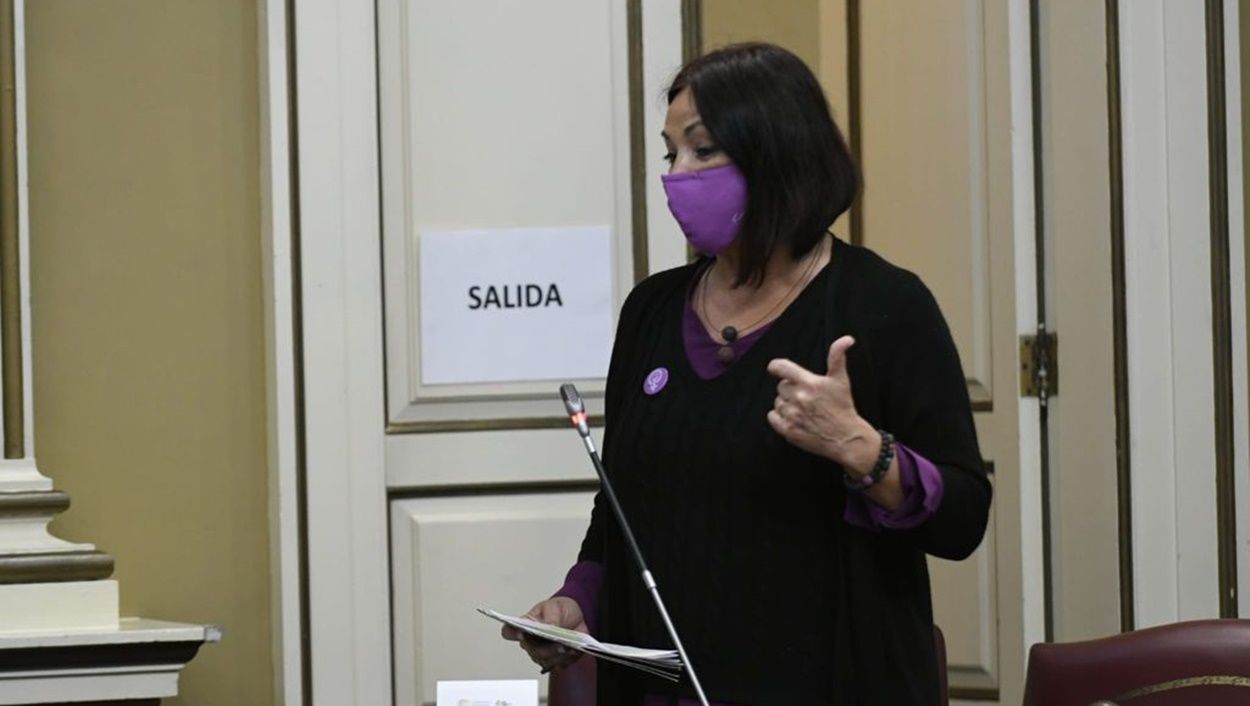
The president of the Sí Podemos Canarias Parliamentary Group, María del Río, has valued that the Department of Social Rights, directed by her colleague Noemí Santana, is launching 'Key A', a "pioneering" program in Spain for the protection of children and adolescents against violence and sexual abuse.
Santana spoke about this project in Parliament in response to a question from María del Río, and defended that with 'Key A' the Islands become "the first Spanish autonomous community to have a project designed with multiple actions aimed at raising awareness, preventing and detecting child sexual abuse".
"Sexual abuse is frequent in both girls and boys and, according to estimates by Save The Children, in Spain only 15% of cases are reported. The lack of knowledge, the fear of telling what is happening to them, feelings of guilt and shame, and the relationship they have with the aggressor, most of the time someone from the close environment - we must not forget that around 84% of abusers are known - leave the victims in a very vulnerable situation and makes it difficult for them to dare to take the step of reporting," Del Río recalled.
The also deputy for Lanzarote insists that child sexual abuse is "something especially painful." "It is very hard for the victims to experience that people they trust, who should protect them, are often the ones who inflict the damage," says the deputy, who also points out that sometimes even "they are the parents themselves or members of the family."
"We are facing a taboo," Del Río assures, "something that is hidden at home and not talked about, that is suffered in silence and without help." "In addition to the horror and seriousness that this implies, the suffering and damage caused by sexual abuse to girls, boys and adolescents, as well as the marks they leave for life, we also encounter another obstacle no less: the questioning of the testimony of the creatures and the protective mothers who dare to report," adds the deputy.
In this sense, Del Río recalls several examples, some very mediatic, "such as the case of the recently pardoned María Sevilla, a real outrage, because it is difficult to understand that such a cruel violation of rights, such as sexual abuse of children, has been maintained over time, penalizing the mother and the child, because more has been believed in the version of the abuser than that of the abused child, the PAS, questioned by the scientific community, than the sister I do believe you."
"This is a sad example of what we do not want to happen again, which highlights the misogyny and patriarchal machismo that still persists in our institutions, and which more than justifies the need to launch programs such as Key A," concludes Del Río.

Add La Voz de Lanzarote as a preferred Google source.
Stay informed with the latest current news.