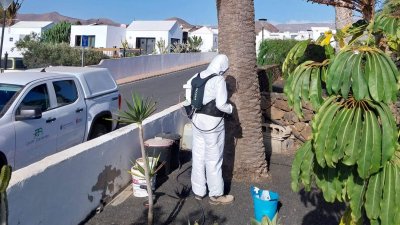
The Cabildo of Lanzarote, in collaboration with the Ministry of Ecological Transition of the Government of the Canary Islands, announces the celebration of a technical conference on management, treatment and conservation of the island's palm grove, which will take place on July 17 within the framework of the Palmeras Lanzarote Project.
This conference, which will be held in the assembly hall of the Cabildo, is part of the control and eradication plan to combat the plague of Diocalandra frumenti, an invasive beetle that seriously threatens the palm ecosystem of Lanzarote.
Since 2024, Lanzarote and La Graciosa have been developing a coordinated strategy for the control and eradication of this pest, in which thousands of specimens have been counted and treated with endotherapy, thanks to a specialized team made up of workers distributed throughout all the municipalities.
In addition to phytosanitary treatment actions, this joint effort between the Cabildo of Lanzarote and the regional Ministry includes monitoring with traps, prevention, technical training and public awareness campaigns, including the publication of informative materials on palm tree care.
The president of the Cabildo of Lanzarote, Oswaldo Betancort, has stressed that this Plan for the control and eradication of Diocalandra frumenti "is a sign of our responsibility towards the natural heritage of Lanzarote."
For his part, the Minister of the Environment of the Cabildo of Lanzarote, Samuel Martín, has stressed the importance of implementing techniques that respect the environment and recalled that this technical conference "will be key to continue forging alliances, sharing knowledge and acting effectively."
A living project
The Palmeras Lanzarote Project was born as a strategic initiative of the Cabildo and the Government of the Canary Islands to preserve the island's palm grove, both in urban and rural areas. With an investment of 2 million euros, the project has become a benchmark in the fight against Diocalandra frumenti in the Canary Islands.
The project is promoted by the Ministry of Ecological Transition of the Government of the Canary Islands and executed in coordination with the Environment area of the Cabildo of Lanzarote, with the technical collaboration of GMR Canarias and the ICIA.
Detected for the first time in the Canary Islands in 1988, Diocalandra frumenti has become one of the main threats to the native palm grove. Its life cycle causes serious damage by feeding on roots, leaves and inflorescences, perforating galleries that compromise the health and structure of the palm trees.


Add La Voz de Lanzarote as a preferred Google source.
Stay informed with the latest current news.