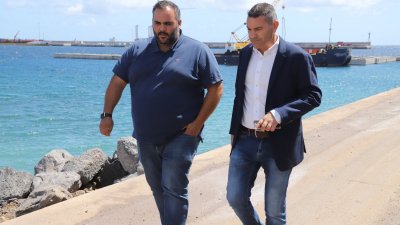
The Cabildo of Lanzarote has expressed in a press release its "resounding rejection" of the pilot project promoted by the European Union, at the request of the Ministry of Agriculture, Fisheries and Food, which aims to assess the conditions for introducing industrial purse seine tuna fishing in the Canary Islands fishing grounds. The island institution warns that this initiative, recently approved at the 29th Ordinary Meeting of the International Commission for the Conservation of Atlantic Tunas (ICCAT) held in Seville, "poses a direct threat to the sustainability of the marine environment and to the future of artisanal fishing in the archipelago".
The president of the Cabildo, Oswaldo Betancort, points out that this project "poses an unacceptable risk to the sustainability of our seas and to a fishing model that has proven to be respectful, balanced, and beneficial for our coastal communities." Betancort emphasizes that the Canary Islands cannot be turned "into a laboratory to test industrial fishing techniques that we already know generate serious impacts on biodiversity." He adds that defending the sea as a source of life, identity, and local economy "requires preserving traditional and selective practices, including 'one man, one hook' fishing, which guarantees responsible catches and respect for the environment."
The institution recalls that both industrial purse seine fishing and trawling are prohibited in the national fishing grounds of the Canary Islands due to their proven impact on marine resources and biodiversity. Authorizing an experimental project of these characteristics would open the door to a future implementation of intensive methods incompatible with the fragility of the Canarian ecosystem and with the fishing model that has historically sustained the islands.
The Cabildo's Fisheries Counselor, Samuel Martín, agrees that the proposal "seriously endangers the balance of the Canary Islands fishing grounds and threatens the survival of a sector that has worked sustainably for generations." Martín insists that artisanal fishing "is the heart of our communities" and warns that the introduction of industrial purse seine fishing or intensive tuna farming "would put those who have always respected natural cycles and opted for selective, low-impact practices at a disadvantage."
Likewise, the Cabildo of Lanzarote warns about the impact that fish aggregating devices (FADs or DAFs) associated with industrial purse-seine fishing, many of them located south of the Canary Islands, are already generating in the mid-Atlantic. These systems alter the natural migration routes of different tuna species, artificially concentrate schools of fish, and promote localized overexploitation, to the detriment of the artisanal fleet that fishes with selective and environmentally friendly techniques. Faced with a model that "hunts" the resource wherever it is artificially accumulated, the Canary Islands' "one man, one hook" fishing represents a clear commitment to responsibility towards the species and the sustainability of the marine ecosystem.
The Cabildo of Lanzarote calls on the Spanish Government to "reinforce its commitment to the protection of the Canary fishing grounds and to the promotion of truly sustainable fishing policies, far from any attempt to introduce industrial gear that compromises the biodiversity of the archipelago's waters". It also demands that the participation of island institutions and the fishing sector itself be guaranteed in any decision-making process affecting the marine resources of the Canary Islands.



Add La Voz de Lanzarote as a preferred Google source.
Stay informed with the latest current news.