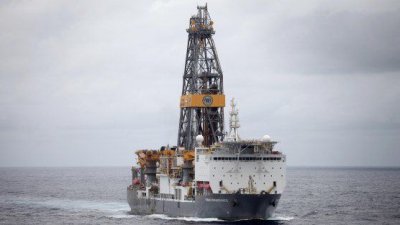
The environmental group El Guincho-Ecologistas en Acción has pointed out this Friday to Federico Ramos as the "architect of the authorization of the surveys in the Canary Islands". The until now Undersecretary of the Presidency of the Government of Spain has submitted his resignation this Friday, after being singled out in the Acuamed case, which investigates alleged cost overruns and commissions in the construction of desalination plants by the Ministry of the Environment. After learning the news, the environmental association has related what was its role in the processing of those permits that, it emphasizes, were granted "ignoring the greatest social, institutional and scientific opposition that had ever generated a project of these characteristics in Spain".
For El Guincho, his "implication" in the Acuamed case "should not go unnoticed by those who have maintained the fight against oil projects in Canary Islands waters." The group points out that an investigation opened in the National Court points to him "as the senior official who authorized irregular payments to construction companies by Aguas de las Cuencas Mediterráneas (Acuamed)".
"But before, it must be remembered that he was Secretary of State for the Environment from 2011 to 2015, when Soraya Sáez de Santa María (PP) 'promoted' him for his 'merits'", they add. The ecologists relate that "on the afternoon of May 29, 2014, on the eve of Canary Islands Day, Federico Ramos summoned the press to his office at the Ministry of the Environment to announce that he was issuing a Favorable Environmental Impact Statement to the multinational oil company, and therefore ignoring the greatest social, institutional and scientific opposition that had ever generated a project of these characteristics in Spain".
For El Guincho, Federico Ramos "acted then according to what most interested the oil companies and facilitated the environmental work so that José Manuel Soria could give the final authorization to the oil explorations".
"Responsible for slowness in processing the SCI"
In addition, the environmental group states that he was also "responsible for the slowness in processing the marine SCI of South and East of Fuerteventura and Lanzarote, which if it had been done in a timely manner probably would have prevented the authorization of oil explorations". According to them, in a meeting held with Ramos on April 16, 2015, a scientific report prepared in October and November 2014 by a scientific team from SECAC and CEAMAR was delivered "by hand", in which "it is demonstrated that the area of the oil explorations has similar environmental values to the SCI proposed by the Ministry as a protected area, and that therefore its inclusion in said SCI is essential to, in passing, guarantee that there will be no new oil drilling in the area".
"The documentation had been transferred in writing in November to the Ministries of Industry and Environment, which ignored it and allowed Repsol to continue", laments El Guincho. In this sense, they point out that the processing of this SCI "was unjustifiably slowed down by the Government of Spain" and, meanwhile, "in parallel, the oil explorations were authorized and carried out". "The SCI was only reactivated in March 2015, a few weeks after the multinational Repsol said that it had not found oil", they recall.
"All scientific studies agree that the area of the SCI should include the area of the explorations. In fact, MAGRAMA itself came to recognize that there were scientific reports that recommended its inclusion for years and that were ignored", concludes El Guincho.

Add La Voz de Lanzarote as a preferred Google source.
Stay informed with the latest current news.