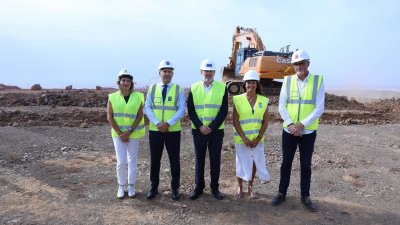
The beginning of the construction of the Socio-Sanitary Center for Seniors and Day Center of Tahiche, promoted by the Cabildo of Lanzarote, becomes this month of September 2025 a historical milestone for the island of care.
The Institution that Oswaldo Betancort resides in begins to build a "pioneering infrastructure that will mark a change of model" in the attention to dependency in the Canary Islands, under a Person-Centered Care (ACP) approach.
Oswaldo Betancort, accompanied by the president of the Canary Islands, Fernando Clavijo, the vice president of the Cabildo, María Jesús Tovar, the mayor of Teguise, Olivia Duque, and the councilor of Social Welfare and Inclusion, Marci Acuña, visited the works on site this morning. "We have saved the Tahíche Senior Residence after years of paralysis and abandonment," Betancort commented shortly before remarking how "fundamental" this infrastructure is "to guarantee the well-being of the elderly and dependent people of our island."
"The socialist government left us a poisoned inheritance; where the lack of diligence led to the breach of administrative deadlines and the return of more than 13 million euros destined for socio-health infrastructures, including the funds of the Tahíche Residence. All they did was place a symbolic cornerstone in 2019, without advancing a single step further in an entire legislature... Now, as is happening in many other issues, we have had to work hard to combat the inaction of others," Betancort stressed.
President Fernando Clavijo, for his part, assured that "we are aware of the challenge of offering comprehensive socio-health care to the Canarian population. This objective requires time and effort, therefore, from the Executive we are already working intensely, in consensus with the Cabildo of Lanzarote, to gradually increase the number of places in socio-health centers destined for those who need it. A new model of care, focused on the users, that we not only owe to them, but also to their families," he added.
The vice president of the Cabildo of Lanzarote, María Jesús Tovar, stated that the launch of the work "represents a before and after for Lanzarote and La Graciosa. After years of neglect by previous leaders, today we unlock a project and a historical demand of the entire citizenry, a firm commitment to the transformation of the socio-health spaces of the island and that will have a very positive impact on our elders."
The sixth island residence
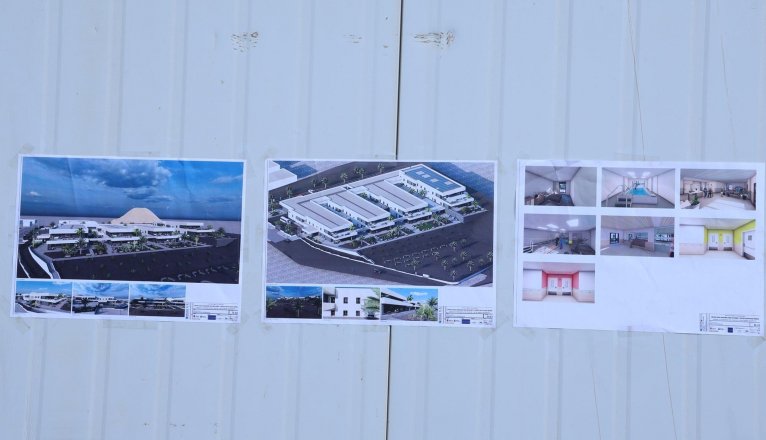
The Tahíche Residence will multiply the census of places destined for people in situations of dependency, distributed in a center of high socio-health requirement (75) and a day stay center (50). "It will be equipped with modern, accessible and adapted facilities to the needs of the elderly and their caregivers, in an innovative architectural complex of four interconnected buildings where sustainability and Canarian architecture are combined," detailed the councilor Marci Acuña.
In addition, he added that "this will be the sixth senior residence that we have," highlighting the importance for the island society of the exponential increase in socio-health places that Lanzarote and La Graciosa are experiencing: "When the works are finished we will have 125 new places, which will increase the island census by 25%, achieving the milestone of being above a thousand socio-health places offered by the Cabildo. And we are going to continue increasing them...".
"With the beginning of this work, the Cabildo of Lanzarote and La Graciosa fulfills the commitment acquired to provide the island with the necessary means through the construction of a socio-health center for the elderly who require medium-high socio-health requirements, through an architectural and functional model adapted to the evolution of the care model in attention to Dependency."
In addition, the new Residence generates an economic and social boost thanks to the creation of employment in the construction phase and the future management of the center.
A new concept of care
The project bets on a residential model based on cohabitation units or "mini residences", with a maximum capacity of 15 people, which will allow to recreate a more intimate and homely environment. This new structure is based on the model of person-centered care, combining private and shared spaces that promote autonomy, independence and the feeling of belonging to a home.
It will have individual rooms in 65% of the places; all with adapted bathroom. Landscaped patios and terraces, which guarantee natural ventilation, lighting and living spaces. Specific areas for physiotherapy, stimulation, social work and psychology, in addition to common services such as cafeteria, hairdressing, chapel and therapeutic pool.
The diligence of the current Government group of the Cabildo of Lanzarote allowed that last June the works were awarded to the company SATOCAN S.A., with a budget of more than 16 million euros (including IGIC) from own funds, and an execution period of 24 months.
"Lanzarote and La Graciosa are advancing towards a model of socio-health care that prioritizes the quality of life and dignity of the elderly, consolidating itself as an example of innovation in the Canary Islands," said Oswaldo Betancort this morning, who also thanked the involvement of the autonomous Executive to find "valid solutions to an essential project"; and congratulated the councilor Marci Acuña and his team, "for the tenacity shown to give the population the public services they deserve."

Add La Voz de Lanzarote as a preferred Google source.
Stay informed with the latest current news.