
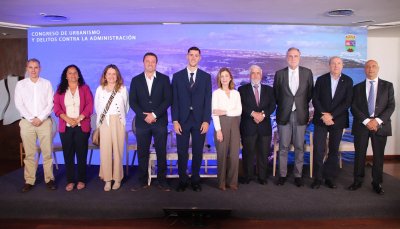
Urbanism is a complex and sensitive topic that also arouses interest and demands knowledge. Thus, the 300 people who attended the Congress on Urbanism and Crimes against Public Administration organized by the Yaiza City Council, with high-level speakers, including magistrates, jurists, and technicians, plus the contributions of a highly qualified audience, demonstrates that it is a living subject and the object of passionate debates.
One of them, the balance between development and respect for the environment, with development understood not only as tourist development, but also as the provision of essential services such as education and healthcare and the right to housing, addressed in the two days held last week in the event hall of the Amura restaurant in Puerto Calero under the moderation of the general secretary of the Yaiza City Council, Óscar Cabrera Pérez.
The congress analyzed the reason for being of municipal and island planning and the high volume of lawsuits and claims that arise around them. Likewise, it delved into the difficulties due to the scarce material and human resources that public administrations and courts have to face the drafting and monitoring of the plans and to exercise the corresponding administrative and judicial controls.
Regarding the first point, the architect and urban planning expert José María Ezquiaga, maintained that even if responsible land use regulation prevails, "planning cannot be a snapshot." For Ezquiaga, municipal or island planning schemes are becoming "chronicles of the past," pointing out that "a plan should have a validity of about 12 years and there are plans that are 20, 30 years or more."
He defended citizen participation in the consultation phase: "plans are public policies and democratic tools". In this direction, he maintained that "participation is important because urbanism is a matter of collective values and not just a compilation of data". Another issue emphasized by Ezquiaga, in light of the annulment of the Yaiza General Plan due to the lack of a roads report, is that sometimes "the procedural displaces the substantial".
The Supreme Court magistrate, Wenceslao Olea, stated that regardless of the rulings of the legislation, which differs from reality, “we have to issue a ruling in accordance with current legality, so what must be done is to present all the reports to adopt a better-founded decision”.
Now, for example, it is also necessary to take into consideration the gender mainstreaming, which must include planning, a topic addressed by the magistrate of the Superior Court of Justice of the Canary Islands, Antonio Doreste. Is it or is it not decisive in planning or can it be a cause for nullity? In case of doubt or interpretations, the report on gender impact must always be incorporated.
Difficulties in judicial proceedings
María Consuelo Uris, magistrate of the Supreme Court, apart from her report on the legitimacy of local entities in urban matters, allowing Municipalities, Cabildos and Diputaciones not only to defend their powers but also the interests they represent, summarized the factors that determine whether a procedure has more or less complexity.
First of all, technical reports of all kinds, urban planning and environmental, and of course, being in a state of law, the guarantor system of administrative and judicial procedure: "the appeals usually take time and that causes the execution of the judgments to be delayed, so that, sometimes and unfortunately, it is very difficult to restore the altered reality".
Corruption, topic and reality
Miguel Ángel Torres, magistrate of the Provincial Court of Málaga, at the time investigating judge of the 'Malaya' case, the notorious corruption scheme in Marbella, analyzed the loss of democratic quality due to the lucrative use of the processing or granting of licenses and the actors who usually participate in bribery, influence peddling, or other crimes committed by organized crime. "In Spain there are no anti-corruption courts due to a lack of political interest," he assured. It is true that now there is more control, but there is a lack of material resources.
“We continue to think that there is more corruption in city councils, but we are seeing cases in regional administrations and at the State level”. For Magistrate Torres, “we also cannot think that everything that is done in urban development is corruption, we simply have to control so that everything that is carried out is within the law”.
For his part, the prosecutor of Las Palmas, Miguel Pallarés, shared the generalized idea of making any reflection from the rational use of a limited resource such as land. “Urban planning prevarication is a criminal offense that is created precisely because in that matter a focus of corruption and greater repercussion occurs than an arbitrary and unjust resolution may have, and that is why it is punished more specifically and more severely than generic prevarication”.
Collecting official Spanish statistics from 2024, Pallarés stated that of 84 demolitions carried out in said year, 25 were voluntary. In Spain there are 150 pending demolitions. "Urban development requires the functioning of inspection action. It cannot be paralyzed when the house or the hotel are practically finished." The prosecutor recommends the competent administration to halt construction as soon as there is a well-founded complaint.
Judges and prosecutors often face what Supreme Court magistrate Wenceslao Olea called "ceremony of confusion," seventeen regional laws, referring to the environmental assessment of plans and urbanism.
The mayor of Yaiza, Óscar Noda, thanked the speakers for their presentations and the participation of the three hundred registered people: “the measure of the importance of the congress is the assessment by the audience of the two days and the debates that the presentations spurred. Technicians and jurists from town councils, island councils, regional governments, politicians, journalists, and students preparing for competitive examinations attended, and the general opinion is that we all learned”.
The secretary of the Yaiza City Council, Óscar Cabrera Pérez, notes that “urbanism is interesting, it is present in the daily life of administrations and in their decision-making, and this congress shows that there are many people who understand it, who like it and who want to continue learning”. Yaiza organized this technical-legal meeting with the collaboration of the Government of the Canary Islands, represented at the congress by Elena Zárate, Vice-Minister of Territorial Planning, and the Canary Institute of Public Administration (ICAP).
Add La Voz de Lanzarote as a preferred Google source.
Stay informed with the latest current news.


