
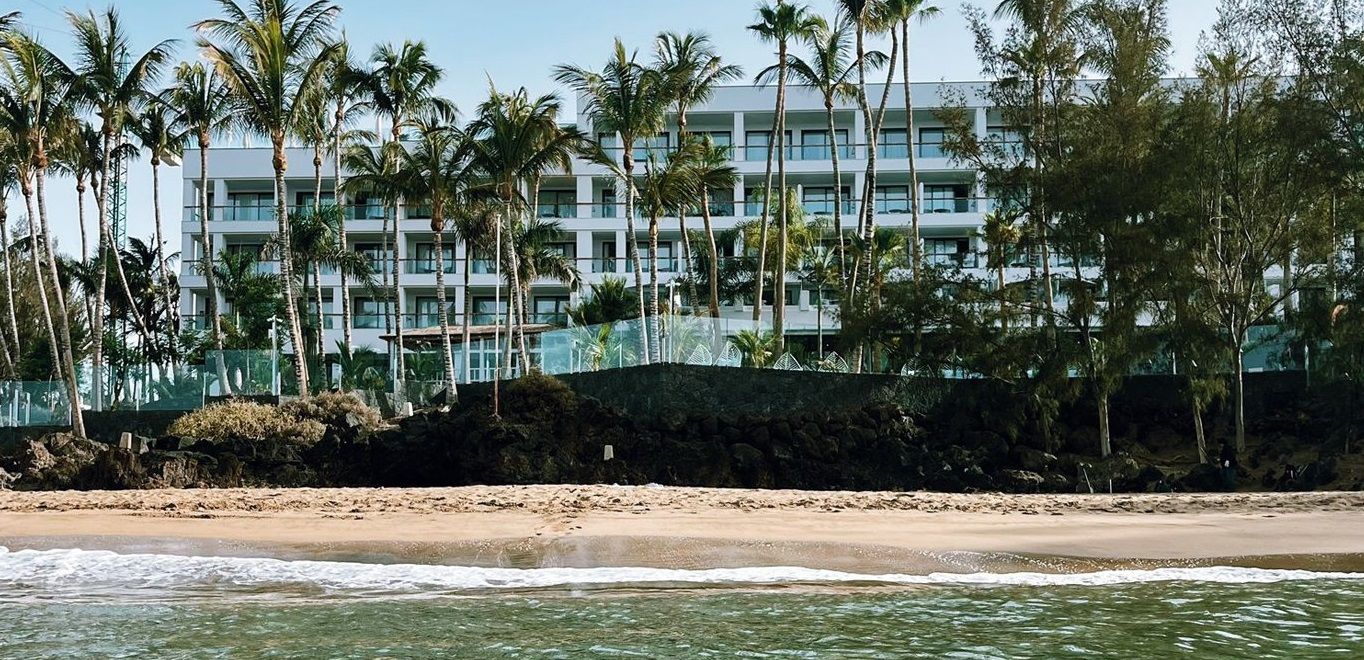
It neither “redounds to the common good” nor responds to the “general interest, quite the opposite.” That is what the General Directorate of Coasts and the Sea has responded to businessman Juan Francisco Rosa, thus rejecting his attempt to legalize the solarium of the Fariones hotel, which was built on maritime-terrestrial public domain land without any authorization.
The hotel had already been illegally occupying this space, but it was three years ago when Rosa requested a concession from Coasts to legalize it, after facing a sanction from this body. In his request, the businessman claimed that he should be granted the use of those 120 square meters of public land on Enmedio beach for 75 years. In the project, he detailed that it would be an area of hammocks and umbrellas with restricted access, and that he intended to charge 10 euros to enter.
According to Rosa, it was justified to grant him that concession “to give a quality service to tourists”, but the resolution of Coasts concludes that the project only “reverts to its own interest”, using public land for this. In fact, it questions that it is intended to give “a private use” -which in practice is what already happens-, when it should be “free and free” access for any user, as stated in the Coasts Law, which establishes that beaches cannot be “for private use”. In addition, it emphasizes that there is no reason to justify that the solarium has to be in that location, since there are “location alternatives on the same plot of the interested party”, without invading the maritime-terrestrial public domain.
“Restore the affected land to its original state”
Although it did not transpire at the time, the resolution reveals that Rosa was already sanctioned three years ago for the occupation of that land, on which he had no concession. The sanctioning procedure was initiated in November 2017, coinciding with the different works that the businessman was carrying out in the hotel and its surroundings -some of which had to be stopped in their day by the City Council- and which also included the walkways to restore public access to that beach.
Coasts had to visit the area to issue reports on these other projects, and it was then that it opened a file for the solarium, which lacked authorization. According to the resolution, that file was resolved in March 2018, sanctioning the company Hotel Los Fariones SA., although it does not detail the amount of the fine. In this regard, it only indicates that the company appealed and managed to reduce that sanction, but not annul it. Afterwards, Rosa requested the concession on that land to try to legalize it, which is the one that has now been denied.
In its resolution, the Coast Directorate emphasizes that before the first intervention was carried out in that area of the solarium, “the sand went into the area currently occupied by the concrete slab”, so the surface of that beach has been reduced. In addition, it warns that this is aggravated at high tide, when there is “a minimum free strip from the shore to the wall of the current installation.”
When it resolved the sanctioning file, Coasts already warned of the need to “restore the affected land to its original state” -that is, to demolish the solarium-, although it postponed that decision, linking it to the result of this concession application file, which is the one that has just been rejected. Thus, now that requirement to return the beach to its original state could be resumed.
Warns that access to that beach remains unresolved
Regarding access to Enmedio beach, which has been blocked for years by the hotel, Coasts also warns that it is still unresolved, despite recent works. And it is that instead of making a continuous promenade, the businessman made two walkways, one from Playa Grande and the other from Playa Chica, which are not connected to each other. In this way, when arriving at Enmedio beach, in front of which is the hotel and its solarium, “the transit must be done through the sand of the beach itself, on land in the maritime-terrestrial public domain”, which according to Coasts continues to violate the Law. In this regard, it points out that the solarium also invades a part of the transit easement area, which is where the promenade should have run, just behind the beach and the maritime domain area.
“The walkways lead to the intertidal zone, so at high tide the beach cannot be accessed”, adds the resolution, which recalls that it already opposed this project in its day. The authorization for these walkways was processed before the Government of the Canary Islands, although the Coast Demarcation of the Canary Islands issued an unfavorable report in 2017. Among other things, it also warned that one of the walkways invaded part of the maritime-terrestrial public domain, as was the case with the projected wall “with the intention of expanding the solarium area” of the hotel.
It was then that Coasts initiated a sanctioning procedure for that solarium that was already built and lacked a concession. The only one Rosa had was on the pier-jetty area, on which an extension was authorized two years ago. However, that concession has nothing to do with the solarium -which already generated controversy last summer, when the businessman placed a sign indicating the price of 10 euros for access-.
Tried to include the solarium in the concession of the small dock
When requesting the extension of that other concession, Juan Francisco Rosa tried to include the solarium area, as if it had always been part of the same permit. However, the resolution of Coasts was clear and only authorized the occupation of 510 square meters “for the purpose of a pier-jetty and retaining walls”, since those are uses that can usually be carried out in that location.
Later, when he had already received the sanction from Coasts, Rosa requested an independent concession for the solarium -“in case the Administration had any doubts about the need for separate processing of the existing works and facilities in the public domain”, he stated in his request-, which is the one that has now been rejected.
In total, the resolution cites up to six articles of the Coasts Law that are violated with this project. “It demonstrates the private use of the beach, by limiting its public and free access to the variation of sea levels according to the tidal regime,” it points out, connecting the illegality of the solarium with the fact that it cuts off the promenade that the businessman had to do to recover public access to the beach.
Three users per day and more than 10,000 euros per year for maintenance
Before issuing this resolution, Coasts requested reports from different bodies, including the Government of the Canary Islands, the Cabildo of Lanzarote and the City Council of Tías. In the case of the Consistory, in March 2020 it issued a report signed by a technician, which concluded that “there would be no inconvenience in granting the concession as long as pedestrian passage between the two areas of the promenade is guaranteed”, as well as access to the beach, and that the hammock service has a price established between the hotel and the Coast Demarcation of the Canary Islands. For their part, neither the Canarian Government nor the Cabildo responded, nor does it “appear” that they issued reports, according to the resolution.
The European Association of People Affected by the Coasts Law did present allegations, which requested that the concession be denied or that “the reasons for granting it for the general interest be explained when said concession will turn a public beach into a private one for exclusive use, for 3 people per day, and no less than for 75 years”. This referred to the project presented by Rosa to request the concession, in which he made an estimate of only 10,950 euros per year in income (30 euros per day), calculating an average of three users per day of that solarium. At the same time, he estimated almost the same amount for the expenses that he claimed he would incur in the “conservation” of this area of hammocks and umbrellas.
Only in water did he budget for alleged expenses of 400 euros per year, to which he added 1,200 in gardeners, 400 euros in energy and 6,000 in repairs and cleaning. To this he added the 2,122.80 that he intended to pay in fees per year, for occupying 120 square meters of public land on a beach.
“The installation of a privatized solarium for which payment is required for its enjoyment must be located outside the maritime-terrestrial public domain, as it is not necessary for its location. In any case, and even if the physical configuration of the coastal stretch does not allow the location on adjacent land, with the exploitation project presented, it cannot be considered a public or public service installation”, the Coast Demarcation already concluded last February, in a report that has now been assumed by the General Directorate of Coasts and by the Ministry.
Thus, it rejects the request for the concession of the land occupied by the solarium, which must be of public access, and also warns that “the transit easement must be permanently clear for public pedestrian passage and for surveillance and rescue vehicles.”


Add La Voz de Lanzarote as a preferred Google source.
Stay informed with the latest current news.