
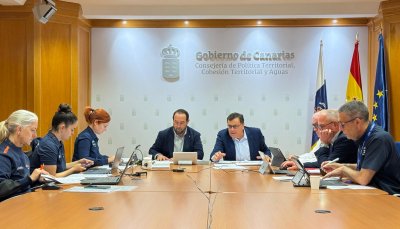
The Canary Islands Autonomous Commission for Civil Protection and Emergency Response approved this Thursday, December 11, five new municipal emergency plans (PEMU's), a key step to reinforce local preparedness for increasingly complex risk situations. With these additions, 61 of the 88 Canary Islands municipalities now have their plans updated, while 17 have yet to complete their drafting, a challenge that the Minister of Territorial Policy, Territorial Cohesion and Water, Manuel Miranda, encourages these town councils to face as soon as possible.
The municipalities of Arafo, Tegueste, Gáldar, Valsequillo, and Puerto del Rosario received the Commission's approval after presenting revised plans adapted to new risks, especially those associated with adverse weather phenomena, forest fires, or floods, scenarios that are becoming increasingly frequent as a consequence of climate change.
In addition, the collegiate body also approved the **Arrecife Local Action Plan for Floods**, the first of its kind validated in the Canary Islands, which represents a milestone for local planning in water and risk management.
The meeting was chaired by the Minister of Territorial Policy, Territorial Cohesion and Water, Manuel Miranda, and was attended by the Vice-Minister of Water and Emergencies, Marcos Lorenzo; the Director General of Emergencies, Fernando Figuereo; the head of the Civil Protection and Emergencies service of the Canary Islands, Montse Román; the director of 112 Canarias, Moisés Sánchez; technicians from the Directorate General of Emergencies and representatives from all the municipalities of the archipelago.
Councilor Manuel Miranda underscored the importance of this collective progress, as "municipal emergency plans are the first line of defense for our citizens. Keeping them updated is not an option, it is a responsibility. Climate change presents us with more demanding scenarios, and we need all municipalities to be prepared," stated the councilor, who insisted that coordination and planning "remain the most effective tools when emergencies knock on the door".
The body also learned about the processing status of various regional civil protection plans, such as the Canary Islands Territorial Emergency Plan (PLATECA); the Canary Islands External Emergency Plan for Chemical Risk (RISQCAN); and the Plan for Civil Protection and Emergency Response for Radiological Risk (RADICAN).


