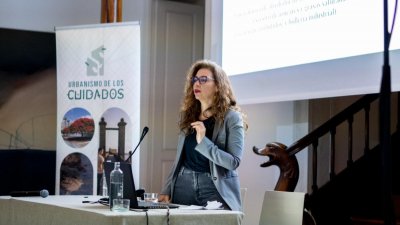
The Urban Planning Department of the Arrecife City Council, headed by Maciot Cabrera, held a new edition of the "Urbanism of Care" cycle this week at the Agustín de la Hoz House of Culture, focusing on the relationship between food, care, and planetary boundaries as keys to rethinking cities in a context marked by the climate crisis and social transformation.
The event, driven by Sinergias In & Out in collaboration with the Biosphere Reserve of Lanzarote and the Urban Planning department, brought together researchers, students, and citizens in a space for reflection on how to design urban environments that sustain life in all its dimensions.
Maciot Cabrera underlines the importance of incorporating these perspectives into municipal work and highlights that "Arrecife is moving towards an urban model where care and sustainability are no longer abstract concepts but become concrete lines of action in our public policies."The councilman adds further that "thinking about the city is also thinking about how we feed ourselves, how we relate to our territory, and how we guarantee that future generations inherit a livable and healthy place".
The session began with the presentation by Carmen Madorrán, a doctor and professor of Philosophy at the Autonomous University of Madrid, who offered a profound reflection on the universal dependence on care, encompassing both human and non-human lives, and how this principle can guide a new urban model committed to the protection and support of life.
Next, Carolina Yacamán, a doctor and professor in the Department of Geography at the same university, analyzed the link between food, territory, and climate justice, pointing out the urgency of transforming urban food systems towards more local, just, and resilient models.
As part of the program, both speakers developed an educational workshop for 4th-year ESO students at IES Blas Cabrera Felipe, titled “Between the Social Floor and the Environmental Ceiling: A Doughnut to Rethink Everything”. Through the construction of Raworth's Doughnut, the students reflected on planetary boundaries and the basic social requirements to guarantee a dignified life, fostering critical thinking and ecological awareness.
The Urban Planning Department highlighted that the Urbanism of Care cycle continues to consolidate itself as an open and plural meeting space that connects citizens, institutions, and professionals in the search for more humane, inclusive, and resilient cities. According to Cabrera, "we want an Arrecife that cares, that listens, and that moves towards urban planning that puts life at the center".


Add La Voz de Lanzarote as a preferred Google source.
Stay informed with the latest current news.