The Ministry of Ecological Transition and Energy of the Government of the Canary Islands, headed by Mariano H. Zapata, has allocated 175,000 euros to the development of a pilot project in Arrecife (Lanzarote) to adapt the municipality to the effects of heat waves, increasing green spaces, shade areas, bike lanes, and places of recreation. All of this is focused on improving the quality of life for citizens.
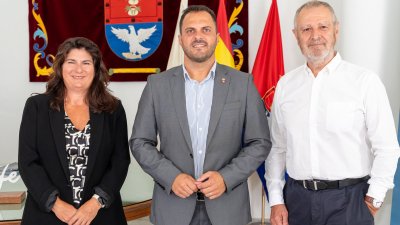
The Deputy Minister of Ecological Transition, the Fight Against Climate Change and Energy, Julieta Schallenberg, and the Mayor of Arrecife, Yonathan de León, have held a meeting to delve into the project. The Urban and Territorial Ecology Foundation (FEUT), led by the urban ecologist Salvador Rueda, an international benchmark in sustainable planning who has directed more than 400 urban and territorial projects in 144 cities around the world, will be in charge of its execution, and he was also present at the meeting.
The deputy minister highlighted that "this initiative places the Canary Islands at the forefront of nature-based solutions, betting on a more resilient, green, and healthy urban model." She also added that "Arrecife is becoming a climate innovation laboratory where sustainability and active mobility criteria will be applied, which will serve as a reference for other municipalities in the Archipelago, ultimately a pilot project that will allow this urban model to be replicated in all the municipalities of the Canary Islands."
Likewise, the Deputy Minister recalled that this October 24 is World Climate Change Day, so she emphasized the need to "continue working on adapting the Canary Islands cities to its effects, taking advantage of this opportunity to build spaces where biodiversity is integrated into urban areas, lowering temperatures by a few degrees and making them more friendly to the residents who inhabit them."
For his part, the mayor of Arrecife, Yonathan de León, celebrated the municipality's selection as the setting for the pilot project and stressed that "this collaboration with the Government of the Canary Islands and with the team of ecologist Salvador Rueda will allow us to take a decisive step towards a more sustainable city, with triple the green areas, and prepared to face the effects of climate change." In addition, he detailed that his municipality already has actions underway that align with these objectives, such as the five eco-boulevards, including the green corridor that will go from Puerto de Naos to Los Cuarteles, along the Vía Medular, or the urban transformation of Calle Pérez Galdós, from Los Alonso to Las Cuatro Esquinas."
He also noted that "the City Council already has the modernization of public transportation underway with electric buses, with eleven units before the end of 2026, in a major commitment to a sustainable municipal public transportation system in the city."
Along the same lines, the project director, Salvador Rueda, explained that "the application of the superblock model in Arrecife -a grouping of blocks within which traffic is restricted and pedestrian space is expanded- will allow the recovery of public space for people, reduce pollution and increase urban biodiversity, contributing to mitigating the impacts of climate change."
The project contemplates several phases, which include the collection of baseline information, the development of a computer tool for the application of the Renaturalization Manual, the practical intervention in urban and green spaces of Arrecife, and a training program aimed at municipal technicians and local agents, which will allow replicating this urban model in all the municipalities of the Canary Islands.

Add La Voz de Lanzarote as a preferred Google source.
Stay informed with the latest current news.