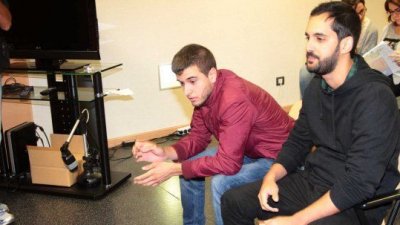
The two defendants in the 'wheelie video' were acquitted because it was not proven that their maneuvers posed a "concrete danger" to the lives of other people. This is established by the ruling of the Criminal Court No. 1 of Arrecife, which considers that "in application of the principle of presumption of innocence", the ruling must be "acquittal". The judge does point out, however, that during the trial the authorship of the events was "perfectly determined". He does not give credence to the version of the defendant Manuel Salces, who at all times maintained that he was not the one driving the motorcycle.
"The images speak for themselves regarding the manifest recklessness, which can be described as spectacular in the worst sense, due to the ostentation of an absolutely inappropriate conduct in road traffic," the ruling states. The judge thus considers that there was "recklessness", but this is not enough, he explains, to convict Oriol Suárez and Manuel Salces of a crime against road safety for reckless driving.
The ruling emphasizes the Penal Code, which establishes that for this crime to exist, there must be a "concrete" danger to the "life or integrity of other road users". An "abstract risk" is therefore not enough. "It must be proven that there were people with respect to whom there was a risk to their physical integrity, even to their lives; specific people even if they could not be identified," the ruling continues.
The magistrate points out that the "rejection" that the driving of the accused produces in him "as a user of that same road", should not "prevent" him from adhering to "the strictest application of the principle of legality". "Apart from other considerations, opinions and abstracting from the focus of public interest placed on this matter due to the dissemination of the eloquent video of the maneuver, through social networks", the ruling resolves that the "danger" generated "cannot be qualified as concrete, but as abstract".
Recording a video, an "immature purpose"
Although the judge considers that Salces and Suárez cannot be sentenced to the two years in prison requested by the Prosecutor's Office, he is critical of the conduct of both drivers. He points out, in addition to the "manifest recklessness" that can be seen in the images, that the two vehicles were traveling at a speed "much higher than allowed" on the road.
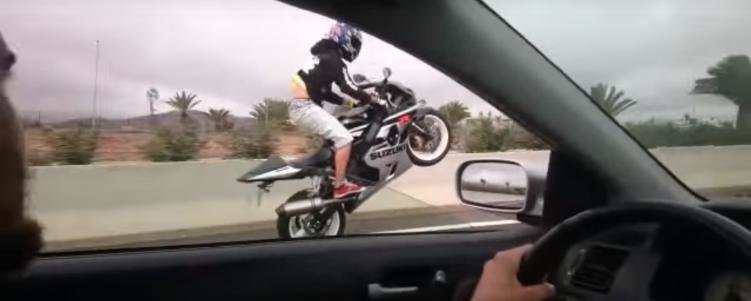
Regarding Salces, the magistrate points out that he placed himself in a "dangerous situation for himself", which he considers "can be described with many adjectives, but the one that concerns us here is that of manifestly reckless". He recalls in this sense the testimony of the taxi driver who witnessed the events, who said she had become "nervous" when she saw the motorcycle maneuver. However, he adds that this woman stated that "the reason for her fear was that the motorcyclist would fall". Thus, the ruling insists that it has not been "proven" that the fact that he was doing a 'wheelie' for 706 meters posed a "proximate risk to the life or physical integrity of third parties".
Regarding Suárez, he refers to the maneuver that can be seen in the video, when the co-pilot shouts "watch out!" and he changes lanes to move away from the car in front. Suárez said in the trial that "not at all" his cousin, the co-pilot who recorded the images, shouted at him because he thought he was going to crash. He assured that he did it because "he thought he hadn't seen it" and added, moreover, that when the co-pilot warns him he had already started the maneuver to change lanes. In this sense, the ruling points out that it is not "proven" that it was an "evasive maneuver in the face of an imminent collision", "as it is not appreciated that there has been a swerve, or a braking, or an abrupt maneuver".
What he does reproach Oriol Suárez for is that he intended to "reach the motorcyclist in full traffic" to record a video, something he also considers "manifestly reckless". For the judge, it is an "immature purpose" that Suárez made those maneuvers to record Salces.
Authorship "perfectly determined"
The ruling dwells especially to talk about Manuel Salces. The defendant denied from the outset being the one driving the motorcycle raised on one wheel. For the judge, however, this has been "proven".
The Local Police found out that Salces had sneakers, a helmet and gloves identical to those of the motorcyclist in the images. He also related it to a motorcycle identical to the one in the video, with the only particularity of the mirrors and the mudguard. During the hearing, Salces argued that the motorcycle in question was not his, but of "a boy from Las Palmas", although he could not specify his name. He assured that the motorcycle was for sale and he was only in charge of showing it to potential buyers. He also stated that that motorcycle was not the same as the one in the video, based on those two different elements.
However, the ruling disagrees with that version. "This judge understands that authorship is proven based on the proximity between the defendant and the motorcycle," the ruling states, which also understands that "it is the same motorcycle that was used in the reported events". It refers, on the one hand, to the "coincidence of clothing" with that of the motorcyclist in the images. On the other hand, he points out that the elements of the motorcycle are "easily modified" and believes that the other 6 coincidences between the motorcycles that Salces argued were different have "more weight".


Add La Voz de Lanzarote as a preferred Google source.
Stay informed with the latest current news.