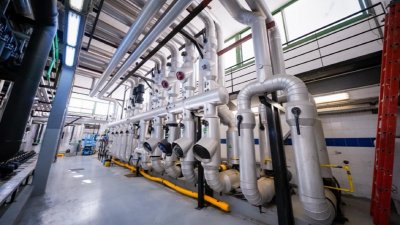
The President of the Canary Islands Government, Fernando Clavijo, the Minister of Health, Esther Monzón, and the Minister of Ecological Transition and Energy, Mariano H. Zapata, visited this Wednesday the new plant for very low enthalpy geothermal energy that has been installed at the Doctor José Molina Orosa University Hospital, the first installation of its kind in a public hospital in the Canary Islands.
The Canary Islands Executive has classified this measure as "a milestone in the decarbonization strategy" of the Canary Islands Health Service (SCS). At the same time, it has pointed out that very low enthalpy geothermal energy "takes advantage of the practically constant temperature of the ground to exchange heat with the building through high-efficiency heat pumps".
Fernando Clavijo highlighted during the visit to this facility that "Canary Islands wants to position itself at the forefront of the ecological transition also through public healthcare. This hospital is an example of how technological innovation can improve the comfort of patients and professionals and, at the same time, reduce our carbon footprint. Today Lanzarote demonstrates that geothermal energy is also part of the Islands' energy future."
The Minister of Health, Esther Monzón, has stressed that "this geothermal plant is a key piece of the Ministry's roadmap to move towards the decarbonization of public healthcare in the Canary Islands, thus advancing with our Health Strategy Net Zero Emissions 2030. The Molina Orosa becomes a benchmark for the rest of the centers, demonstrating that energy efficiency is not only an economic issue, but also one of health and responsibility towards future generations."
For his part, the Minister of Ecological Transition and Energy, Mariano H. Zapata, stated that "geothermal energy is one of the great allies for decarbonizing the islands, especially in environments like Lanzarote. This project shows how energy policies and health policies can go hand in hand to reduce emissions, stabilize consumption, and intelligently harness our natural resources."
The first project in a Canary Islands public hospital
This is the first geothermal pilot project in the SCS hospital network and a fully replicable installation in other Canary Islands hospitals. The project equips the hospital center with a thermal power of 1002 kW, capable of integrated production of air conditioning, heating, and domestic hot water (DHW) from the clean energy of the island's subsoil. It is estimated that the plant will contribute around 2.7 GWh of thermal energy annually to the hospital, approximately 1.87 GWh for heating, 0.58 GWh for cooling, and 0.22 GWh for Domestic Hot Water.
Thanks to seasonal performance factors (SPF) exceeding six for heating and five for cooling, the installation multiplies the useful energy obtained by more than five compared to the electricity consumed, which translates into a very significant drop in the energy bill and a substantial reduction in emissions linked to the use of fossil fuels.
Investment
The total investment for this device amounts to 1,232,711 million euros, of which 650,983 euros have been co-financed through the Ministry of Ecological Transition and Energy, via the subsidy program for thermal renewable energy installations in different sectors of the economy 2022, within the framework of the Recovery, Transformation and Resilience Plan. For its part, the Canary Islands Health Service contributes a total of 581,728 euros of its own funds to the project.
The works on this facility have been developed since 2024, adapting the new geothermal plant to the existing technical rooms, distribution networks, and equipment of the hospital.
Four wells
The very low enthalpy geothermal project was proposed by the Engineering department of the Lanzarote Health Management as a disruptive solution to reduce consumption, recover thermal energy to produce hot water, and decrease environmental impact.
The project was structured in two main phases, the first of which consisted of the drilling of four wells equipped with pumps located sixty meters deep and capable of recirculating water flows of up to 230 cubic meters per hour. In the second phase, the thermal installation is reformed, including two high-efficiency heat pumps to harness this geothermal energy for air conditioning, heating, and domestic hot water circuits.
With the commissioning of this plant, the Canary Islands Government has defended that the Molina Orosa Hospital "takes a qualitative leap that has led to an improvement in the building's energy rating and consolidates it as one of the pioneering hospitals in Spain in the use of geothermal energy for the integral climate control of its facilities, reinforcing the Canary Islands' commitment to the ecological transition and the fight against climate change from the healthcare sector".
Net Zero Emissions Health, a Strategic Project of the Canary Islands Government
During the event, Fernando Clavijo recalled that the Net Zero Emissions Health 2030 strategy has recently been declared a Strategic Project for the Canary Islands and distinguished with the "Strategic for the Canary Islands" seal, which reinforces the regional Executive's commitment to a more sustainable, innovative public health system aligned with the Canary Agenda 2030.
"By declaring Health Net Zero Emissions 2030 a strategic project, the Canary Islands Government makes it clear that the fight against climate change is also waged from hospitals. This project at Molina Orosa is one of the first emblematic actions under that banner and sets the path for what we want for the rest of the public health network," the president emphasized
The Zero Net Emissions Health Strategy 2030 integrates a set of flagship projects in energy efficiency, renewable energies, sustainable water management, and the circular economy in Canary Islands healthcare centers, which will benefit from the support, technical advice, and visibility planned for projects declared strategic by the Government of the Canary Islands.


Add La Voz de Lanzarote as a preferred Google source.
Stay informed with the latest current news.