Celiac patients, 1 or 3% of the Spanish population, suffer the highest prices in the shopping basket in our country. Some products such as bread, flours or pasta, among many others, that do not contain gluten have exorbitant prices. The demonstrations that have recently emerged in the Peninsula, in which patients asked the Government for financial aid, are also necessary for residents in the Canary Islands, specifically in Lanzarote.
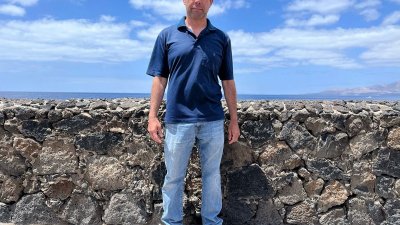
Given the importance of giving a voice to people affected by the disease, Juan Miguel Fiorillo Machado from Lanzarote, a member of the Celiac Association of the Province of Las Palmas (Asocepa) and diagnosed with celiac disease 20 years ago, shows the readers of La Voz the differences that celiac patients have to live with when eating in their daily lives.
Fiorillo explains how he was diagnosed with the disease. The "good" experience he had with his doctor helped him identify the disease. "I was lucky enough to find a digestive doctor who diagnosed me on the spot," he recalled. A luck that many people who suffer from the disease do not have, who are unaware that they have it. "There are people who do not associate the symptoms with what they eat," he pointed out. The European Institute of Health and Social Welfare has revealed that 75% of celiac patients in Europe are still undiagnosed and do not know they have the disease.
In the association he has shared talks with some people who were suffering from it for years without being diagnosed, as is the case of a 70-year-old woman. "They had diagnosed her at that age, and they always told her that she had a weak stomach," he stressed. Fiorillo lists some of the symptoms that may indicate celiac disease, but are not usually associated with it: psoriasis, fatigue, extreme tiredness, migraines, insomnia and also, something related to depression.
"I was lucky enough to find a digestive doctor who diagnosed me on the spot"
Fiorillo resides in Arrecife with his partner, who also suffers from Gluten Sensitivity, a situation that means they have to buy twice as many gluten-free products. "We spend about 600 euros a month between my partner and me," he detailed. The weekly economic outlay of the couple in its entirety clearly shows the difference that exists. "We spend between 150 and 180 euros on the shopping basket a week," he revealed.
A shopping basket that includes gluten-free products such as pasta and sliced bread, foods in which they "invest more money" and also food that by nature does not contain gluten such as rice, fish, meat, vegetables, legumes, nuts, eggs and vegetables. "Our diet is naturally varied, except for foods that contain gluten," Fiorillo said. A healthier diet in which there is no room for processed and ultra-processed products, the man stressed. "We cannot eat prepared products that are sometimes cheaper," he added about the difference between a celiac family and one that does not have gluten intolerance.
"We spend about 600 euros a month between my partner and me on the shopping basket"
The conflict generated by the War in Ukraine, which began in February 2022, has caused the price of gluten-free products to rise for celiac patients. "It has risen 5 or 6% more since the war began," a circumstance for which many families cannot make ends meet or even have their money saved. "There are months when we are just right, we can't save, the money goes on food," Fiorillo revealed.
From the association and in Fiorillo's particular opinion, the request for financial compensation is "totally justified." "It is logical that an economic compensation is requested," the man said. The main argument is the final price of the products they buy every day. He focuses attention on bread, on the food in which you can spend up to 2.10 euros on a loaf. The celiac has made it clear that the only alternative to not leave the money in those foods is "not to consume them." "I can decide not to eat bread, but it is giving up what I like," he declared.
In the case of adults, taking the initiative to stop consuming certain foods can be a "less costly" task, he confessed, although in the case of the youngest it becomes "more complicated." Celiac children suffer the consequences when attending the birthdays of their friends or classmates. This was stated by Fiorillo, who recalled the testimony of parents with celiac children. "Children go scared, they can eat a piece of cake without realizing it and end up contaminated."
"I can decide not to eat bread, but it is giving up what I like"
The main reason why the association transfers the need for financial aid is the lack of treatment or medication for the disease. "Our medication is a gluten-free diet," the man pointed out, who pointed out the importance of qualifying that argument. As it is a "genetic" disease, there is usually "more than one diagnosed case" in the family environment, Fiorillo added, so access to gluten-free food becomes much more expensive. "We have not chosen the disease, eating gluten-free food is not an option for us," he specified.
In addition, another issue to which the association pays much attention is the operation of the hospitality industry. From the group of members they ask that restaurants have "more awareness" of the problem of celiac patients, the fundamental basis for them to lead a comfortable social life.
The price of food also increases when eating out at a restaurant. The gluten-free food they serve has its corresponding supplement. An extra price that is added in pasta, the moon bread or in the gluten-free pizza base. "The product already goes up two or three euros more," he said.
Products that do not reach Lanzarote
The non-capital island still has difficulties in accommodating some gluten-free products, Fiorillo remarks that there are still some "shortcomings" in this regard. "There is less variety compared to the capital islands, in the supermarket shelves there is a fairly large difference," he stressed. The foods in which he has noticed this lack the most have been flours, pastas, types of cookies, cakes and biscuits, are the confectionery products that are most reduced on the volcanic island.
The population of Lanzarote has noticed the increase in the offer of these foods during these years, thanks to some supermarkets such as Mercadona and Aldi, which were the first to include their own range of gluten-free products. An initiative that was joined by chains such as Hiperdino or Spar, which has boosted that currently they can be accessed more easily. "Before there were no specific products, only in herbalists and specialized stores," he specified. The options were scarce, so celiac patients had to resort to paying for some products "much more expensive," he stressed.
With regard to gastronomy on the island, celiac patients do not have a wide range of options to go to eat at restaurants. Fiorillo has offered data on the establishments that dedicate part of their menu to gluten-free products. "Lanzarote only has two restaurants with gluten-free products incorporated in the menu," he pointed out. Two businesses, which together with a hotel in Playa Blanca, have taken the initiative to associate with Asocepa, with the aim of facilitating the social outings of celiac patients.
"There is only one restaurant that has the entire gluten-free menu"
The 19 citizens that make up the association, appreciate that Lanzarote has a restaurant that offers an exclusive service for celiac patients. "There is a restaurant that has the entire gluten-free menu," an alternative that they consider "scarce" considering the limitations that there are also in stores and supermarkets.
What is the social life of celiac patients on the island like?
Social life for celiac patients becomes "more complicated" than that of a person tolerant to gluten, especially when going to eat at restaurants, Fiorillo argued. The various details that hoteliers must attend to when a celiac patient goes to their business will make the difference between a good or bad experience.
The Lanzarote native offers some examples of situations experienced in first person in which the importance of carefully taking care of the service for celiac patients is shown. "It is important to know the details to avoid contaminating the food," he revealed. The most important is to maintain cleanliness between the products. When using the griddle to cook, if meat is grilled and next to it a piece of bread is going to be toasted, it is very important that the griddle is cleaned very well, the man recalled. What happens on many occasions is that the food is served without "care" in those details that seem "insignificant, but they are not," he pointed out. "The moment they serve it to me, the meat is going to be contaminated," he assured. Something similar happens with the oil in the fryer or the cutting board used to cook in restaurants. "If on the same board on which the bread is cut, they cut another food and it is not well cleaned, the food is contaminated," he added.
The most "difficult to avoid" is the so-called cross-contamination, one of the most "serious" problems when going to eat outside the home. When serving the cutlery and bread in the same basket, that is the moment when the celiac patient can be harmed. "Then we have to tell them to change the cutlery," he clarified. An issue in which he insists to improve their experience. "More training is needed by the hospitality staff, both in the kitchen and in the dining room," he said.
"The most difficult thing to avoid is the so-called cross-contamination"
Fiorillo and his partner use some techniques to avoid the discomfort caused by the ingestion of gluten. Before going to the restaurant they make the determination to notify the staff of their disease and ask about the options they have, in addition to the measures they take later once they sit at the table of the establishment. "I place myself in the corner and I tell my friends: "I am going to take the bread first so as not to contaminate myself," he stressed. He is also the first to serve himself the food before the others. "When the food arrives I put on the plate what I want," he pointed out.
Despite being cautious with their health, it is "inevitable" to have some unpleasant experience. Which makes them stop attending meetings with friends. "People have to adapt to us," he acknowledged with regret. In the case of outings to meetings with work colleagues, on several occasions, they have chosen to stay at home. "When they have wanted to go to a teleclub we have not been able to go," he revealed.
"Our social life is altered, it is one of the great stigmas that we celiac patients have"
When they are invited to eat at a friend's house something similar happens to them. The determination they make is to eat in their home and then go to the meetings. "When we are invited to eat at friends' houses, the nerves start, I get tense," Fiorillo confessed. "We eat at home and then we go with them," he stressed. They have even taken their own food to many of the events, such as the Carnivals, to avoid going hungry. "In the afternoon we can't stop to eat, sometimes we have had to stay without tasting anything," he said.
The man has assured that they like to "control" what they are going to eat, something that becomes "impossible" when going out, when "everything changes." "Unfortunately, there are more reliable restaurants and others that are not so reliable," he pointed out. A way of living that he has stated to be unknown to people who are not celiac or who do not live with celiac patients. "People do not know to what extent it affects," he wanted to raise awareness about the disease.
An app designed by the association
The association has a telephone application to help celiac patients who want to feel safe when traveling through Spain. Asocepa is responsible for putting at your fingertips the location of the list of bars and restaurants that offer gluten-free food in the Spanish territory. These establishments have decided to associate and therefore, have received training for their staff and have a follow-up carried out by the association. "With the application there is a guarantee for celiac patients," he concluded.
Add La Voz de Lanzarote as a preferred Google source.
Stay informed with the latest current news.