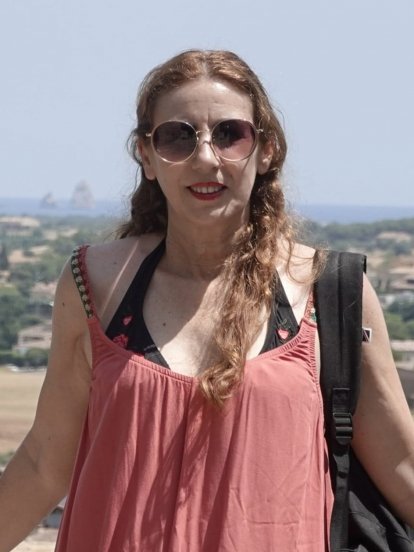
Teresa Curbelo and her family, the only residents of Lanzarote who traveled on the Costa Concordia and survived its shipwreck in January 2012 off the island of Giglio (Italy), have joined other affected parties to demand greater compensation due to the persistence of their sequelae, which have worsened over the years and become chronic
This was confirmed to La Voz by Teresa Curbelo herself, who explained that "there has been an worsening for the whole family." In this regard, her family was the first to file a lawsuit against the cruise company, represented by the lawyer for the Association of Spanish Victims of the Costa Concordia 2012, Antonia Barba. After that, she says that "we were never psychologically evaluated nor was the expert called to see us, something they did later with other groups, who were given a larger compensation."
To know if a person's sequelae from a traumatic event like the one that occurred have worsened and become chronic, at least a year must pass. "On a day-to-day basis, you see how it has changed and affected you," she points out. According to the affected person, "every person in my family has gone to a psychologist, there are people who have never stopped going".
In Curbelo's case, he explains that it **has affected his routine**, leading him to do things he didn't do before. "I've developed **OCD** (obsessive-compulsive disorder) that I didn't have before, especially regarding security," he states. "For example, I lock my front door and have to check again that it's locked. These are things that at first you think are silly and that they would disappear, but I've realized they haven't," he continues.The survivor has also **developed fears she didn't have before**, such as simply being at work and getting scared because someone greets her by touching her back.
A Norwegian Cruise as Shock Therapy
The consequences of the tragedy have led the affected person and her family to have to trust something as simple as transportation again. Living in the Canary Islands, this is unavoidable because to travel we have to do so by boat or plane. "I've always said I've never been afraid of anything, for me traveling by plane was like being in my living room, but after what happened, everything churns up inside me when I get on one, especially when there's turbulence," she says.
Regarding the boat, his psychologist recommended that **a shock therapy would be to travel on a cruise again** and to confront his fears head-on, although he reveals that "if I did it, it had to be spectacular and out of the ordinary." "Last year, after 13 years, **I went on a small cruise to Norway** from the south to the North Pole," he recounts.
During one of the nights of this trip, there was a storm in which waves of up to six meters were expected, but they finally reached thirteen. "The captain sent us to our cabins and to lie down horizontally, I was on the fifth floor and things started to fall... this took me back to that night on the Costa Concordia, but even worse, since we were in the cabin and I thought that if the ship sank I wouldn't be able to get out," he recalls.
Looking back, she recalls that tragic night in 2012, when she **lost her husband and son for two hours and saw a person die**. "I didn't know if they were alive or dead," she says. "Nobody attended to us, and the most important people on the ship (17 people) left in the lifeboat with the captain, and it was a case of 'every man for himself'," she continues.Likewise, because no emergency drills had been conducted, she didn't know where to go. "I started looking for my husband and son on the decks of the sinking part and I saw that the lifeboats had numbers, so I told everyone I met on the ship that if they saw them, to tell them to go to lifeboat 17, and a couple managed to see them," she recounts. Shortly after, **they reunited in that lifeboat**, which was the last to depart
Serious comparison with other survivors
Furthermore, Curbelo criticizes the "serious disparity" that has occurred regarding other survivors of the tragedy. "Some **have been valued in one way and others have never been valued**," he asserts. In this regard, he attributes the reason for this to the fact that "we were the only ones who went to court because the other survivors always reached agreements through their lawyers."According to his account, the company's psychologist never contacted them to assess them. However, "when agreements began to be reached with other affected parties without going to court, they were assessed and, after a year, the psychologist assessed them as moderate, which means a higher compensation for them."
Teresa Curbelo and her family were compensated at the time with a total of 52,500 euros, 17,500 per person. The affected party emphasizes that over the last 14 years they have not stopped fighting "even though the media has not echoed it".
Now, the goal is to obtain greater compensation for the chronic health problems caused by the shipwreck by providing medical reports that demonstrate this worsening. "We are not only providing the reports we have, but we want the company itself to assess us," he argues.
The cruise ship was carrying 4,229 people on board and sank after colliding with a reef off the coast of the Italian island of Giglio. There were 25 dead and seven missing, and the tragedy occurred after the ship's captain, Francesco Schettino, approached the island's coast, deviating from the established route.

Add La Voz de Lanzarote as a preferred Google source.
Stay informed with the latest current news.