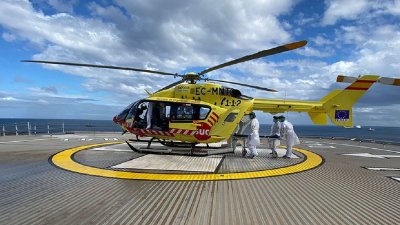
The Canary Islands Emergency Service (SUC), which depends on the Ministry of Health of the Government of the Canary Islands, has once again put out to tender the competition for the provision of new medicalized helicopters after the previous one was unsuccessful, which contemplates the incorporation of one more health aircraft to its fleet of aerial resources.
This third advanced life support helicopter, which will be added to the existing ones in Gran Canaria and Tenerife, will be based on the island of Fuerteventura. The regional government defends that the island of Majorera is the base of this third helicopter because it has "a hospital heliport".
The SUC has defended that "the location will allow for a similar response time", between Lanzarote or Fuerteventura, "in the event of a serious incident in either of these two island areas of operation". The other two helicopters will maintain their bases as before at the Tenerife South and Gran Canaria airports.
The crew will be composed, like the current aircraft, of a commander and a pilot, together with an advanced life support (HEMS) medical team, with a medical professional and a nursing professional.
In this way, the islands will have three aircraft of advanced life support, which they assure "will contribute to the reduction of response times when an aerial resource of these characteristics is needed".
These devices are mobilized for assistance and transfer between hospitals of different levels of patients who require specialized care for serious health problems or for injuries presented by a person who has suffered a traffic accident or in an outdoor activity, for example, and must be evacuated urgently from remote or difficult to access places to a health center.
It is an aerial resource of extrahospital care very necessary in the archipelago, due to the fragmentation of the territory, which operates 24 hours a day, 365 days a year. This need translates into the activity recorded by these resources, since in 2024 alone the two medicalized helicopters currently available to the SUC were activated on 1,065 occasions.
A new tender, after the previous one was unsuccessful
Among the changes in this new tender, after the previous one was unsuccessful, the base price of the tender, which amounts to 39,155,276 million euros, stands out. In addition, it is introduced as a novelty that two units will be operational 24 hours a day and a third will offer a service of 12 hours a day.
As for the estimated number of flight hours, it remains at 1,800 hours per year, but the amount changes and amounts to 1,119 euros per hour, for the first year. In addition, an annual increase of 2% is contemplated for successive years. Another change is that the execution start date is reduced to 180 days, compared to the 240 days contemplated in the previous bases.
The evaluable criteria have also been expanded, incorporating new improvements such as pediatric and neonatal high-flow oxygen therapy; the viability of blood transport on board, with the incorporation of a portable equipment to perform blood tests at the time; a system to mitigate the consequences of a fire on board or perfusion pumps with universal syringes to save time in patient care.
Among the requested novelties, the proposal that the electromedical material has a digital integration system so that the SUC has access to the information and monitoring of the patient in real time from the coordination room, making it possible for this data to be sent also to the destination hospital center. This makes it possible to carry out, a posteriori, an analysis of each case to develop therapeutic improvements.
It has also been included among the best scoring that the helicopter can have its own ECMO, which is a medical technique of extracorporeal membrane oxygenation that provides life support to patients with severe respiratory or cardiac failure. It allows blood to circulate through a machine that acts as an artificial lung and heart, allowing the patient's heart and lungs to rest and repair.
The contract, which includes the probability of a one-year extension and possible modifications, is co-financed by the operational programs of the European Regional Development Fund (ERDF) 2014 - 2020, and may be eligible for financing in the new programming period 2021 - 2027. The deadline for submitting offers is next Tuesday, June 3.

Add La Voz de Lanzarote as a preferred Google source.
Stay informed with the latest current news.