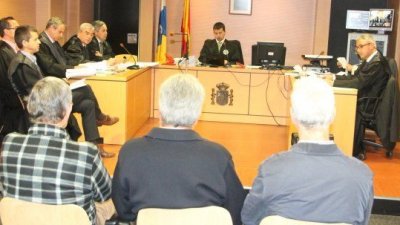
The three Inalsa workers who were convicted last January for the explosion that took place at the Lanzarote IV plant in 2005, in which a worker was seriously injured, have finally been acquitted by the Provincial Court of Las Palmas. In a ruling dated September 19, the Second Section of the Court upholds the appeals of the three defendants and revokes the sentences of 8 months in prison and 6 of disqualification "from exercising the position of head or person in charge of personnel" that Criminal Court number 1 imposed on Domingo Bonilla, Antonio Sánchez Rodríguez and Juan Manuel Bethencourt.
These three employees held positions of responsibility in the control of that plant, whose explosion caused significant burns to an electrical fitter who was carrying out a repair in the area, and which have left him with after-effects and prevented him from returning to work ever since. More than ten years after that event, the three employees were convicted in the first instance of crimes against the rights of workers (in matters of risk prevention) and of injury due to negligence.
However, this new ruling, which is final and against which no appeal is possible, considers that it cannot be concluded that the actions of the accused put "the life or integrity" of the worker in danger. The ruling maintains that, although there was "clearly a violation of safety regulations", it is not "proven" that this "generated a criminally relevant risk" from which a "criminal responsibility" of these three heads arises.
Regarding the injuries due to negligence, the Court concludes that the defendants "did not omit any duty of care" and emphasizes that, based on the instructions they gave to the electrician who was injured and the work that was going to be carried out, they could not "foresee" what was going to happen, nor consider that they should "demand the use" of protective equipment, which he was not wearing at the time of the accident. "There is no causal link between the work entrusted and the final harmful result suffered by the worker and, consequently, there is no duty of care infringed by the defendants," the ruling concludes.
"It cannot be affirmed" that they were "endangering his life"
To exonerate these three workers, the Court takes into account the statement of the affected party himself, who was present in the case as an accusation but later "renounced" to exercise a claim against the accused, according to the ruling. The events occurred on July 28, 2005, when operators from an external company went to the plant to carry out a repair and this Inalsa electrician was designated to go with them. At this point, the Court's ruling disagrees with that of the first instance.
"We cannot share", the ruling states, that the worker "was designated to collaborate with Eléctrica Centro in their maintenance work", "or that his function was collaborative". Thus, the Court emphasizes that the affected party himself explained it in his statement and "could not be clearer". "He was not sent to work, his function should be limited to indicating to the engineer in charge of the repair where things were", to a "mere accompaniment", says the ruling about the instructions given to him by Sánchez and Bonilla, who were, respectively, head of production and manager of the plant. Thus, it considers that the function he finally developed was "much further" than the one entrusted to him.
The work entrusted to him, in the opinion of the Court, "does not seem to deserve that the accused demand that the worker wear a face mask, gloves, a pole and a fireproof suit". "He could have worn it", the ruling adds, "but what cannot be affirmed is that by not demanding that he wear it, the accused, ex ante, were endangering his life or his physical integrity". Despite the assignment they gave him, the victim of that work accident explained that he himself activated the circuit breaker of the electrical panel because he was the one who "was closest".
"No one, not even the affected party himself, has affirmed that the work was dangerous"
In this regard, the ruling emphasizes that the maneuver itself was not "dangerous" and also underlines that the equipment was in "perfect condition". Furthermore, it adds that the "electrical arc" that was generated when it was activated, and which caused serious injuries to the electrician, occurred for reasons that "are unknown".
The ruling of the first instance affirmed that Sánchez and Bonilla had not only sent the worker to carry out "electrical work without adequate protection equipment", but that also, when "realizing" this when they saw the electrician and the rest of the operators heading to the repair point without protection, "they did nothing" to reverse it.
That ruling considered that, even if he had not been "specifically" ordered to carry out those tasks, "the mere fact of being in an area where work was going to be carried out with electricity imposed the duty to use that equipment given the danger of the work". "No one has affirmed that the work consisting of lowering the circuit breaker was a dangerous work in itself. Not even the affected party himself maintained it", the Court's ruling rebuts in this regard.
A "unfortunate coincidence", possible cause of the accident
The ruling also underlines that the "real cause of the incident is unknown" and points to a "unfortunate coincidence" as a possible cause. And it is that, on the one hand, it points out that the day before the engineer of Eléctrica Centro himself had activated that same circuit breaker several times without "major complications, which does not precisely point to the dangerousness of that specific work or of the work to be carried out as a whole, given that they were always carried out without tension".
It adds that that piece was "in perfect condition" and also cites a report from the Canarian Institute of Occupational Safety that points to the possibility that the accident occurred "as a consequence of the entry into the area of a foreign conductive body, which at the time of activating the lever" generated that "electrical arc". This, "speaks more of an unfortunate coincidence than of the dangerousness in itself of the work in question".
In conclusion, the ruling emphasizes that "we are not facing facts that could, in some way, be foreseen by the accused", "much less could they foresee that that work was going to be carried out by the person to whom they had exclusively entrusted accompaniment tasks". Regarding the acquittal of the third of the accused, Juan Manuel Jesús Bethencourt, who was the production director and who was convicted in the first instance for not having "provided" the appropriate protection equipment"; the ruling points out that protection equipment did exist, although it was not in that specific area, and that in any case, these "were not even necessary to fulfill the order that was conferred on him". Thus, the Court concludes that it is not "understood" that the designation of this worker should "generate any concern, when that did not imply the execution by him of work under tension".
The ruling dwells especially on addressing the absence of fireproof suits, which Inalsa lacked when the accident occurred and which it ended up acquiring later. In this regard, it explains that in the risk assessment carried out by an external company, the acquisition of that material to deliver it to the workers had not been "interested". It also adds that it is not "proven that it was previously considered indispensable" to have those suits and that, "in any case", it is also not proven that these "were necessary to perform the tasks" that were entrusted that day to the electrician, who suffered second and third degree burns on 60% of his body in the accident.



Add La Voz de Lanzarote as a preferred Google source.
Stay informed with the latest current news.