
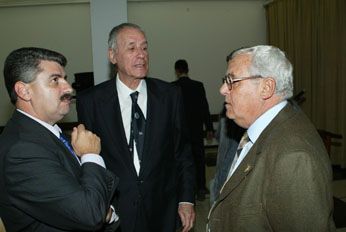
Photos: Javier Fuentes.- The Academy of Sciences and Engineering of Lanzarote has paid tribute to one of the most illustrious sons of the Island, Dr. José Molina Orosa, who was recently named by the institution itself as an Honorary Academic posthumously, a fact that occurred in March of this year.
What was commemorated last Friday at the Arrecife Gran Hotel with the attendance of nearly one hundred people was the 122nd anniversary of the birth of the distinguished doctor and politician from Lanzarote, who gave his life to the most needy.
As explained to LA VOZ by one of the greatest experts in the life of Molina Orosa, Ramón Pérez, "it was a loving act, with a warm and sentimental atmosphere".
Several people took to the stage to dedicate a few words in honor of the man who was known as the doctor of Lanzarote. And so, two of his children, José Molina Aldana and Dina Molina Aldana; as well as Javier Cabrera Pinto, José Ferrer Perdomo, Abelardo Bethencourt Fernández, Ramón Pérez himself, and Francisco González de Posada, president of the Academy of Sciences.
After the end of the speeches, those gathered approached the monument to Molina Orosa to deposit four wreaths of flowers at its feet, by the Cabildo of Lanzarote, the City Council of Tías, the Academy of Sciences and Engineering, and the College of Physicians of Lanzarote, respectively. The family also left a bouquet of flowers.
"Far from you"
The daughter of Molina Orosa revealed in the hall of the Arrecife Gran Hotel the story of the love that accompanied the distinguished doctor from Lanzarote in life. Her name is Inocencia Aldala and Orosa met her in a play in the Villa de Teguise, when the girl was barely 14 years old, although Molina Orosa was also no more than a teenager.
But what most surprised and moved the public was a poem that Don José composed when he left the Island to study medicine in the peninsula.
The poem, which we quote below, is titled "Far from you".
When will the morning be
of my distant return...
When will I be imprisoned again
in your beloved window.
Oh window of your house
where I left the joy!
Oh how slowly time passes
far from you, my life!
A distinguished life
Better known as the "doctor of Lanzarote", José Molina was born on December 18, 1883 in Arrecife. At the age of two, he contracted severe infantile paralysis, as recounted in the book that compiles his life under the name of José Molina Orosa, the doctor of Lanzarote, which caused him to have a marked muscular atrophy of the lower extremities for the rest of his life, a fact that perhaps was decisive when choosing a professional career.
The suffering of Molina himself, caused by the diseases that marked his life from the earliest childhood, committed the generous doctor for the rest of his life in the performance of the profession, always willing to provide unconditional help to all the people of Lanzarote, without taking into account the fees that he should receive for his work.
Having finished high school at the age of 15, Molina moved to Cádiz to take a preparatory course to enter the faculty of medicine, but bad luck once again crossed his path in the form of typhus, which in addition to keeping him away from his studies for three years, left significant sequelae on his health.
Once established in Lanzarote, Molina stands out not only for his excellent skills as a doctor and scientist, but above all for his enormous qualities as a human being, always concerned with alleviating the suffering of the sick and with bringing development and the advances of modernity to the island he loved so much. In his early years here, Molina faces precarious conditions when performing his duties.
After practicing in such pauper conditions for some years, he considers it urgent to draw the attention of public opinion and the authorities to the need to create a hospital in Lanzarote, given that at that time only two houses housed the sick from all over the Island and these were impracticable for the performance of medical work. But the efforts of the noble son of Lanzarote were not rewarded until 1950 with the inauguration of the Insular Hospital, since in previous years politicians did not listen or did not want to listen to his arguments.


