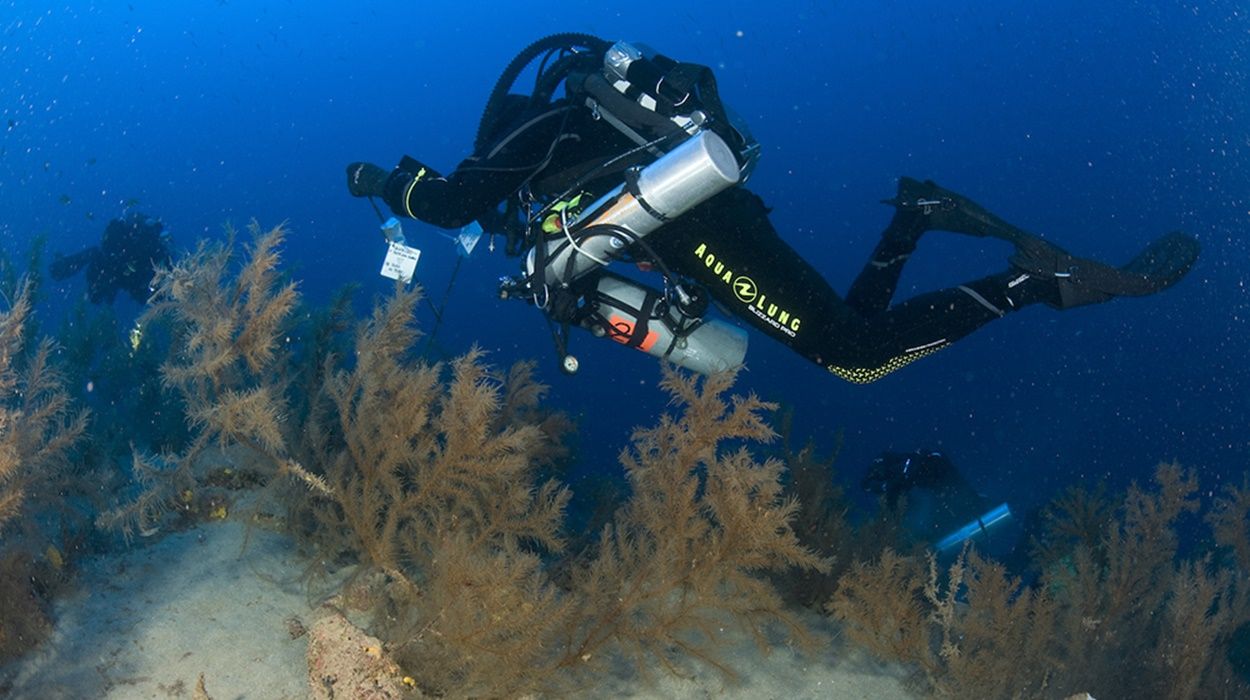
The researchers of B-CHARMED, the European project that studies the importance, role and extension of the black coral forests that live from 45 meters deep in the coastal area of Puerto del Carmen, began this week the first dives in the waters that host these complex ecosystems.
As explained in a statement, the situation experienced by the pandemic forced a postponement of several months in the start of the research work, which finally has been able to start this week with the first explorations of the area, which will be mapped with a novel technology that combines side-scan sonar systems and multibeam echosounder with deep dives. The campaign will continue with new explorations during the months of February and April this year.
The first works in the water have served to begin to determine the sampling methodology, test the technological material that will be used to map the black coral forests throughout the next year and establish the work areas from where to perform the measurements.
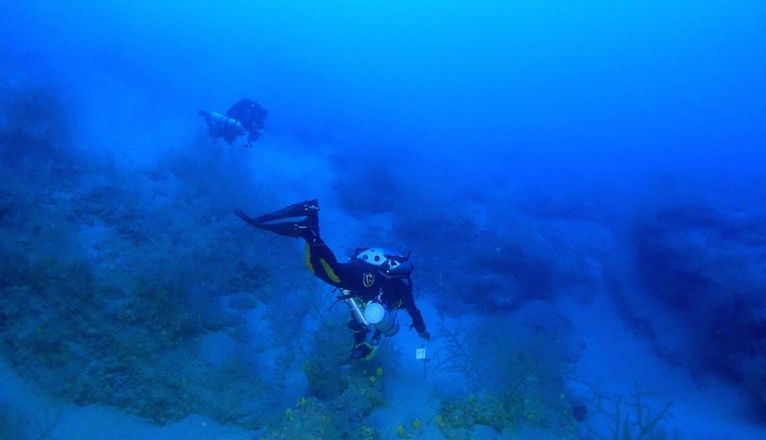
B-CHARMED aims at the integral ecological study of black coral forests in Macaronesia (Lanzarote will be used as a model area for the study), as well as the development of acoustic tools to determine their extension. It is led by the Atlantic Biodiversity and Sustainability Association (ABAS), an association located in Las Palmas de Gran Canaria, the Laboratory of Ecogeochemistry of Benthic Environments, in Banyuls sur Mer (LECOB - France) and the Leibniz Institute for Baltic Sea Research in Warnemünde (IOW - Germany).
In this first week of field work, three researchers have participated: Francisco Otero-Ferrer, principal investigator of the project, from the Atlantic Biodiversity and Sustainability Association (ABAS); Fernando Espino, associated to the University Institute of Sustainable Aquaculture and Marine Ecosystems (IU-ECOAQUA) of the University of Las Palmas de Gran Canaria (ULPGC), who participates as main collaborator in the project; together with Lorenzo Bramanti, researcher of the CNRS (National Center of Scientific Research) belonging to LECOB.
According to Francisco Otero-Ferrer, these first days will serve to prepare all the planning of the dives that will begin to measure the dimensions of the Lanzarote forests. "The depth where these coral forests are located, which extend from 45-50 meters, makes every minute under water valuable," he says, so it is necessary to define and adjust the experimental protocols that will be used in order to adequately plan the immersion time and the corresponding safety measures.
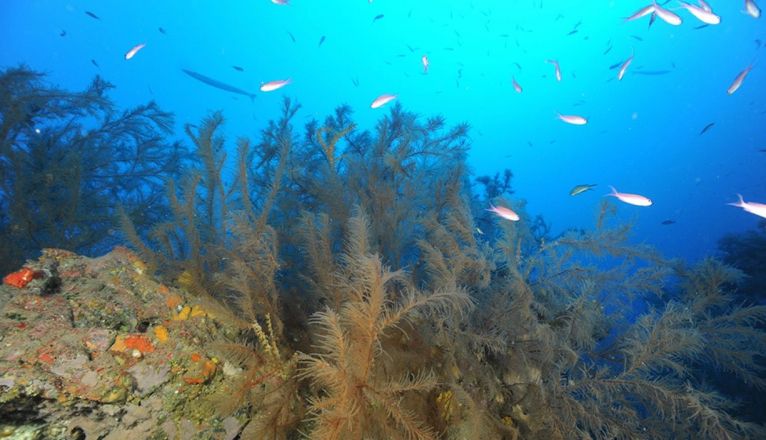
The B-CHARMED project (Acronym for The Black Coral forests as unexplored Biodiversity Hotspots in the MAcaronesian Region: ecosysteM functions and sErvices analyseD) will allow to know the scope and importance of these still little known marine forests in Lanzarote. Although in tropical countries the black coral forests have been studied in depth, they consider that there are still many things to discover about these ecosystems in Macaronesian waters, as is the case of those on the island.
What are black corals?
Black corals are colonial animals formed by hundreds of individuals called polyps, similar to small sea anemones, which are physically connected and function as a single unit. The polyps are usually only a few millimeters in size and have a series of stinging tentacles, usually 6, that surround the mouth through which they ingest food.
Black corals are typical of deep waters, although many species appear in a very wide depth range. With morphologies similar to real trees, coral communities can aggregate abundantly on the seabed of the Canary Islands from 30-40 meters deep, forming authentic "underwater forests" that modify the landscape, and influence the presence of other species of fauna and flora, functioning therefore as true "bioengineers" of marine ecosystems.
Unlike other corals such as those that form the Great Barrier Reef in Australia, whose skeleton is made of calcium carbonate, black corals have a skeleton composed of proteins (about 50%) and chitin, another flexible and resistant compound that is part of the cell walls of fungi or the skeletons of many insects. Despite having different appearances and striking colors due to the polyps, the skeleton of these animals is usually black (hence its name), and may be covered by a series of spines that are used to differentiate the species. Therefore, black corals are also known as "thorny corals".


Add La Voz de Lanzarote as a preferred Google source.
Stay informed with the latest current news.