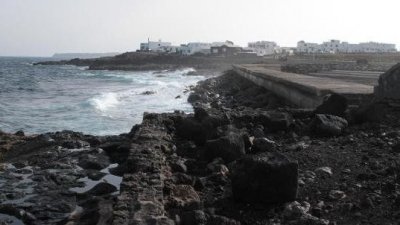
PHOTOS: Sergio Betancort
Visiting Los Cocoteros is, in a way, traveling to the past. Mobile telephony still seems like a distant invention in this town with hardly any coverage, where not even the landline reaches. The tranquility is appreciated in its streets; in the children who run tirelessly from one side to the other, in the parents who observe them, unconcerned about the hustle and bustle of cars in other towns. "Here you live as you lived before," says one of its neighbors proudly. Its inhabitants agree in describing this small town as a haven of peace. However, they believe that the calm that is breathed and that they would not change "for anything", sometimes turns into isolation, into an "abandonment" that they claim to have suffered for years. "We are all delighted here, but we need things," they claim.
A group of young neighbors has taken charge of the El Riadero association, which had been inactive for months, to channel all these requests. The trigger for their complaints is the recent dredging of the Charca, the result of which they believe is not adequate and that could even be "dangerous" now. But although this was the issue that led them to contact La Voz de Lanzarote to make their complaints public, the list of shortcomings they enumerate goes far beyond. "They are not big things," says one of the neighbors, while a girl of just five years old huddles behind her. "We are not asking for so much either, a pond where we can bathe without anything happening, a telephone, a meeting place...", points out another.
And it is that in Los Cocoteros, where according to these residents live something more than 550 people (although only about 250 have the right to vote), there are hardly any common spaces, beyond the court at the entrance, where there is a wifi point that "maybe works once a year". The life of young and old practically runs between the street and their houses in this town in which, since last summer, there is no longer even a bar where you can have a coffee or take shelter from the inclemency of the weather.
The elders of the town meet in two prefabricated containers that one of the neighbors gave them, worried that her octogenarian grandfather did not have a place to take shelter to play cards or dominoes. They currently lack a socio-cultural center. According to them, the City Council pays the rent for the old bar to act as a teleclub, but with the works to condition it already awarded, it remains closed, "without light, without water" or a place to "sit". Public transport does not arrive either and the bus stop is only the stop for children and teenagers when going to and from school.
Improvements "without losing the essence"
This old private urbanization, whose spaces have been gradually becoming public places for two decades, houses about 200 houses. Most of them were until not long ago weekend or summer homes, second homes of "rich people", the neighbors say with irony. In recent years the situation has changed. This group of neighbors recounts how the town has been regaining life and the houses have been filling with young families with small children, who were captivated by the tranquility of Los Cocoteros to raise their children.
Those children fill with their joy some almost deserted streets on a March afternoon. Their parents relate everything they would like to improve in Los Cocoteros, although "without losing the essence". And it is that, although happy with that "tranquility", they feel "abandoned". Among other examples, they explain that the cleaning is "precarious" and they have not seen a street sweeper for at least three months. They also show several gardens whose plants look shiny because "the neighbors take care of them".
When touring the town, they point out with humor what they have baptized as the 'lamppost of coverage', one of the few places where, if you are lucky, it is possible to obtain mobile network. Data phone in hand and arm raised, there is the delivery man of a prepared food company who tries to charge a customer with a card. Its location and the jokes of the neighbors leave no doubt that the scene is something habitual. "What, did you get it today?", one of them asks. "Not yet", he replies patiently, still with the electronic device in the air.
A pond "full of holes" and a park "without light"
Although they believe that lately the situation has "improved a little", these neighbors feel relegated "for years". The dredging of the pond, according to them, is a claim that dates back to 2012 and that they consider has finally been carried out after the "ultimatum" that the association gave to the Consistory last January to meet their requests. "On the fly they called, they said that the machines were coming already and that the work" of the teleclub had also been awarded, they point out.
Regarding the dredging of the pond, they explain that the bottom has been "uneven", "full of holes everywhere", something that can be "dangerous for children who are learning to swim". According to the Consistory, these works are completed pending the placement of "pebbles or gravel on the surface" to "improve the accessibility of users to the Pond". For the neighbors, however, the work is not finished. In addition to their concern for those "holes" in the bottom, they point out that in order to dredge it, it was necessary to break a part of the stone wall that surrounds the pond, to make a hole through which the machines could fit. There was the access ramp for the disabled, which, together with its railing, has been partially covered by the earth of the excavators. The opening in the wall has not been closed either. "But is this going to stay like this?", the residents ask indignantly.
Just a few meters inland, there is a playground. The neighbors regret that the children can only play in it "during the day", since there is no lighting. The lamppost they have requested "they say is coming, but it has been coming for two years", they point out. According to them, then they placed Led lampposts in several streets, but just in that area "they did not put". "When it gets dark, you have to leave", says the mother of another girl.
An ‘unknown’ teleclub
Especially striking is the situation of the future teleclub of which, according to them, the Consistory was paying the rent without anyone, apart from the owner of the facilities, knowing it for months. It was precisely knowing about it that prompted this group of neighbors to take charge of the association to manage the teleclub and organize activities in the town.
According to them, the Teguise City Council began to pay those payments in August 2014, but it was not until March or April 2015 when the neighbors found out, when the mayor told them at a meeting. "The owner received the money from the City Council, but the City Council did not organize any activity", they explain. Already with the association in operation, the Consistory gave them the keys. The neighbors then found a building that "was not in conditions". "There was no water or electricity", says one of the neighbors. "Not even a place to sit", adds another. Faced with this, the association decided last December to return the keys to the Council, with a writing in which they recorded the state in which it was.
Currently, the teleclub remains closed, presided over by a sign announcing these improvement works by the Consistory. The works have already been awarded, but there are no workers in the area. According to the residents, the Consistory has indicated that they cannot carry them out because "there is no light", something that does not stop "surprising them", since they affirm that they themselves explained it when returning the keys to the premises. "The operators came, sanded two doors and that's it", laments one of them. "Yes, it is true that the work was awarded, but they are not doing anything here", says another, who considers it a "waste of money".
According to them, at Christmas several pages and some of the councilors of the City Council came to carry out activities for the children in the teleclub, as had been programmed in the rest of the towns of the municipality. "They found the teleclub closed", recalls a neighbor, who maintains that they left "outraged", "as if they did not know".
"Nothing like getting up and smelling the tide"
Faced with all these demands, they believe that the administrations have been "putting patches" to "shut them up". "The mayor always comes with his little notebook and we always ask him for the same thing", points out one of the neighbors. The problem, however, is not reduced to the current administration, as they consider that it has been a constant. "The only one who cared a little more was Juan Pedro (Hernández)", comments one of the neighbors, who explains that he grew up in the town and that in the last 35 years he has been able to see its "deterioration".
This neighbor looks back and remembers some projects that did not come to fruition, such as the one that was to "make a promenade, fix the pier, the cove...". From that project, points out another resident, came the new wall of the Charca or the large steps around it, but "the money never arrived for the rest". This neighbor recalls the appearance that the pier had years ago, the railing that was there to be able to go down to take a dip or the pool. All that, he adds, was spoiling little by little and was never replaced. "The tide took it away and it remained in the memory".
He also remembers that they have been "20 years, since Dimas", waiting for the telephone line to go beyond the poles that end at the borders of the town and reach the houses. But, despite all these claims, none would leave this haven of calm, because, as one of these young mothers who moved to Los Cocoteros seduced by its peace says, "there is nothing like getting up and smelling the tide".



Add La Voz de Lanzarote as a preferred Google source.
Stay informed with the latest current news.