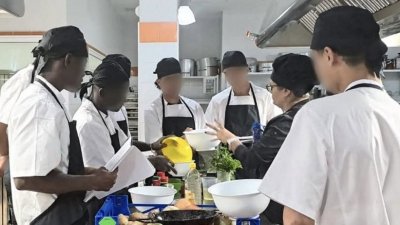
The integration of young migrants into society is one of the great challenges they face when starting a new life in the Canary Islands and the rest of Europe. The language barrier or lack of education are some of the obstacles that, thanks to the work of the Main Canary Foundation, they can overcome. In Lanzarote, the organization has already worked with 56 minors, many of whom have already obtained a job thanks to the training they provide.
The Main Canary Foundation, promoted by the Institute of the Daughters of Mary Help of Christians (Salesian Sisters Spain), arrived in Lanzarote at the beginning of 2025 and since then has been carrying out a project on the island through a training and socio-labor integration program for migrant minors.
Agustina López, a social educator and Spanish teacher at the Main Canary Foundation, says that this program is divided into several phases. "In the first part, they take 200 hours of Spanish, which also includes working on social skills, and when they pass this phase, they move on to vocational training," she explains.
In this sense, over the months they have already had a total of three groups. Two of them decided to study cooking and others trained as waiters. This has allowed those who had their documentation in order to find a job, something vital when starting a new life.
"It's very positive for them that, once they have finished this cycle of Spanish and professional training, they have been able to quickly enter the world of work," López points out.
Acceptance by companies
When doing internships in companies, the Foundation approaches them after the young people have finished their Spanish classes for initial contact.
According to the social educator, "the reception from companies has been very good." "In fact, we recently went to an open house at a hotel and they are eager to find people to work because there is currently a lot of work in Lanzarote," she continues.
The main requirements for young migrants to be able to work in these companies are "speaking Spanish well and having skills."
Ease of Learning Spanish
The level of Spanish that the minors arrive with "is surprising," although it all depends on each case, according to López. "In the group that we currently have, there are some who have been here for four months and already understand Spanish perfectly," she says. The content of these classes involves their usefulness in day-to-day life.
However, they do find writing more difficult, but they have a very good understanding because "they have a lot of facility when it comes to learning languages." Among the boys are sub-Saharan Africans, Moroccans, Gambians, Guineans, Malians, and Senegalese, among other nationalities.
Furthermore, another characteristic that the social educator highlights about the minors is "their desire to start a new life."
Regarding the racist and xenophobic rhetoric that some sectors of society launch regarding migrant minors who arrive in Spain irregularly, he states that "no one likes to leave their country, and in their countries, they do not have these opportunities, and here they do, they come to have a better future and to feel productive."
"This is something we are seeing today because they come here after having started working, like two young men who recently started working in a hotel and are very happy because it has changed their lives and they only have words of gratitude for the Foundation because the work is very important and necessary," he continues.
On the other hand, despite the fact that some of the minors do not yet have their documentation in order, Agustina López emphasizes the story of one of them who decided to continue his training through the Canarian Employment Service. After receiving his work permit, he started working. "He could have given up or stayed in the centers, but he didn't," she points out.
A day of surfing as the culmination of Spanish language training
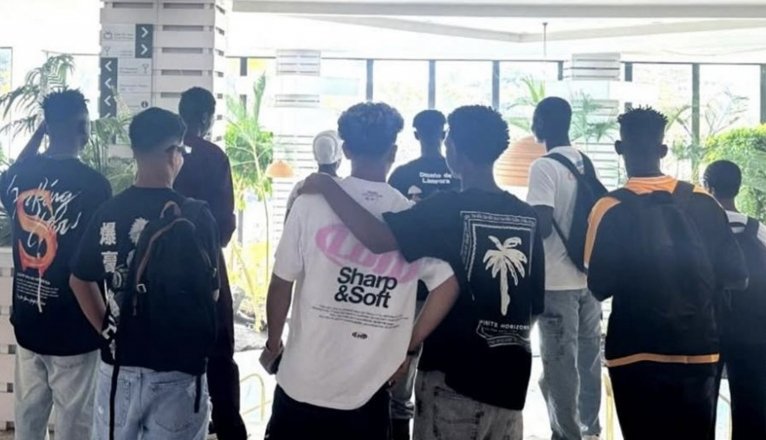
To mark the end of Spanish classes, the Main Canaria Foundation decided to hold a surfing day this week where young migrants were able to spend a day of socializing, fun, and sports.
"We believe that integration can occur through sports and the values it offers because we are a group, and ultimately, in every job we go to, we have to work as a team and listen to each other. Therefore, through this activity, many of them, who come in *pateras* [small boats], are afraid of the sea and don't know how to swim," he explains.
The goal of this surfing day was to spend a day of coexistence, and they plan to carry out another activity soon in which each person brings a typical food from their country. "Knowing other cultures helps us feel a little more free and get to know the other," she says.
Outdoor activities beyond the juvenile centers "are very helpful for them to escape and acquire skills, to see that they can also have fun even though they come to work and train."



Add La Voz de Lanzarote as a preferred Google source.
Stay informed with the latest current news.