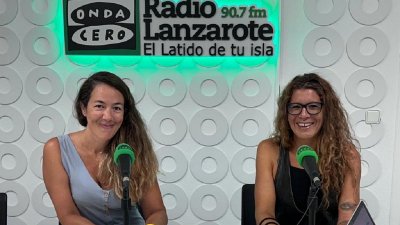
Ana Suárez and Tharais Armas work through the 'Derecho y Justicia' Association in the Tahíche prison, bringing smiles back to the prisoners who are incarcerated in the penitentiary. Suárez teaches a laughter therapy workshop to "improve the emotional level" of the inmates, she explains in a recent interview on Radio Lanzarote-Onda Cero.
A "pioneering in Spain" therapy that aims to promote the "positive attitude, resilience and self-esteem" of people. An original way to make the prisoners "spend their stay in the best possible way". In addition to giving them "tools to face problems and lead a better life", both inside the prison and facing the future that awaits them outside.
"We make them see that they have the capacity to have a positive thought and good attitudes," says Suárez. Through the games that make up the workshop, the prisoners "loosen up and work on concentration, which makes them focus on the activity," she adds.
A workshop that has had a favorable response for them, "they feel more self-confident and cheerful, sleep better and express themselves better with their colleagues, to the point of starting to deal with some that they did not deal with before", Suárez points out about the effectiveness of the project. "A penitentiary and laughter therapy seem like opposite poles, but results are seen", she acknowledges.
A fundamental initiative for the "reintegration" of the inmates, as it provides them with "tools to leave prison better, being a benefit to everyone, to them and society", Armas, the coordinator of the projects in the association, remarks. "The fundamental basis is the reintegration and rehabilitation of the prisoners", the clear objective of the workshop and the association, she reveals.
"The goal is to provide tools for them to leave prison better, being a benefit to everyone, to them and society"
From the 'Derecho y Justicia' Association, they emphasize that the prisoners "have the same right to enjoy these workshops as people who are outside", an important nuance for which they have decided to create the laughter therapy workshop.
A project subsidized by the Cabildo de Lanzarote, from the Area of Social Welfare and Inclusion, which "has been running for three months", with "the idea is to reach about 150 inmates", Armas points out. "After a month and a half we have already started to see the evolution", Suárez clarifies. The success is remarkable since "in September another six groups of fifteen inmates will start", they anticipate.
In addition, they encourage the people of Lanzarote to sign up for the workshops, "you don't have to enter a penitentiary to do the workshop and start laughing", Armas encourages.



Add La Voz de Lanzarote as a preferred Google source.
Stay informed with the latest current news.