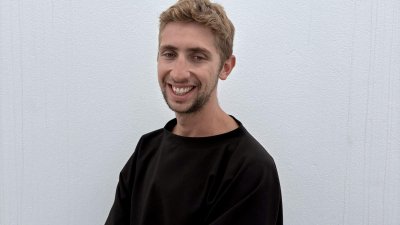
The Lanzarote singer and pianist Jorge Caluz (Playa Honda, 1999) is one of those people who radiate light just with their personality. Despite having a visual impairment from birth, a vision percentage of 10%, his life has been marked by daily overcoming and his ability to laugh at himself and face challenges with humor. Through parodies of songs and videos on his social networks such as Instagram and TikTok, the young man transforms many songs with lyrics as if they had been written by a blind person.
Although Jorge Cabrera, his real name, has some vision and recognizes people's faces, he says that he "sees through a tunnel", which considerably reduces his field of vision. This visual impairment was not an impediment for him to start playing the piano at just five years old. "The teachers would read the scores to me and when I went to study outside the island I had to find a way to read them, and what I did was enlarge the scores on the computer screen to memorize them," he says.
However, this is complicated because having to enlarge the scores so much, it takes much longer to read them, but as he says, "since I play more soul or pop music, it is much easier to get them just by ear".
In addition, his passion for music led him to be selected to represent Spain in the final of the International Low-Vision Song Contest (ILSC) 2024, a competition that promotes the creativity of blind or severely visually impaired musicians. He currently works in hotels with a musical duo where he delights guests with his talent.
Parody songs to disseminate visual impairment from humor
His talent, personality and passion for music have led him to record and upload versions of songs to social networks with the aim of "getting followers who consume the music that I would like to release". However, during this process he realized that he also liked the dissemination about visual impairment.
"I think it is something necessary and, above all, to do it from humor because disability is something that is stigmatized and many times people with disabilities victimize ourselves, although it is also legitimate to get angry and complain, but I want to vindicate from humor and that people know the reality of this condition in my specific case," he explains.
In this sense, the artist wanted to combine his facet as a musician with the part of his disability that makes him more unique. "Combine humor, vindication and music," he points out.
This dissemination makes society understand how a person with visual impairment lives and invites them to reflect. Asking is vital to understand others. "I advocate for people to ask me, I don't mind being asked and I talk about it in the most natural way possible, as long as it is from respect," he emphasizes.
"Many people take many things for granted about disability and I think the important thing is to assume your ignorance if you don't have a close case and ask with caution and respect, I'm happy for people to ask whatever they want, even the most obvious thing," he continues.
Day-to-day life with visual impairment
During his daily routine, the young man, like many other people with some type of disability, encounters obstacles that hinder his mobility and autonomy. In the case of Jorge, who goes out with his cane, transportation is one of them. "I don't have a license and even if there are buses, if you want to go to a town or more distant areas it is difficult and a quite large limitation," he says.
On the other hand, and although he emphasizes that it doesn't happen so much here, sidewalks also pose a problem. "I was living in Crete and there were hardly any curbs on the sidewalks and I was afraid to go out alone because if there were no sidewalks I had to go down the street and be aware of not being run over," he recalls. When going out, Jorge combines the use of the cane with what he sees.
In his day-to-day life at home, many of the everyday things that most of us take as normal, become a challenge for Jorge. "Using the ceramic hob, for example... when I lived in Madrid I put stickers on the buttons because I couldn't see them to turn them on," he declares.
As problems arise, the young man solves them as he can, although the ONCE (Spanish National Organization for the Blind) is also a great help in this sense, as it has different tools that facilitate many tasks.
The change in routines for people with disabilities such as visual impairment is a major inconvenience, such as changing the dishes in the kitchen or the presence of a new construction on a street that the person usually passes through. "I always have everything organized and if they change something, then it's hard for me to find it, or when they leave a door or window ajar, I bump into them," he says with a laugh.
Anecdotes he has faced
Throughout his life, the young man has encountered uncomfortable situations in which his disability has been the central axis. One of them, as he said in one of the videos published on his social networks, occurred when he went to a hairdresser in Madrid. At that time, he was not carrying the cane because a friend accompanied him.
"I went to sit in the chair but since I couldn't see it, my friend accompanied me and the hairdresser was quite surprised, so I told him that I had a visual impairment and that I saw very little," he says. "At one point I asked him for a tissue to blow my nose and he extended his hand to give it to me so I could take it and I didn't realize it at first. Since I took so long to take it, he asked me if I really couldn't see," he continues.
Despite the explanations, he noticed the hairdresser's discomfort. "When he went to wash my head, my friend got up and helped me go to the sink, but at that moment he said things like if I couldn't see anything and how could I be like that at my age," he relates. He also asked him why he didn't wear glasses. "It was as if he was scolding me for not seeing, he was shocked because no one had ever spoken to me like that because of my disability," he says.
Another of the anecdotes also occurred in Madrid, when he went to a health center during the covid pandemic. "After waiting my turn, I went to the counter and the girl asked me what was wrong with me in a rather unfriendly way. I had to go to the bathroom for a urine sample but I couldn't see where it was and I asked if someone could accompany me. I assumed that she had seen the cane, but I don't think she realized it and at that moment she told me how someone was going to accompany me to the bathroom in the middle of a pandemic," he says.
At that moment, a man noticed Jorge's disability and accompanied him to the bathroom. "The girl started to confront the man and another administrative realized my disability. He told me that his colleague had not realized that he had a cane but I told him that those are not ways to treat anyone, whether they are blind or not," he concludes. Later, the administrative apologized to him.
However, on other occasions, his disability has led him to skip waiting lines without expecting or asking for it when they see him with the cane.
Add La Voz de Lanzarote as a preferred Google source.
Stay informed with the latest current news.