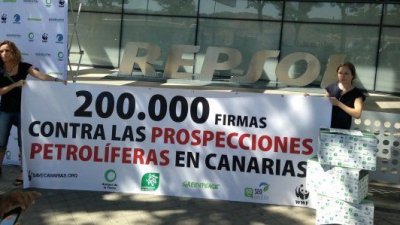
The NGOs WWF, Greenpeace, SEO/BirdLife, Ecologistas en Acción and Amigos de la Tierra have delivered this Tuesday at the central office of Repsol, in Madrid, more than 200,000 signatures asking its president, Antonio Brufau, for the immediate suspension of oil exploration in the waters of Lanzarote and Fuerteventura. This delivery took place after the surveys received "the approval" of the Ministry of Environment, by approving the environmental impact statement.
The signatures, collected through the initiative www.savecanarias.org, come from 183 countries and subscribe to a manifesto addressed to the president of Repsol, the top managers of the other two oil companies that make up the consortium to operate in the Canary Islands (the German RWE DeaEnergy and the Australian Woodside), as well as the presidents of the governments of Spain, the European Commission and the European Parliament. Public officials will receive the signatures in the coming days at their respective official headquarters.
The environmental organizations have delivered the petitions together with a person in charge of the Canary Islands campaign against the surveys, in which both the environmental NGOs and various social groups, foundations, scientific entities, and public administrations of the Islands participate. These associations have stated that both the Government of the Canary Islands and the councils of Lanzarote and Fuerteventura "have been expressly represented" in the delivery of signatures to the president of Repsol.
A "serious threat"
These environmental NGOs have demanded that Repsol "attend to, respect and accept without delay" the demands of the Canary Islands population, the "international" tourism sector and the scientific community, sectors that have been "repeatedly warning of the risks of exploration on the oceanic and coastal natural environment, on tourism and even on the supply of drinking water to the population, since 100 percent of this resource in Lanzarote and Fuerteventura comes from sea water".
The five organizations regret that the Ministry of Environment, "the highest Spanish authority responsible for the conservation of natural values", adopts decisions that "not only do not guarantee the conservation of one of the richest areas in the world for its biodiversity, but seriously threaten it".
In this sense, they recall that the area where Repsol intends to "drill" is located in an oceanic strip of 616,000 hectares, "9.7 kilometers from Fuerteventura and 18 kilometers from Lanzarote, and coincides with one of the 10 marine areas of Spain designated by the Life-Indemares project for inclusion in the Natura 2000 Network for its exceptional biological values".
This space is pending to be declared a Site of Community Importance (SCI), and houses one of the "most important" cetacean communities "in the world", with 29 different species including beaked whales, fin whales, sperm whales, dolphins, pilot whales and orcas. These NGOs have insisted that the environmental impact statement favorable to Repsol recognizes the possibility that, in the event of a serious spill during the surveys and the well gets out of control, "the Canary Islands would receive 5.85 percent of the spills and 26.2 percent would impact the Moroccan coast".
Waiting for the Supreme Court
The Supreme Court has not yet ruled on the seven appeals filed against Repsol's explorations in the Canary Islands, despite the fact that the deliberation began last Tuesday the 10th. However, the Supreme Court confirmed to La Voz that the ruling would take "days".
These NGOs have shown their "firm support" to the Canary Islands population for having "massively" expressed their opposition to the Repsol project and have recalled that the demonstrations of June 7 were "the largest" recorded "in the history of the Canary Islands". In this sense, they have described these acts of protest as "one of the most significant social expressions in Spain and Europe in an environmental conflict". According to the organizers, more than 200,000 people attended the demonstrations against oil in the eight Canary Islands.


Add La Voz de Lanzarote as a preferred Google source.
Stay informed with the latest current news.