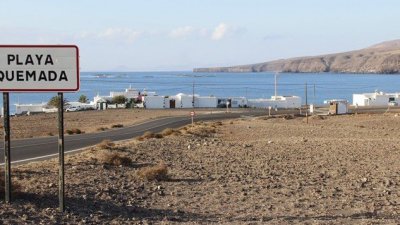
Ecologistas en Acción has awarded this year's 'Black Flag' in the Canary Islands to Playa Quemada, in the municipality of Yaiza, together with the beach of Canto del Barranco, in Garachico (Tenerife) and the Oliva Beach hotel complex, in Fuerteventura. This is reflected in the 'Black Flags 2021' report, which analyzes the nearly 8,000 kilometers of the Spanish coastline and has considered those cases most characteristic of pollution and poor environmental management.
Since 2015, when the number of flags was standardized to 48, the organization has awarded a total of 332 black flags. Of these, 75% of the complaints correspond to four specific reasons: spills and lack of sanitation, urban development, industrial activities and ports and cruises.
However, the coordinator of the Ecologistas en Acción report, Clara Megías, has stated that this number of annual flags "could be much higher, since only the most serious cases have been selected, two per province".
In the case of Playa Quemada, the report points out that "the activity of the company Piscifactorías Atlántico has been causing organic pollution since 2011 due to the industrial cultivation of sea bass and sea bream, with its expansion planned along the coast in areas between Costa Teguise and Playa Blanca". The expansion of these new aquaculture areas, contemplated in a document of the Government of the Canary Islands initiated under the mandate of CC, has already been rejected by both the town councils and the Cabildo of Lanzarote.
From the ecologist association they denounce that the Regional Plan of Ordination of the Aquaculture (PROAC) "does not take into account the zones like the Natural Monument of Los Ajaches and its Zone of Special Protection for the Birds (ZEPA), where due to its proximity a multitude of birds trapped in the cages have been documented". In addition, it warns that "it overlaps its occupation with areas of special conservation zone (ZEC): Sebadales de Guasimeta and Cagafrecho, where by law it is recommended to avoid fishing, anchoring or any other activity that could degrade the fauna and flora".
In turn, it adds that "some ZEC areas overlap with Sites of Community Importance (LIC) such as the marine area east and south of Lanzarote-Fuerteventura, areas of high biodiversity, habitats or unique communities of Sebadales, transit of turtles and cetaceans; reasons why the PROAC has been denounced by numerous groups of citizens, town councils and fishermen's associations of Lanzarote".
Other black flags in the Canary Islands
Regarding the Tenerife beach of Canto del Barranco, Ecologistas en Acción denounces that "since before 2001 there has been knowledge of a dangerous spill on this beach caused by the obsolete and inefficient treatment plant (EDAR) existing in Barranco Hondo, which severely affects the ecosystem of the channel and the marine environment, in addition to the health of the communities of neighbors who live near the area". According to the ecologist organization, "this irresponsibility has led to the payment of significant fines for polluting the marine environment".
The ecologists explain that from 2017 the Plataforma Los Silos-Isla Baja leads the fight against this spill by putting pressure on local corporations, but regrets that the City Council of Garachico "does not show a real interest in solving the problem in situ and, on the other hand, the solution proposed by the CIATF is to transfer the spill to the municipality of Los Silos through a marine outfall that does not comply with the law and where the increasingly scarce Canary Island clam (Haliotis tuberculata coccinea) lives, considered in the Catalog of Protected Species of the Canary Islands".
As for the Oliva Beach hotel complex of the Riu family, it obtains the 'Black Flag' for the second consecutive year in Fuerteventura for poor environmental management. "In all these years of exploitation, its wastewater outfall remains in poor condition and discharging pollutants in one of the most important places of Red Natura, the sebadales of Corralejo, underwater forests, declared a Special Area of Marine Conservation, and key points for biodiversity. Fundamental underwater forests and gardens that absorb CO2 and curb climate change", says the association.
In this regard, it argues that "in times of high occupancy you can see the spill, even the toilet paper and excrement pushed by the current towards the beaches of the Natural Park of the Dunes." Also, the organization accuses Riu of "simulating before the public opinion the restoration of the building due to poor condition of the hotel, when really what is proposed is a modification of the volume and major reforms, moving the pool site and increasing the number of apartments, among other actions, which are incompatible with the Law of Coasts".
Ben Magec-Ecologistas en Acción warns about the annual increase of the deterioration suffered by the coastline due to the effect of human action (anthropic) in the archipelago. Therefore, they urge all public administrations "to take urgent measures to reverse the situation and take seriously the high vulnerability of the Canarian biodiversity, knowing the high exposure to adverse meteorological phenomena to which climate change exposes us".


Add La Voz de Lanzarote as a preferred Google source.
Stay informed with the latest current news.