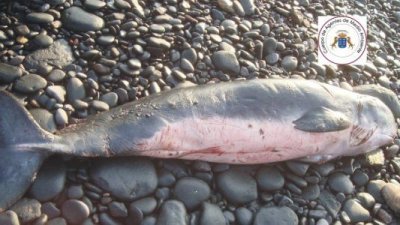
The body of environmental agents of the Cabildo de Fuerteventura has proceeded to remove during the morning of this Tuesday the corpse of a pygmy sperm whale, located at the mouth of the Barranco de La Torre, on the coast of Antigua. This new finding occurs three weeks after another specimen of the same species appeared on the beach of Costa Calma.
Given its small size -the sperm whale measured 1.76 meters long and less than 200 kilograms in weight- the corpse corresponds to that of a young specimen, according to agents. After being transferred to the Biological Station of La Oliva, the corpse remains in the cold room of these facilities managed by the Cabildo de Fuerteventura, awaiting the scientific team of the University Institute of Animal Health and Food Safety (IUSA), which will be responsible for performing the necropsy.
This same team, led by the professor of the Faculty of Veterinary Medicine of the University of Las Palmas de Gran Canaria (ULPGC), Antonio Fernández, took charge of the analysis of the previous sperm whale that appeared in Costa Calma. In a preliminary report on the stranding that occurred on November 20, the Institute determined that the animal "suffered from a serious chronic disease of the central nervous system", which they interpreted as "the main cause of the stranding".
"Great concern" to coincide with the surveys
For its part, the Minister of Environment of the Cabildo majorero, Natalia Évora, has stated that the appearance of this new corpse of cetacean "undoubtedly causes great concern", since it has been found "on the east coast of Fuerteventura, just in front of where the oil surveys are being carried out".
As in the previous case, from the Cabildo majorero emphasize that the corpse showed no external signs, "which rules out collision with boats or propellers as the cause of death." In any case, they clarify that for the moment it is not "possible to determine a direct relationship between both facts (the death of the animal and the oil surveys that Repsol is carrying out off these coasts), until the necessary scientific analyzes are carried out".
Cetacean strandings in the Canary Islands occur more frequently during the spring, coinciding with the time of greatest activity of the different species in the area.


Add La Voz de Lanzarote as a preferred Google source.
Stay informed with the latest current news.