
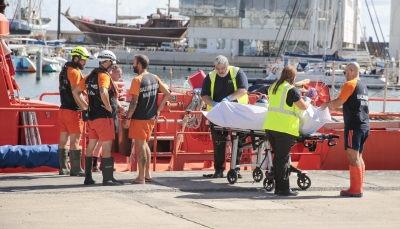
The investigation Monitoring Right to Life 2024 by the non-governmental organization Caminando Fronteras has highlighted "good practices" in the judicial police of the Civil Guard of Costa Teguise, in Lanzarote, and in the Command of El Hierro when facilitating family members' access to the identification of dead and missing persons on the migratory route to the Canary Islands.
This year 2024 has become the deadliest for migrants who have embarked on a journey in a small boat, inflatable boat or canoe to the coasts of the Canary Islands. In total, 9,757 people have died or disappeared, according to Caminando Fronteras, in the journey between Morocco, Western Sahara, Mauritania, Senegal and Gambia to the archipelago. These people came from different countries, many plagued by poverty or armed conflicts such as Mali, Ivory Coast, Burkina Faso, Somalia, Syria or Sierra Leone. In addition, people from Asian countries such as Bangladesh or Pakistan have also arrived. Despite this, the lack of official means to locate people who have disappeared or died in boats that capsize on European borders leads families to experience "revictimisation".
Caminando Fronteras highlights "the complexities and institutional barriers" faced by families trying to find the bodies of their loved ones. Thus, this report states that there are "dead and missing persons of the second class" and that the families of the victims are "crossed by institutional racism" when looking for answers. In contrast, it points to "advances in the filing of complaints" and good practices in the judicial police of Costa Teguise.
The identification of corpses of missing persons, such as those followed by La Voz, arises from a search between nations. In most cases, this NGO identifies that the documentation necessary to identify the deceased "is in other countries", so the work of the consulates in the countries of origin is crucial.
In addition, it argues that DNA testing is "a tool to protect the rights of victims and families", although it states that "systematically" the Ministry of Foreign Affairs "denies the performance of these tests and puts all possible obstacles" to not attend to families.


