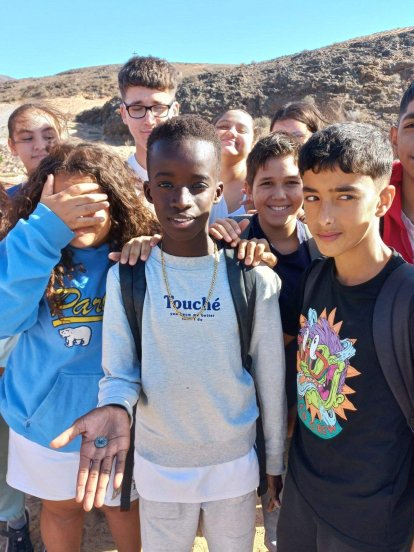
A second-year ESO student from CEO Playa Blanca found an old coin last Wednesday, November 8, at the archaeological site of San Marcial de Rubicón, located in the municipality of Yaiza. This space is the subject of scientific research following an agreement signed by the Directorate of Cultural Heritage of the Government of the Canary Islands, the Yaiza City Council and the two public universities of the Canary Islands. In mid-October of this year, the fourth phase of exploration of the first Franco-Norman settlement in the Canary Islands was completed, where the first contacts between European settlers and the native Canary population in the 15th century are reflected.
The chance discovery of this tiny coin occurred while a group of students from CEO Playa Blanca participated in a guided tour of the site. This excursion is part of the extracurricular activities program Environmental workshops for the citizens of the municipality of Yaiza, promoted by the City Council in schools to promote knowledge of the southern cultural, landscape and environmental heritage among the youngest, a program whose execution is in charge of Senderismo Lanzarote.
The mayor of Yaiza, Óscar Noda, values "the gesture of responsibility of the student, Senderismo Lanzarote and the educational center in immediately communicating the discovery and handing over the coin to enable its numismatic study." In no case was the discovery the product of an excavation, the coin was collected from the surface being semi-hidden by the jable.
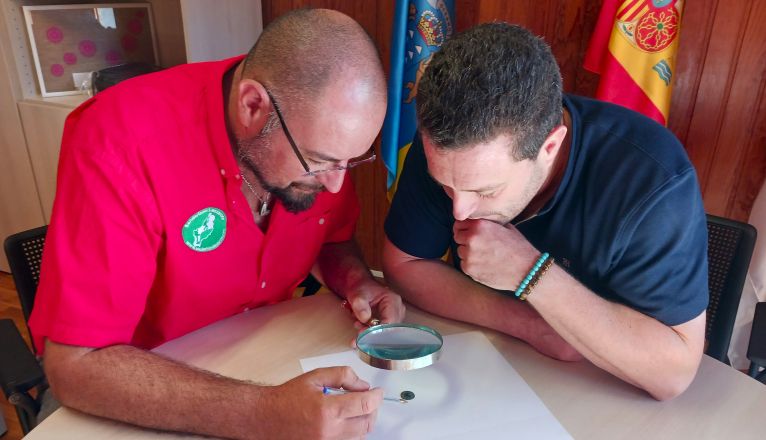
The director of Senderismo Lanzarote, Ignacio Romero, formally handed over the public domain asset to the City Council for its custody, which, according to the Councilor for Heritage of Yaiza, Silvia Santana, remains awaiting instructions from the Canarian Government. The discovery was communicated on the same day by its discoverers to the Cabildo de Lanzarote and the Yaiza City Council, which in turn reported the fact to the Directorate of Cultural Heritage of the Government of the Canary Islands, the area responsible for resolving the destination of the coin.
Valuable findings
The research at the site led by archaeologists Esther Chávez (ULL) and María del Cristo González (ULPG) is progressing with significant results. The fourth phase that has just culminated leaves the discovery of bone remains of ten human bodies, six adults and four minors, whose laboratory analyzes date between 1408 and 1445, apart from the investigative monitoring of the defensive and habitat structures and archaeological pieces discovered in previous excavations.
At the end of 2021, a total of nine coins were found, a "unprecedented" discovery as they are the oldest monetary elements discovered in an archaeological context in Lanzarote. Due to the previous treatment, it is expected that the work with this new coin will consist of its cleaning and consolidation by Patricia Prieto, restorer of the Museum and Archaeological Park Cueva Pintada of Gran Canaria, to then proceed to its study in the laboratory.
The foreseeable objective is to confirm if, as in eight of the first nine coins found, this one also has a countermark that represents a Gothic letter 'B' as proof that it is also a coin attributable to the coins of Enrique II or Enrique III, called "crowned dinars". Historical documentation determines that the king granted the conqueror Jean de Bethencourt the power to mint coins, so if it is confirmed that this new piece found has the 'B' it would be one of the coins minted by Bethencourt with the authorization of the royalty.
PD: we send a photo of the CEO group at the site, where the student who found the coin appears in the foreground, and another image of the delivery of the coin to Óscar Noda, mayor of Yaiza, by the head of Senderismo Lanzarote, Ignacio Romero.

Add La Voz de Lanzarote as a preferred Google source.
Stay informed with the latest current news.