
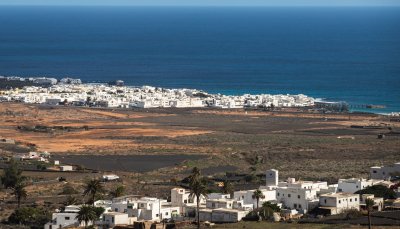
Lanzarote and the rest of the Canary Islands are characterized by having a strong aboriginal identity that we can appreciate in different aspects such as the toponymy of the islands. This heritage of the ancient inhabitants of the Canary Islands is reflected in the names of the towns, whose origin predates the Castilian conquest of the archipelago, which began in 1402 and ended in 1496.
Towns like Tahíche, Yaiza or Tinajo are some of the examples that owe their origin to the majos, the Canarian aborigines, terms that reflect the cultural and historical richness of the Canary Islands.
In the case of Tahíche, its origin is aboriginal and, according to Toponimia de Lanzarote, the intercalated h it carries is preserved to this day due to the pronunciation made by the oldest people in the town (Taxíche).
Yaiza is one of the most widespread names regionally, not only as the name of a town, but as a given name. Its origin is also aboriginal and is related to the legend of Princess Yaiza, the daughter of a Majo king who ruled Lanzarote and possessed great beauty. However, various experts point out that this theory is not entirely reliable because there are no sources to accredit it. Other experts attribute its origin to Castilian, specifically to the Riojan words yasa (overflow) or yaza (to hunt).
Returning to the charming past of Lanzarote we find Tao. This town in the interior of Lanzarote also has a pre-colonial origin and can be translated as 'fortress'. According to Toponymy of Lanzarote, it appears in all the historical records of the island, although varying in its spelling as 'Taor'.
A few kilometers from Tao is Tinajo, whose origin is aboriginal, something that is revealed by its beginning 'tin', characteristic of the Berber language. Despite this, some experts attribute its name to Castilian because of the 'tinaja', a small cistern. Tinajo is named in historical documents for the first time after the eruptions of Timanfaya.
Another of the Guanche legacies is Teguise, although its origin is also divided into two theories. On the one hand, some point out that the name originates from the word 'Teguse', a Majo king prior to the conquest. However, it is also suggested that Teguise was the name of an aboriginal princess, daughter of Zonzamas, and who was the wife of Maciot, nephew of the Norman who conquered Lanzarote.
Arrieta, Haría and Tías, of Castilian origin
On the other hand, Arrieta is the other side of the coin. Despite what many think, it is not a word of aboriginal origin, but rather comes from the French hidalgo Arriete Preud´homme, governor of Lanzarote and Fuerteventura who arrived on the island in 1402. His surname was Hispanized as Perdomo and he married Margarita de Bethencourt, daughter of Maciot and the Guanche princess Teguise.
For its part, with Tías there are several theories about where its name comes from. On the one hand, some writings record that the town was founded after the eruptions of Timanfaya to relocate the displaced people in 1730. However, the Lanzaroteño writer Agustín de la Hoz assures that it was founded at the end of the 15th century as "a concession from the Governor of Gran Canaria, don Alonso Fajardo, to some aunts of his". For this reason, it is believed that it ended up being called 'Tías de Fajardo', although it is not based on any documentary historical source.
To Haría, located in the north of Lanzarote, a Castilian origin is attributed in the same way. According to the website Historia de Haría, Vicente García de Diego explains in his Spanish and Hispanic etymological dictionary that the name may come from the Latin word 'farina', that is to say, the powder from grinding cereals or legumes, which evolved and which was pronounced differently in different areas of Spain. Specifically, in Basque it was said 'haría'. In the case of Aranese, the language spoken in the Aran Valley of Catalonia, it is also said 'haría'.
Therefore, until now there is no clear explanation for the origin of the name of this northern town, nor is there for many other localities in Lanzarote and the Canary Islands. What is clear is the cultural and historical wealth inherited from the ancient Canarians, which makes the islands a unique oasis of toponyms.


