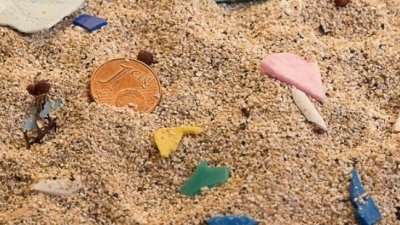
Unesco specialist Sarantuyaa Zandaryaa has highlighted the work of this organization in the fight against plastic and in particular on freshwater microplastic pollution, its impact on biodiversity and ecosystems in general and on the Lanzarote Biosphere Reserve.
Spain is a "very active" representative in the work of water sciences at Unesco, Sarantuyaa Zandaryaa, specialist of the Secretariat of the Intergovernmental Hydrological Program (IHP) of the United Nations Educational, Scientific and Cultural Organization, told EFE.
She makes these statements before the start of the United Nations Environment Program (UNEP) Conference on Plastics this Monday in Paris.
Sarantuyaa Zandaryaa, an expert in the Division of Water Sciences and the study of plastics and microplastics, has highlighted the work of the Director General of Water, Manuel Menéndez Prieto, who serves as Vice-President for Western Europe and North America on the Intergovernmental Council of the Intergovernmental Hydrological Program (IHP) of Unesco.
In addition, she stressed that Spain supports (with funding) Unesco's work on the Capacity Development Initiative within the framework of the Global Acceleration Framework for Sustainable Development Goal 6 "Clean Water and Sanitation", whose objective is to support the development of institutional and human capacities to provide water and sanitation-related services with special attention to education and training.
In relation to the fight against plastic, the central theme of the meeting that begins in Paris to achieve an international treaty, Zandaryaa highlighted Unesco's work and priorities on plastic pollution, in particular on freshwater microplastic pollution, its impact on biodiversity and ecosystems in general and on the Lanzarote Biosphere Reserve.
The announcement coincides with the 30th anniversary of the designation of Biosphere Reserve in 1993, together with Menorca.
The Unesco expert highlighted "the special characteristics of the volcanic island of the Canary Islands", designated as a biosphere reserve for being a territory where the conservation of biological and cultural diversity and economic and social development through the relationship of people with nature has been "harmonized" for years.
She assured that "there is little research on the monitoring of microplastics anywhere on the planet, but there is no research on the monitoring of microplastics in the Lanzarote ecosystem", and recalled that these small particles are found throughout the food chain, and, therefore, affects all beings, and ends up in food.
She highlights the "very specific" example of the Lanzarote Biosphere Reserve where there is "a unique ecosystem, with species of very high value and more than twenty of them endemic".
According to the work of the Intergovernmental Science-Policy Platform on Biodiversity and Ecosystem Services (IPBES), she recalls, pollution is one of the five main causes, the driver of biodiversity loss and ecosystem degradation.
Microplastic pollution "is one of them", stresses Sarantuyaa Zandaryaa, adding that only species that "are tolerant to certain pollutants will remain".
She highlights that according to new scientific evidence and findings from research supported by the LimnoPlast project, associated with Unesco, on "Microplastics in the fresh water of Europe" in which ten universities and more than 10 associated organizations in Europe are working, which was presented at a conference in March 2023, new data from this research and others carried out in India and Japan have been known.
Among other conclusions, she highlights that freshwater microplastic pollution is "an important source of marine microplastic pollution. Rivers carry enormous amounts of microplastics and plastics to the ocean".
In addition, microplastics, which are not biodegradable, "affect the reproduction and growth of aquatic organisms".
Also, plastics are not only made of polymers, but also "contain chemical additives that are toxic" and are endocrine disruptors, which mimic natural hormones and affect hormonal functions in humans and other organisms.
All this is "a threat to fragile or uniquely valuable ecosystems such as that of Lanzarote" and other areas on the planet.
Therefore, she stresses, it is "really necessary" to investigate to learn more about the presence of microplastics in water, soil, coastal areas or the sea, in ecosystems and "how they can affect different species" in ecosystems as a whole.
She explains that UNESCO is promoting research, awareness, scientific awareness on this issue, "because when we have scientific knowledge and research, then we can identify the sources of the problem and possible solutions".


Add La Voz de Lanzarote as a preferred Google source.
Stay informed with the latest current news.