
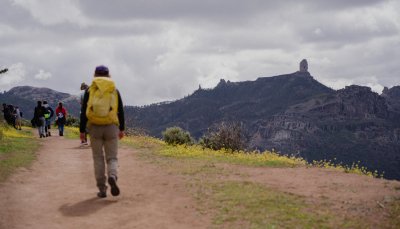
The Contramapas project, by the Atlas Cultural and Environmental Association, returns in 2026 with a new journey that, from April 30 to May 30 - Canary Islands Day -, will once again unite the archipelago on foot from La Graciosa to the Faro de Orchilla, in El Hierro. It will do so following the route of the Canary Islands Long Distance Path GR 131, almost 600 kilometers that cross the Archipelago and that, in this edition, become something more than a path: a living classroom to learn, share, and rediscover the territory.
In this third edition of Contramapas, students from eight secondary schools, one per island, will participate, integrating into an experience that unites education, nature, and community. In Lanzarote and La Graciosa, they will be the IES Teguise and the CEO Ignacio Aldecoa, respectively.
That student presence is not accidental. It is the natural continuation of Aula GR131: Paths that connect, an initiative promoted with the support of the General Directorate of Educational Planning, Inclusion and Educational Innovation of the Government of the Canary Islands, which has been sowing a different way of looking at the territory for months. Through workshops, talks, and shared experiences, the girls and boys have been able to approach the GR131 not only as a path, but as an educational resource of enormous value, capable of connecting history, landscape, culture, and daily life.
The proposal starts from a simple but powerful idea: to turn the territory into a classroom and walking into a methodology, fostering experiential learning, collective work, and the construction of a shared identity from direct knowledge of the environment.
In 2026, the Atlas Association will thus complete its third journey along this axis that structures the Canary Islands, consolidating a project that has been growing with each edition. If the
first year was focused on culture and the second on social inclusion, this third edition places education at the center of the adventure. A natural evolution that reinforces
the profound meaning of Contramapas: walking to understand. Valuing the territory, but also the relationships that inhabit it, the knowledge that sustains it, and the challenges that
cross it.
Physical activity becomes, in this way, a tool to disseminate environmental, social, cultural, and ethnographic values, bringing knowledge closer through experience.
The route will once again draw a continuous line between islands, with a journey structured around about thirty stages that will unfold over a
month. From the start this Thursday in La Graciosa, the team will cross Lanzarote, Fuerteventura, Gran Canaria, Tenerife, La Gomera, and La Palma, until reaching El Hierro on May 30 - with a powerful cultural closing event on the 31st -, completing an itinerary that connects peaks, midlands, and coasts.
Each island will be traversed through several days of walking, ascending to the highest points of each territory and crossing natural spaces, historical paths, and enclaves full of identity. It is not just about moving forward, but about stopping: at each stage there will be encounters, activities, and moments of exchange with the students and with the local communities, thus building a collective narrative that goes far beyond the map.
At the head of the project is Manuel Cabezudo, who leads a multidisciplinary team made up of Elena Carbó (coordination), Pedro Padilla (mountain guide), Laura Purroy (logistics), Judith Negrín (environmental outreach), and Lucas Ramírez, a 17-year-old student invited to complete the entire journey. A group that combines experience, knowledge, and sensitivity to shape an initiative that is, at the same time, physically very demanding and profoundly human. "Reaching a third edition is, in itself, a sign that the project makes sense and has a future.
Contramapas has been growing thanks to the support of many entities and people, and that allows us to continue advancing in the defense of the values we aim to transmit. The GR131 is an extraordinary resource, still little known by a large part of the population, and it has enormous potential as an educational tool and as a space to understand the reality of the Canary Islands,” explains Cabezudo. “Our goal is for people to feel it as their own, to walk it, to know it, and to live it,” he concludes.
As a novelty, this edition will allow you to follow the walk in real time. Through a link, which can be found on the Contramapas Instagram account, anyone
will be able to know the exact location of the Contramapas team at all times, 24 hours a day, making it possible to follow the journey from a distance and feel part of the tour.
Contramapas has the backing of public institutions and private entities that make this project possible, consolidating a network of support that reinforces its regional dimension.
Government of the Canary Islands, Ministry of Social Welfare of the Cabildo of Lanzarote, Area of Natural Environment, Sustainability, Security and Emergencies of the Cabildo of Tenerife, Ministry of Social Welfare of the Cabildo of La Palma, Ministry of Social Welfare of the Cabildo of El Hierro, City Council of El Pinar de El Hierro, Casa África, LPGC 2031, UD Las Palmas Foundation, Fred Olsen Express, Xtravans, Bull Timing and Líneas Romero Foundation, along with collaborating entities such as Meraki, Transpirenaica Social y Solidaria or Urmuga, are part of a project that continues to grow step by step.


