The installation of renewable energies as an alternative to the burning of fossil fuels is the order of the day. At the same time, as solar panel fields grow and wind turbines are erected, the population of regions such as the Canary Islands or Galicia demand green growth in accordance with environmental preservation.
The visual and landscape impact produced by windmills and solar panels has generated debate in Lanzarote for years and divides institutions on how to advance in the fight against climate change without sacrificing its landscape.
Lanzarote has been the first Canary Island to agree with the regional government on the declaration of Renewable Energy Acceleration Zones (ZAR), a measure of the Canary Islands Executive to promote the installation of solar and wind energy in the archipelago. For the moment, its approval opens the door to introducing the first and controversial fields of photovoltaic plants in Lanzarote soils, as well as installing new wind farms.
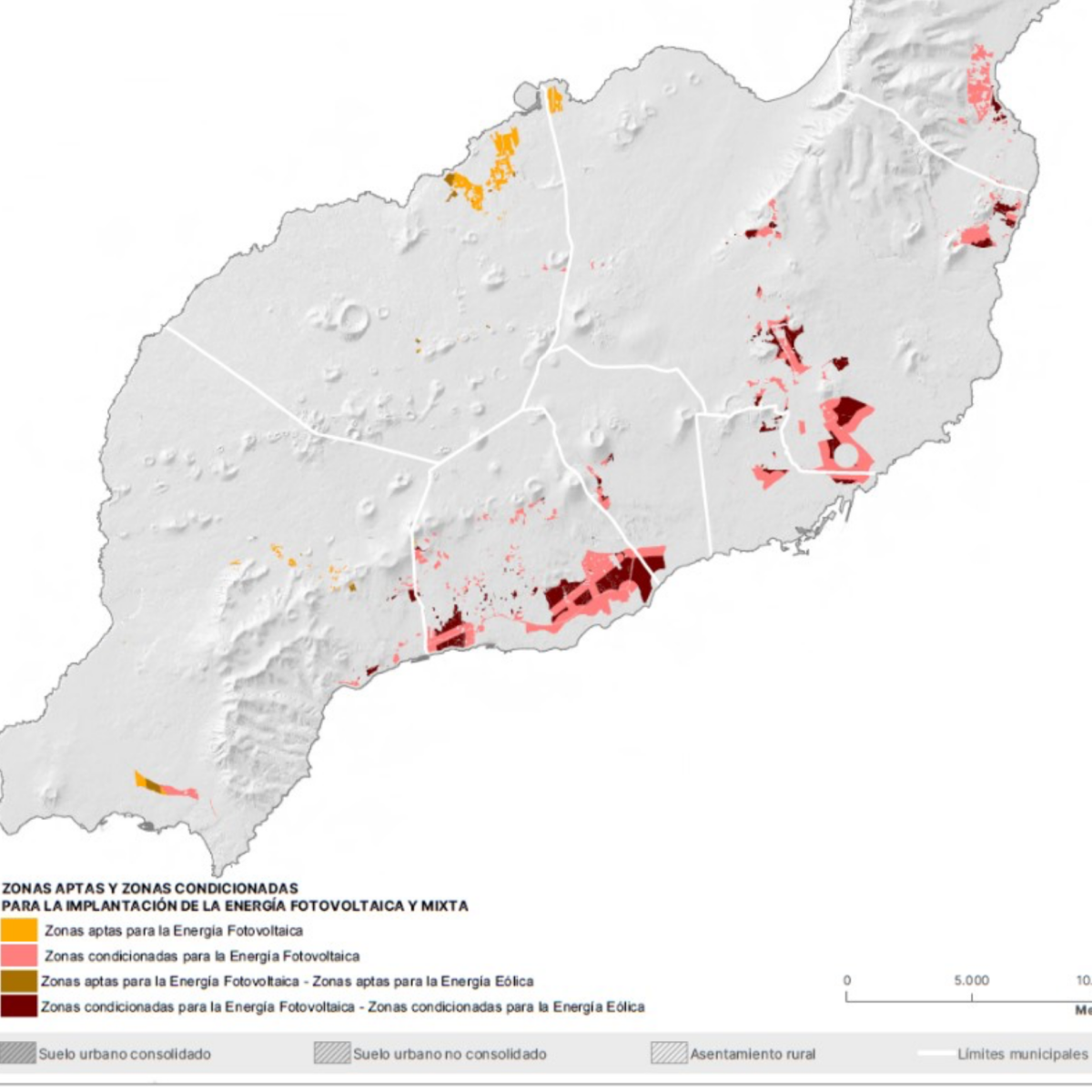
In a resolution published at the end of August, the Minister of Ecological Transition and Energy, Mariano Zapata (PP), and the president of the Cabildo of Lanzarote, Oswaldo Betancort (CC), have agreed on which spaces on the island can host this type of energy facilities and which could do so if certain conditions are met.
More than 3,100 hectares of the island, that is, 3.75% of its territory, may host wind and photovoltaic projects. However, the institution estimates that with 0.23% of the island's territory, the decarbonization objectives of the 2030 agenda would already be achieved.
Suitable areas for renewables
The project has defined two types of zones: one where the installation of renewables is suitable and another where it is conditional. The latter must first review incompatibilities in aspects of Agriculture, Biodiversity or aeronautical easements, among others, in order to become suitable.
Sources from the Ministry of Ecological Transition of the Government of the Canary Islands and the Cabildo of Lanzarote have confirmed to La Voz that these projects would be developed on the ground and not on roofs or roofs. In this way, the Executives led by Coalición Canaria and the Partido Popular, clash with the criteria of the PSOE of Lanzarote, which advocates exhausting the roofs of already built spaces so as not to consume more territory.
According to Ecological Transition, the areas exclude spaces included within the Natura 2000 Network, Sites of Community Interest, protected natural spaces and takes into account criteria of incompatibility with municipal and sectorial planning. However, they do contemplate their installation on rustic land, on non-cultivable surfaces and that do not present other incompatibilities with the law.
The idea of these Renewable Energy Acceleration Zones (ZAR) is to "facilitate promoters" the identification of suitable locations and speed up their installation, according to the aforementioned resolution.
These proposed areas must go through an administrative procedure that determines the final delimitation and present an environmental assessment.
Yaiza and Tinajo: green light for solar and wind
In the published maps, the areas of the island that are already suitable for installing wind and photovoltaic farms are Tinajo and Yaiza. However, the resolution has identified potential locations in all the municipalities of the island to install solar panels and wind turbines.
In the case of wind energy, the municipality of Yaiza has classified as suitable areas the surroundings of the town of Playa Blanca, also between the towns of Yaiza and La Degollada, the town of Las Casitas and a small strip in El Hoyo. Meanwhile, in Tinajo, they see viable the installation of windmills in Tinguatón, La Vegueta, the town of Tinajo and in the surroundings of the towns of El Cuchillo and La Santa, with part of the forecast also affecting the municipality of Teguise.
As for solar energy, the agreement includes in Yaiza a wide section in Playa Blanca, another in Las Breñas, La Hoya, the area of the mountain of En Medio, between La Degollada and the town of Yaiza, as well as another space between Las Casitas and Uga. In the municipality of Teguise, the installation of solar panels is also suitable in the town of Caleta Caballo and in the town of Muñique.
Thus, in the municipality of Tinajo, it is possible to install solar fields in the surroundings of the town of La Santa, in that of Tinguatón and in La Vegueta, as well as between the towns of Tinajo, Tajaste and La Costa.
Thousands of square meters planned throughout the island
In addition to the areas suitable for installing photovoltaic and wind power, this agreement also provides for thousands of square meters of solar panels that could be installed in Haría, Teguise, Arrecife and Tías, conditioned to the approval of different aspects in relation to agriculture, the environment and other types of conditions.
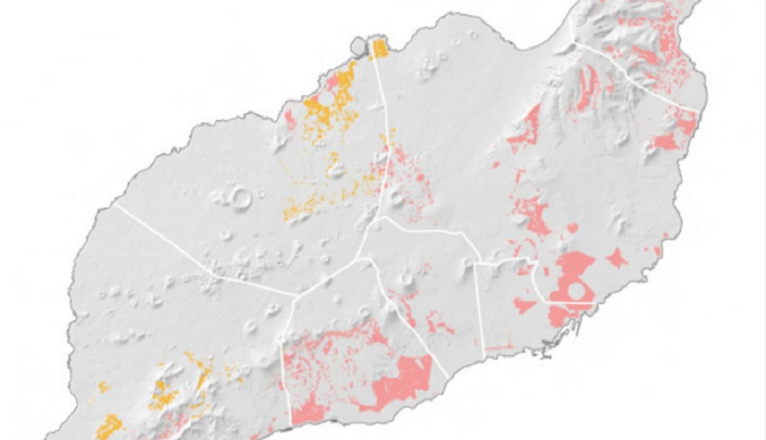
In municipalities such as Teguise and Haría, this resolution contemplates mixed installations to the north of Costa Teguise, Tahíche, in the surroundings of Nazaret and in the area of La Montaña, near La Villa de Teguise. In addition to near the towns of Guatiza, Los Cocoteros and Charco del Palo. It also considers wind and photovoltaic installations in the town of Arrieta and in the surroundings of Tabayesco.
In addition, the project contemplates installations in the surroundings of Zonzamas and in the Argana Alta neighborhood, in Arrecife. In addition to Playa Honda and Güime, in the municipality of San Bartolomé.
Tías, against converting the land into solar panel fields
The municipality of Tías is one of the most coveted for the installation of green energies. The City Council, led by the PSOE and Unidas Podemos, has recently opposed on two occasions the installation of photovoltaic panels promoted by private companies in Mácher. One of them proposed to install 7,000 panels and a second, another 1,680.
Despite the fact that the Cabildo of Lanzarote and the Government of the Canary Islands assured that the signing of this agreement was made with the connivance of the municipal institutions, the mayor of Tías, José Juan Cruz Saavedra (PSOE), has denounced in the morning program of Radio Lanzarote-Onda Cero that they have not counted on them and that they only discovered the areas affected by the publication in the Official Gazette of the Canary Islands.
"We live on the image, the landscape, we are a tourist island, a tourist municipality and what we say is that coverage should first be given to roofs and degraded areas that do not impact," he continued.
In the case of Tías, the resolution contemplates large mixed areas, where solar and wind will converge. In this sense, it contemplates land occupations in the surroundings of Puerto del Carmen and Puerto Calero. In addition, there are plots in the towns of Mácher, La Asomada and Conil.
"The town councils will have to say something and we are not going to allow them to sow all the territory of rustic land, in the surroundings of the Mácher substation, with solar panels," Cruz said, visibly annoyed. Tías has announced that they will put in the hands of the municipal legal services to appeal this agreement.



Add La Voz de Lanzarote as a preferred Google source.
Stay informed with the latest current news.