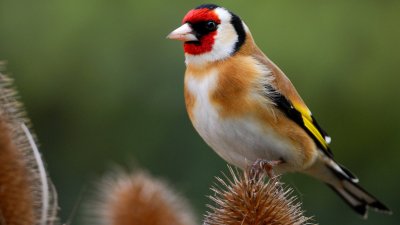
The vote for Bird of the Year, which was open to the public, has declared the European goldfinch the winner, a species that, despite not being endangered, represents a very complete range of different nature conservation problems, from agricultural and urban models to illegal trapping.
This bird inhabits widely in the peninsula, as well as in the Canary Islands. In Lanzarote, we can find the European goldfinch in the northern part of the island, where it is a resident all year round.
The European goldfinch, one of the most well-known and beloved birds in the Iberian avifauna, has been chosen this year after society and nature enthusiasts participated in the election between the three candidates proposed by SEO/BirdLife: the European goldfinch, the common skylark, and the European shag.
To date, 36 species have received this distinction with the aim of raising awareness about their population decline or because their habitats present relevant threats to their conservation. And this year, the European goldfinch is proclaimed Bird of the Year as a citizen response to give a voice to common birds and defend fields and cities with more biodiversity.
Following an open and participatory voting process that received a total of 11,515 votes, one of the most participated editions, the European Goldfinch has been chosen as Bird of the Year 2026 with 6,519 votes (56.61%). The European Shag came in second place with 2,524 votes (21.92%), followed by the Common Skylark with 2,472 votes (21.47%).
The red-faced bird, a link between the countryside and the city
With its striking plumage—a red mask on its head, black wings with yellow bands, and a brown back—and its varied song, the goldfinch is easily recognizable and highly appreciated by the general public. It is an abundant species with a wide distribution in Spain, present in practically the entire territory—including the Canary and Balearic Islands—and with a national population estimated at around 14-15 million individuals.
Despite its good population status —classified as Least Concern on the European Red List of Birds—, the European goldfinch faces significant threats derived from human activities: illegal capture for trade and captive keeping, and the effects of excessive pesticide and herbicide use in agricultural systems, lead to substantial losses of individuals each season.
The Bird of the Year 2026 campaign aims to raise awareness of these threats and highlight the importance of conserving biodiversity in agricultural landscapes, spaces where the goldfinch spends a large part of its life cycle. As a representative species of open and multifunctional environments—including olive groves, dehesas, pastures with trees, and agricultural margins—its selection offers a valuable opportunity to foster a dialogue about agricultural models that are more respectful of nature.
But furthermore, the European goldfinch is very common in towns and cities; therefore, it will also allow us to **draw attention to the need to re-green cities** and implement less intensive gardening schemes.
Actions proposed by SEO/BirdLife
During 2026, SEO/BirdLife will carry out communication, education, advocacy, and conservation activities focused on the European goldfinch, with the aim of **raising awareness among institutions, administrations, and citizens** about the need to protect this emblematic bird (it is only protected in Aragon and La Rioja) and to maintain the habitats that sustain it, as well as to contribute to improving agricultural practices, urban models, and conservation policies.
In this line of work, SEO/BirdLife maintains projects such as Iberian Agro-steppes and the Living Fields model, which advocates for the recovery of biodiversity in agroecosystems such as olive groves, cereals, and vineyards, as well as in hazelnut and chestnut groves. This translates into added value and market differentiation, benefiting species like the European goldfinch. The NGO argues that agriculture and biodiversity can go hand in hand, confirming that the ecological transition is not a hindrance but an opportunity for the countryside, for health, and for the rural economy, and that producing with biodiversity means producing better, for people and for the territory.
Furthermore, the NGO will continue its work to promote urban biodiversity, focusing on a city model based on natural solutions, capable of improving health, habitability, and urban resilience. It will continue with actions aimed at improving the reduction in mowing frequency, which favors the availability of food in the form of herbaceous plant seeds. Or the sowing of flowery spaces with native seed mixes, also widely used by goldfinches in late summer. With adequate management, urban plots and marginal spaces could also be a habitat of interest for this and other finches.
Likewise, SEO/BirdLife will insist that the deregulation process proposed by the European Commission does not threaten the progress made over the years thanks to the European Green Deal's "Farm to Fork" strategy, which promoted the reduction of dangerous pesticides, the prohibition of their use in sensitive areas, and the implementation of sustainable agricultural practices such as organic farming, crop rotation, biological control, and regenerative and precision agriculture.


Add La Voz de Lanzarote as a preferred Google source.
Stay informed with the latest current news.