Each year, four kilometers of natural coastline are lost in the Canary Islands due to the construction of ports, hotels, tourist centers, and their associated infrastructure. Lanzarote is the island that has adapted worst to the Coastal Law, despite having had 38 years to do so.
The island of volcanoes has only determined 81.36% of its maritime-terrestrial public domain, almost thirteen points below the regional average, and has delimited 86.73% of its public servitude, which prevents construction in the hundred meters adjacent to the public domain, 8.4 points below the Canarian average. A study concludes that the biggest gaps in adapting the law occur "at the exact points where the hotel industry has the greatest interest".
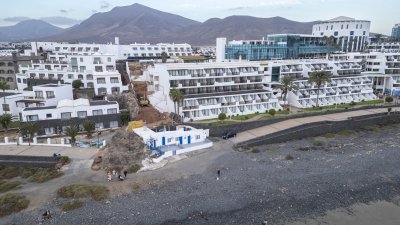
The worst adapted municipality is Yaiza, with 20 pending kilometers. The tourist town of Playa Blanca came to be the piece of Spanish coast with most illegal hotels.
The research promoted by the Foundation for Nature and the Environment Canarina and elaborated by the Observatory of Sustainability has brought to the table an exhaustive analysis of the reality of the Canary coast, comparing and crossing public data to explain the reality of the archipelago. "The coast is the one suffering the most environmental pressure," the general director of the Canarina Foundation, Anne Striewe, a graduate in Biological Sciences and an expert in Environmental Management, told La Voz.
Lanzarote, "the most serious set of problems in the archipelago"
The conclusions of the investigation warn that Lanzarote has "the most serious set of problems in the archipelago" due to tourist complexes occupying public maritime-terrestrial domain areas and public easements.
For example, in Yaiza they point out the case of the Cala Lanzarote Suites resort, which states that it occupies six square kilometers of public easement, the Hotel Volcán, which "does not even have the easement delineated" and the Sandos Papagayo, which in addition to being illegal was built more than a decade after the Coastal Law, with a 20-meter easement. In fact, the definitive demarcation by Costas in Playa Blanca leaves practically all of the formerly called Papagayo Arena within the new easement.
The investigation not only delves into Yaiza's case, but also exposes that, in Tías, public servitude "has 20 meters or less in more than nine kilometers of coastline". Among them, it assures that the Hotel Las Costas "occupies more than two hectares of public maritime-terrestrial domain". Meanwhile, it adds the case of the Hotel Sands Beach in Costa Teguise, and indicates that "it introduces its swimming pools within the public maritime-terrestrial domain, occupying more than one hectare of state-owned land, at a point where the servitude is not even delineated".
Lanzarote, the second island with the most tourists per inhabitant
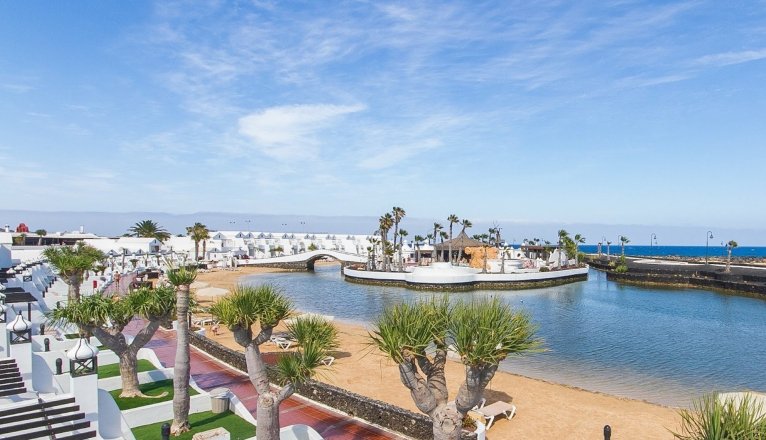
One of the values that the research considers is the degree of touristification of each island, which arises from the relationship between the accommodation places available in hotels and vacation homes and the resident population. According to this scale, Lanzarote has the second highest touristification rate in the Canary Islands, only behind Fuerteventura. In figures, the island offers forty tourist accommodation places for every one hundred inhabitants.
There are even municipalities on the island where there are more accommodation places for tourists than registered inhabitants, as happens in Yaiza, where there are 145 accommodation places for every one hundred inhabitants. The southern town is alongside Pájara, Mogán, San Bartolomé de Tirajana, and Adeje in the Canary Islands towns where touristification is greater than 100%.
The municipality of Yaiza is not only the one that has adapted worst to the Coastal Law, nor the one that presents the worst index of touristification, it is also the one that has its coastline most artificialized. The study exposes that in the town, outside of protected areas, "practically all available land is artificialized".
The closer to a beach, the more tourist pressure
At the same time, the research exposes that the closer a beach is, the greater the percentage of artificialization of its surroundings. In the case of Lanzarote, one third of the territory located one hundred meters from the beaches is artificialized. Despite this index being high, it is worse in the capital islands. In Gran Canaria, for example, it reaches more than half of the territory located at this distance, and in Tenerife, a quarter.
To this reality, the research highlights the influence of "urbanistic and tourist interests" on the drafting of urbanistic plans, whose final approval falls to the city councils. Without counting protected natural spaces, 40.9% of the territory within one kilometer of the coast is urbanized or urbanizable.
The investigation exposes that in Arrecife it is projected to "urbanize all available land" between the LZ-2 and Playa Honda. While in Yaiza, the proposed classification would give the green light to a tourist city of almost 20 square kilometers. Finally, in Tías, it points out that the coast of Puerto del Carmen has been filled, "without leaving non-developable land" between this nucleus and the southern limit of the municipality.
The coast of Lanzarote is also affected by the loss of agricultural land. With tourism development, part of the coastal lands previously cultivated has been abandoned in the archipelago. Compared to the original, in Lanzarote only a quarter of the land that was cultivated before is now cultivated.
Marinas and golf courses
This investigation exposes that from the eight ports available in the Canary Islands in 1950, we have moved to about 60 facilities at present, with capacity for 10,000 moorings and more than 60 kilometers of coastal breakwaters. In this regard, it adds that 70% of these facilities are within or very close to the Natura 2000 Network.
The report commissioned by the Canarina Foundation indicates that coastal breakwaters "permanently alter the sedimentary and morphological dynamics" of the islands, but also that marinas generate "physical occupation of the coast," the displacement of other uses, and coastal pollution. Thus, it indicates that although this situation is more serious in Tenerife and Gran Canaria, in Lanzarote they are located very close to protected areas.
Meanwhile, it delves into the 24 golf courses in the Canary Islands and indicates that they occupy 1,260 hectares of the islands' territory, but also warns that the most critical environmental impact is water consumption (2.1 million liters per day per course).
Buggy rides and rallies in sensitive areas
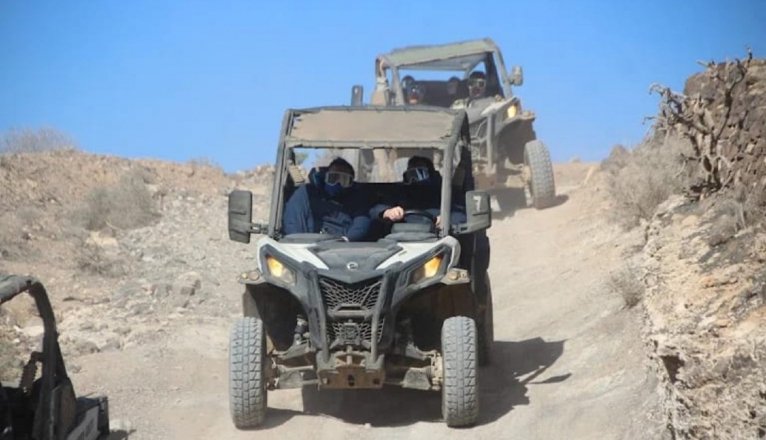
The growth in the recreational use of off-road vehicles in the Canary Islands is undeniable. The study reflects that in 2023 there were already 65,000 all-terrain vehicles in the archipelago and 220,000 motorcycles and mopeds, which include quads and buggies. Of these, it adds that "practically half" are owned by rental companies.
Faced with this reality, it shows that the greatest impacts are soil erosion, destruction of vegetation cover, and soil compaction, as well as massive access to sensitive natural areas. In this way, it points out that regulation is accompanied by "lack of control and surveillance" and, even, "contradictory policies," by mixing sporting events such as rallies in areas of "high environmental sensitivity" in Lanzarote.
The investigation into the reality of the Canary Islands' coasts also delves into wastewater discharges into the sea, the risks of river flooding, from ravines and runoff, as well as marine flooding. The latter shows that Arrecife is one of the most exposed Canary Islands cities to sea-level rise, affecting its only thermal power plant and also its main desalination plant.

Add La Voz de Lanzarote as a preferred Google source.
Stay informed with the latest current news.