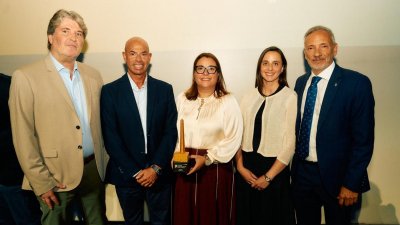
The Canary Islands Technological Institute (ITC), a public company attached to the Ministry of Universities, Science and Innovation of the Government of the Canary Islands, has received the Juan de León y Castillo Award for the DESALRO 2.0® project, a technological solution developed in conjunction with Canary Islands industrial companies that has managed to establish itself as a world benchmark in energy efficiency applied to desalination of seawater.
The 3rd edition of the Juan de León y Castillo Awards, with a total of three mentions and four main awards, was held at the Elder Museum, in Las Palmas de Gran Canaria, in an event presided over by the Minister of Public Works, Housing and Mobility of the Government of the Canary Islands, Pablo Rodríguez.
These Awards, of a biennial nature, aim to recognize outstanding professional careers, projects, and infrastructures in civil engineering that constitute a significant reference in the development of the Canary Islands. The competition, organized by the Ministry of Public Works, Housing and Mobility of the Government of the Canary Islands, in collaboration with the Las Palmas Demarcation of the College of Civil Engineers, honors the figure of the illustrious engineer from Telde, Juan de León y Castillo, a historical reference for the sector.
The executive CEO of ITC, Guayarmina Peña, collected the award, granted to the DESALRO 2.0® project, from the president of the College of Civil Engineers of Las Palmas, Miguel Ángel Carrillo.
A project with Guinness Record
During his speech, Peña highlighted that this recognition values “the engineering that responds to territorial challenges”. In this regard, he recalled that DESALRO 2.0® was born precisely from the challenge of “making seawater desalination more efficient”.
And in the Canary Islands, the water generated constitutes an increasingly critical resource and a basic condition for development; so that optimizing the process to obtain drinking water from the sea means “advancing in sustainability, water security and resilience,” he pointed out. Likewise, he affirmed that DESALRO 2.0® is “innovation developed in the Canary Islands,” the result of years of research, testing, and specialized knowledge from the ITC team, along with close collaboration with local industry, especially with Elmasa and Canaragua.
Peña also recalled that the project has received Guinness World Records certification for achieving the lowest energy consumption recorded in a seawater desalination plant, with 1.794 kilowatt-hours per cubic meter. Added to this international accreditation are recognitions such as the Europa Se Siente 2024 Award, granted by the Ministry of Finance for the best national project executed with European funds in the Water category, and the Honorable Mention for Innovation at the AEDyR Awards 2025, awarded by the Spanish Association of Desalination and Reuse.
The DESALRO 2.0® project has had financing granted by the Government of the Canary Islands, through the Canary Agency for Research, Innovation and Information Society (ACIISI), via REACT funds, within the framework of the Next Generation EU instrument. This support has made it possible to turn years of work into a real infrastructure, located at the ITC facilities in Pozo Izquierdo and linked to the DESAL+ Living Lab platform.
Within the framework of the event, a video was also screened featuring the intervention of the Minister of Universities, Science, Innovation and Culture of the Government of the Canary Islands, Migdalia Machín, who highlighted that “innovation is key to modernizing the economy and strengthening social cohesion”. The minister stressed that the ITC is a strategic tool of the Government of the Canary Islands to provide solutions adapted to the needs of the archipelago, and pointed out that DESALRO 2.0® is an example of technological innovation that combines scientific knowledge and applied engineering, with the collaboration of local companies in the sector.
How does it work exactly?
DESALRO 2.0® materializes in an experimental reverse osmosis desalination plant, designed on an industrial scale, with the capacity to produce 2,500 cubic meters per day of desalinated water. Its design combines optimized hydraulic solutions, high efficiency equipment, advanced energy recovery, and a modular configuration that facilitates its replication and scalability.
This advanced design, with a Canary Islands seal, is already being applied in operating desalination plants and has also been replicated in a dozen containerized systems that are being implemented throughout the archipelago to increase the availability of water for agricultural irrigation, in response to water scarcity.
The plant is part of the infrastructures associated with the DESAL+ Living Lab, a public-private R&D platform aimed at demonstrating advanced solutions in desalination and water reuse in the Canary Islands. This environment allows for testing and validating technology under real conditions, consolidating the archipelago's role as a natural laboratory for the development of solutions in water sustainability and resilience.
With this new recognition, DESALRO 2.0® highlights the role of public R&D, through the ITC, in turning challenges into innovation and knowledge into opportunities. It also demonstrates that the Canary Islands water industry is capable of positioning itself at the forefront of advanced desalination and generating high-impact technological solutions, transferable to other island territories or those with water scarcity.
Do you usually read us to find out what's happening in Lanzarote? Choose La Voz de Lanzarote as one of your preferred sources on Google

Add La Voz de Lanzarote as a preferred Google source.
Stay informed with the latest current news.