
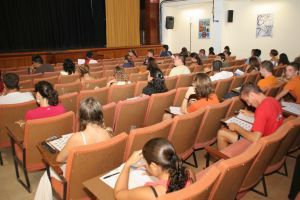
University districts in several autonomous communities have brought forward the dates for the university entrance exams (PAU) of 2026, which would be held on June 2, 3, and 4 for the ordinary session, and on June 30 and July 1 and 2 for the extraordinary session.
Second-year high school students from Murcia, the Canary Islands, and Castilla y León will face the first university entrance exams in the first week of June, which are expected to be repeated in the rest of the autonomous communities, as happened in 2025, when most regions started the exams on the same day and at the same time, except for Catalonia, the Canary Islands, and Valencia.
In Madrid, the calendar has not yet been approved, but university sources confirm to EFE that the tests will be in the first week of June, and that starting on Monday, June 1, is being considered, to finish on a Friday instead of a Saturday.
In the Canary Islands, sources from the Ministry of Education confirm to the EFE delegation that the dates will be June 2, 3, 4, and 5, and they note that they usually started on a Wednesday and ended on a Saturday, but this year they will be from Tuesday to Friday.
### Exam templates to be published between October and November
Throughout October and November, the organizing committees of each university district, composed of representatives from public universities, the educational administration, and high school teachers from public centers, as well as other experts, will publish the exam models for each subject.
University and secondary school teachers are responsible for developing the tests for each subject based on the content and evaluation criteria established for each one.
Some communities such as Madrid, Galicia, Murcia, Castilla y León, and Andalusia have already published them or have advanced the main novelties, although the Student Affairs Committee of the Conference of Rectors of Spanish Universities (CRUE) has agreed on a document that advances towards even more practical tests.
The Community of Madrid reaches almost 70% agreement with the criteria proposed by the CRUE.
According to this document, which EFE has had access to, the exams will continue to be 90 minutes long and with a single exam model per subject, so the optionality will be within each block.
However, there will be greater competence, and while in Spanish History a minimum of 50% is established and could reach 100%, in Art History practical questions must represent between 80% and 100% of the exam. In Spanish Language and Literature II, at least 70%, and in Geography or Applied Mathematics, it cannot be less than 50%.
Regarding optionality, the same degree is set for the different subjects throughout the territory. In Mathematics II, two questions are proposed to be chosen from among blocks; in Applied Mathematics, the optionality must be at least 40%, and for Geography, a maximum of 50%.
The CRUE recommends not penalizing spelling mistakes in subjects where there are no extensive texts
On the other hand, although each community has leeway to apply penalties for spelling mistakes, and last year many autonomous regions did not count errors until the second or third mistake, the CRUE recommends that in subjects where there are no lengthy texts, penalties should not be applied.
Last year's PAU [University Access Exam] contemplated a maximum penalty for spelling mistakes of 2 points maximum for Spanish Language and Literature II and co-official languages, a maximum of 1.5 points for the foreign language exam, and 1 point for the rest of the subjects.
This year, the new guidelines stipulate that there should be no penalty whatsoever in Mathematics II, Applied Mathematics, Artistic Drawing, Technical Drawing II, or Business and Business Model Design.
In Physics, the evaluation of coherence, cohesion, grammatical, lexical, and orthographic correctness of texts, as well as their presentation, may not be less than 10% of the grade for the corresponding question or task.
And in Spanish History, Geography, Latin, Music, Design, Biology, Technology and Engineering, or in Art History, it can never be more than 1 point, while in Language and Literature II and in the examinations of co-official languages, the maximum penalty will remain at two points.
By 2026, Madrid has also revised correction criteria for some subjects, using multiples of 0.1 instead of 0.25.
In Andalusia, the main novelty is that in university degrees where Mathematics II and Applied Mathematics to Social Sciences II are weighted with the maximum coefficient -0.2-, only the one that is most favorable of the two will be considered for the calculation of the university admission grade, along with another different subject.
Add La Voz de Lanzarote as a preferred Google source.
Stay informed with the latest current news.


