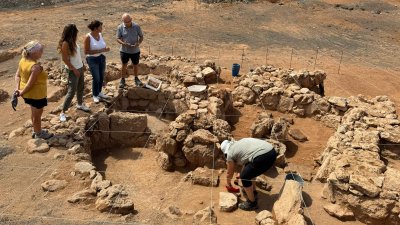
The Teguise City Council has expanded the archaeological excavation area at the El Bebedero site. This intervention began two weeks ago. The research is being carried out by a multidisciplinary team from the University of Las Palmas de Gran Canaria (ULPGC), led by the professor of Prehistory, Pablo Atoche Peña.
The mayor of Teguise, Olivia Duque, considers the El Bebedero site "fundamental" to understanding our oldest history. She also highlights that "current and past discoveries not only enrich our knowledge, but also highlight the importance of Teguise as a point of cultural and economic exchange throughout the centuries."
This research seeks new findings to expand the knowledge provided by previous works at the El Bebedero and Buenavista sites, regarding the origin and evolution of the island's indigenous culture, analyzing the contact they had with navigators from the Roman cultural sphere, as well as the socioeconomic and environmental changes that occurred. Both sites are two of the oldest settlements in the Canary Islands.
The first mayor affirms that, from the Consistory, "we are committed to supporting these investigations that highlight our heritage, guaranteeing the accessibility of these discoveries for future generations, in addition to continuing to provide information about the history of Lanzarote and La Graciosa."
For her part, the Councilor for Heritage, Mar Boronat, points out that this year's archaeological intervention includes new advanced technologies, such as georadar and geolocated 3D scanning, providing a detailed view of the structures and facilitating the conservation and digital registration of the site. "These methods allow us to preserve and study our valuable heritage with greater precision," she says.
Mar Boronat explains that different types of samples have been taken to complement the almost three dozen C14 datings already available, which will expand knowledge about the chronological sequence and the environmental environment in which the indigenous culture developed.
El Bebedero archaeological site
El Bebedero, the first site where the Roman presence in the Canary Islands was detected, was an indigenous village considered one of the oldest in the archipelago. Since 1985, evidence has been found that demonstrates exchanges, over more than four centuries, between indigenous people and navigators from the Roman cultural sphere. At this site, several constructions with thick walls and plants adapted to different functions have been discovered, including several dedicated to the kitchen.
Thanks to this discovery, an important indigenous domestic trousseau has been recovered, dated from the 1st century BC and made up of ceramic vessels modeled by hand, circular mills, stone knives carved in basalt, polished lithic stelae made on the same material, in addition to abundant remains of domestic and marine fauna.
Along with these indigenous elements, objects of Roman origin have also been found, dated between the 1st century BC and the 4th century AD, represented by fragments of different types of amphorae and common ceramic containers, in addition to a complete amphora, a unique finding of these characteristics recovered throughout the archipelago; Likewise, a glass bead has been located, artifacts that increase the findings of that cultural origin that have been recovered in previous campaigns.


Add La Voz de Lanzarote as a preferred Google source.
Stay informed with the latest current news.