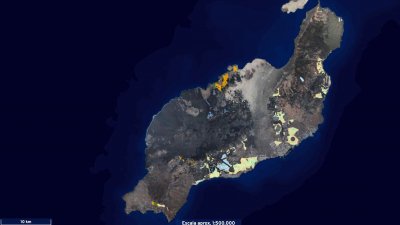
Lanzarote became the first island of the Canary Islands to agree with the Regional Government's Ministry of Ecological Transition on the zones of renewable acceleration, that is, those areas where solar panel fields and wind energy mills can be implemented. The announcement took place in July 2025, the publication of the maps where 3,100 hectares of the island (around 4,341 football fields) susceptible to host renewables were collected, in August.
Despite the agreement between institutions, since last summer there has been an open conflict between the Cabildo de Lanzarote and the Canarian Executive because in the published maps, areas that were not agreed upon appeared drawn as suitable spaces for installing renewables. Ecological Transition attributes it to an error by the public company that produced them, while the Councillor for Territorial Policy of the Cabildo de Lanzarote, Jesús Machín Tavío (CC), denounced that it was "a colossal error" and decided to walk away from the table.
At the beginning of this year, the first island institution formally asked the regional Government to reverse the project. Currently, the proposal for renewable acceleration zones can be consulted on the Grafcan public portal. To understand what has happened, we propose six questions and answers.
What are the renewable acceleration zones?
In June 2024, the Ministry of Transition of the Government of the Canary Islands, in the hands of the Popular Party, modified Law 6/2022 on climate change and energy transition of the Canary Islands to introduce the renewable acceleration zones (ZAR), terrestrial spaces where "promote and facilitate" renewable energy projects.
It was then agreed that the Department of Transition, in collaboration with the Cabildos, could select the areas in which to give the green light to the installation of solar panels and wind turbines. The modification of the law arose with the objective that promoters could know the suitable places to present renewable projects.
The law establishes that these spaces be selected based on the potential of available renewable resources, previous infrastructure, proximity to the electricity grid, priority over artificial surfaces, and "environmental and social considerations". Furthermore, it excluded its application in areas included in the Natura 2000 Network and protected natural spaces.
What did the Cabildo de Lanzarote sign with Transición Ecológica?
The Minister of Ecological Transition of the Government of the Canary Islands, Mariano Hernández Zapata, and the president of the Cabildo of Lanzarote, Oswaldo Betancort, signed a protocol of action that included the proposal of areas designated as renewable acceleration zones in Lanzarote and La Graciosa. In total, 3,100 hectares, 3.75% of Lanzarote, although to achieve the decarbonization objectives set for the year 2030, only 0.25% of Lanzarote was needed.
On August 20, 2025, the Official Gazette of the Canary Islands published the maps that included the areas suitable to be considered as renewable acceleration zones. Their approval came into effect the following day for a period of four years. However, the definitive delimitation of these areas remained pending the conclusion of a subsequent administrative procedure that adapted to the regulations.
What areas are affected?
In the maps, which remain published and are publicly accessible in the Official Gazette of the Canary Islands and in Grafcan, suitable areas appear for installing wind and photovoltaic farms in different areas of the island.
In the municipalities of Haría and Teguise appear as suitable or conditioned areas, a stretch between Arrieta and Mala, between Mala and Guatiza, in the surroundings of Charco del Palo and in the surroundings of Montaña de Tinamala. Between Las Caletas, Costa Teguise and Tahíche, next to the area of the Tahíche volcano or in the surroundings of Nazaret.
Additionally, the project contemplates facilities in the vicinity of Zonzamas and in the neighborhood of Argana Alta, in Arrecife. In addition to in Playa Honda and Güime, in the municipality of San Bartolomé.
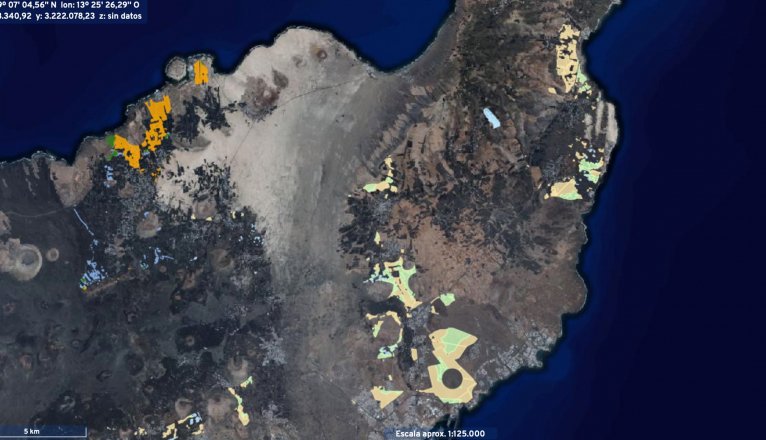
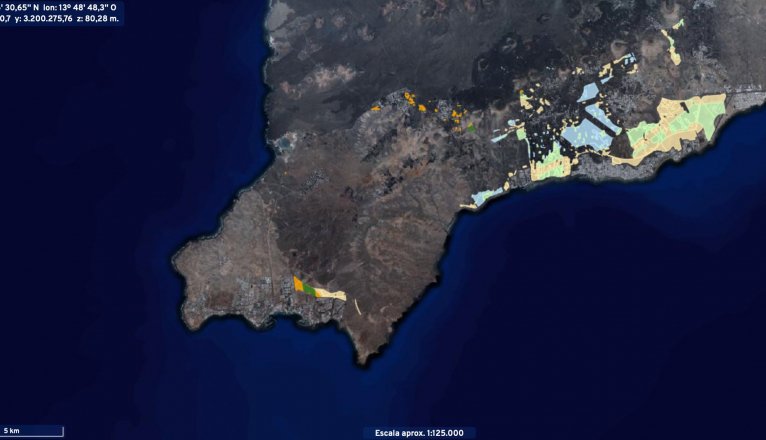
For example, in the municipality of Yaiza, the possibility of its installation opens in the surroundings of the town of Playa Blanca, also between the towns of Yaiza and La Degollada, the locality of Las Casitas and a small strip in El Hoyo.
Meanwhile, in Tinajo, the possibility of installing solar panel fields opens up in the area between Caleta de Caballo and Club La Santa, in the surroundings of La Santa, El Cuchillo, La Costa and the town of Tinajo. In addition, it contemplates the installation of wind farms at the entrance of Timanfaya National Park, next to the visitor center.
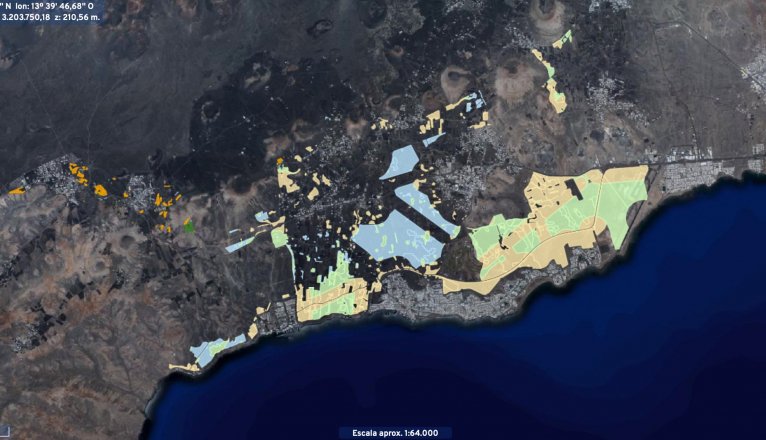
Regarding solar energy, the agreement includes in Yaiza a wide stretch in Playa Blanca, another in Las Breñas, La Hoya, the area of the En Medio mountain, between La Degollada and the town of Yaiza, as well as another space between Las Casitas and Uga. In the municipality of Teguise, the installation of solar panels is also suitable in the town of Caleta Caballo and in the town of Muñique.
In the case of Tías, the resolution contemplates large mixed zones, where solar and wind will converge. In this regard, it contemplates land occupations in the surroundings of Puerto del Carmen and Puerto Calero. To this, plots are added in the towns of Mácher, La Asomada and Conil.
Does it contemplate an environmental assessment?
Until Spain transposes Directive 2023/2413 into state law, renewable projects in acceleration zones will not be subject to an environmental assessment, but a procedure that determines the environmental impacts will suffice.
The law states that renewable projects in acceleration zones are subject to a procedure of "no environmental impact", instead of a standard environmental assessment. An environmental assessment will only be necessary in initiatives that seek to install renewables in areas included in the Natura 2000 Network, protected natural areas, maritime spaces, and the construction of overhead electricity lines with a voltage of 220 kilowatts or more.
The regulation states that the promoter must present, among other points, an elaborated executive summary that summarizes the main impacts on the Natura 2000 Network, protected areas and their peripheral protection zones or habitats of community interest; if it is on a renewable acceleration zone, it will not have to present it.
At the same time, it must include in the project's affectation protected or threatened species, indicate if it will generate discharges into public waterways or the coast, the generation of waste, the use of natural resources, cultural heritage and the socio-economic impact.
After the documentation is submitted to the environmental body, this will analyze within a period of two months whether the project "predictably" will have negative effects on the environment and will prepare a proposal for an environmental impact report. This body will determine whether the project must undergo an environmental assessment or if it is not necessary. The report that determines the environmental impact cannot be appealed, except through administrative or judicial channels.
What is the follow-up commission?
The Cabildo of Lanzarote committed to the Government of the Canary Islands to appoint within a month two representatives to form a Joint Monitoring Commission which was to meet every six months. The first island institution never appointed these representatives, something that the Ministry of Ecological Transition has criticized on several occasions.
The most critical voice of the Cabildo of Lanzarote has been the island counselor of Territorial Policy, Jesús Machín Tavío (CC), who had insisted that he was not going to appoint the technicians after the Government of the Canary Islands made a mistake in the publication of the maps and included the possibility of implementing renewables in spaces such as Caleta de Caballo and Soo.
Among other measures, this commission must be responsible for following the actions, resolving the problems of interpretation and application or promoting revisions and modifications of the protocol.
Can the Cabildo de Lanzarote eliminate the protocol by itself?
No. As agreed with Ecological Transition, the Cabildo de Lanzarote and the Government of the Canary Islands must reach a joint agreement both to modify and to eliminate the protocol. After months of conflict and contradictions between institutions, the Cabildo de Lanzarote and the Government of the Canary Islands agreed last week that they would sit at the table of the mixed commission to address the contradictions.
At the same time, the Cabildo of Lanzarote announced this very Monday that it will constitute an internal table, formed by technical and political staff, to review the current plans and "correct the errors detected in the printing of the maps".
Both announcements come after months of criticism from some affected town councils and from ecological, environmental, and social groups for how the installation of renewables in Lanzarote has been managed, alluding to the lack of consensus. For example, Ecologistas en Acción has pointed out the "incoherence" by not holding a "real public debate" that takes into account social, environmental, and "energy justice" criteria and has questioned "who benefits from these oversized infrastructures”.

Add La Voz de Lanzarote as a preferred Google source.
Stay informed with the latest current news.