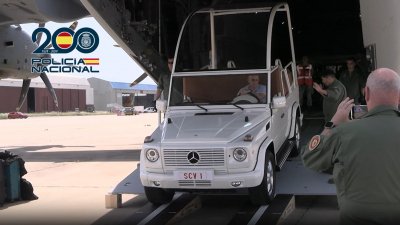
The upcoming visit of Pope Leo XIV to Spain, between the 6th and 12th of the current month, will entail the greatest logistical security challenge in the more than 200 years of history of the National Police.
The apostolic visit requires the implementation of a broad security device where the movement of human and material resources to the different venues – Madrid, Catalonia, and the Canary Islands – is fundamental to guarantee security and the normal development of the events.
More than 15,000 agents from different units will be deployed in Madrid (9,700), Barcelona (600), Las Palmas (1,200), and Tenerife (1,000), along with 2,600 police officers in training from the National Police School in Ávila. Throughout Pope Leo XIV's stay in Spain, his individual protection detail will be composed of agents from the Central Protection Unit along with members of the Special Operations Group, GEO.
Likewise, the contingent of material resources amounts to almost 600 vehicles, including 250 vans from the Police Intervention Unit – UIP –, 17 trucks from the Cavalry Unit, 24 vans from the Canine Unit specialty, 38 vehicles for GEO use, or the 91 vehicles designated for protection details. In addition, from the Police Air Unit, they will have an airplane, seven helicopters, and 16 drones; and Subsoil and Environmental Protection will have eight vans from the specialty.
In the performance of their duties, agents will have 40 early threat warning recording cameras, 160 metal detection arches, 162 security scanners, 302 metal detectors, 43 frequency jammers, and 44 individual evacuation kits.
Transfer of units to the Canary Islands
The transfer of police units to the Canary Islands is a logistical challenge. This past Tuesday, two ships departed from Huelva bound for Las Palmas and Tenerife with approximately 215 agents, more than 170 vehicles, and 16 dogs, to whom another 1,300 agents will join, departing on seven flights in the days prior to His Holiness's arrival in the island territory. Likewise, inter-island transfer will be necessary between the 11th and 12th of June via a ship that will make the Agaete-Tenerife route with more than 320 agents, 160 vehicles, and four dogs.
In addition, the Air and Space Army will collaborate in the transfer of heavy vehicles such as the trucks of the Technical Intervention Operations Group –GOIT- and the special vehicles of the Police Intervention Unit -BMR and 4x4-.
Coordination throughout the apostolic visit
For the coordination of the device, each venue will have a CEMAN, an Intelligence Desk, and an Air Security Coordination Cell, which will remain operational from the day before His Holiness's arrival in the city until the end of his stay. At the CEMAN, from where any incident during the apostolic visit will be coordinated and resolved, representatives of the units involved in the device will be located, and images transmitted by the Police Air Unit will be received and viewed in real time.
The Intelligence Desk, managed by the General Information Commissariat, will carry out permanent monitoring of social networks and possible emerging threats to, after analyzing the data, make the obtained information available to the involved units to facilitate operational coordination.
In addition, a Cybersecurity Cell is already operational, led by the Operations and Digital Transformation Division of the National Police, which is responsible for coordinating cyber-patrolling on networks through the monitoring and analysis of digital information. This work expands the capacity for detection, prevention, and response to risks in the digital environment.
Prohibition of using unauthorized drones during events
The National Police reminds that the use of drones and unmanned aircraft will be restricted in the areas affected by official events, displacements, public gatherings, and specially protected areas planned in Madrid, Barcelona, and the Canary Islands. These measures aim to guarantee the safety of attendees, the entourage, authorities, emergency services, and authorized air media that may participate in the device, as the unauthorized use of drones in these environments can pose a risk to public safety, interfere with the development of events, and compromise the actions of police, health, or emergency services.
Drone flights will not be permitted in restricted areas without prior authorization, even when the flight is intended for private, recreational, informational, or image capture purposes. Any unauthorized operation is detected by the SIGLO-CD (Global System Against Drones) early warning system, and may lead to the immediate intervention of agents, the identification of the pilot or operator, the immobilization or intervention of the equipment and, where appropriate, the processing of administrative or criminal responsibilities that may correspond in accordance with current regulations.

Add La Voz de Lanzarote as a preferred Google source.
Stay informed with the latest current news.