On February 27th and 28th, La Villa de Teguise will be the setting for the third series of conferences entitled El Jable, an (Un)known System: Biodiversity and Anthropocene. Conservation Challenges. This event will bring together leading specialists in various disciplines to address the importance of conserving El Jable de Lanzarote, a unique ecosystem facing multiple threats.
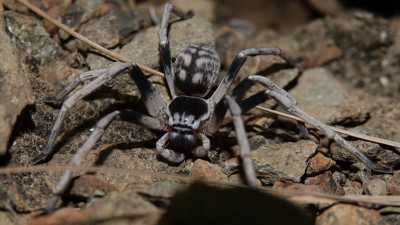
One of the experts who will participate is Sergio Henríques, biologist, expert in arachnology and leader of the IUCN Spider and Scorpion Specialist Group (Indianapolis, USA). At the conference, he will discuss the importance of El Jable as a habitat for the spider Cerbalus verneaui and the danger it is in due to the destruction of its environment.
Henríques explains that "spiders and scorpions are the best-known groups of an extraordinarily diverse class of arthropods, the arachnids. They are ubiquitous in terrestrial ecosystems and thrive in some of the most hostile environments on Earth, from the summit of Mount Everest to the deepest caves, from the Arctic tundra to the sandy deserts."
"Despite their global distribution and crucial role in ecosystems, most species are poorly studied and the risks to their survival are largely unknown. The goal of this group is to protect all arachnids, as well as their habitats around the world," he continues.
The importance of spiders in the ecosystem
Spiders are one of the most common and abundant species in the world. "They are the most diverse group of predators on Earth, the entire web of life depends on them to maintain the balance of the tons of animals they eat every day, including agricultural pests and insects that spread human diseases," says the biologist.
"Although they are predators, they also play an important role as prey, becoming an important component of the diet of many species. They also have a special role in ecosystems because they are ecosystem engineers, spiders produce burrows deep in the soil, enriching it, all the way to the tops of trees where they can feed on animals within the bark, defending the tree that supports them without harming it. Their silk is also remarkable, and many birds could not make their nests without it. Without spiders, we would lose many of the birds we love," he emphasizes.
In the case of the spider Cerbalus verneaui, "the painted lady of El Jable is an evolutionary treasure, just like the species of the Galapagos that have helped us understand natural selection and how evolution works; Cerbalus verneaui is part of a group that occurs in the Southern Mediterranean, which has evolved and adapted to the arid habitats of the Canary Islands," he says.
"It is also a treasure for the ecology and natural conservation of these extraordinary islands, as it is the main predator of its world, a giant in its desert kingdom. It is an elegant and beautifully colored giant, from which we would do well to learn before losing it forever," declares the expert.
Other species of this same genus are found in the Southern Mediterranean. The painted lady of El Jable is only found in the Canary Islands, it is part of the natural heritage of this remarkable place, and therefore "it is the sole responsibility of the inhabitants of these islands to protect it," he states.
The importance of the El Jable population in the global context
Henríques assures that "the sad reality is that we don't know how large the El Jable population is, nor how it is currently doing. Being a biologist who studies these species is like being a librarian who studies a remarkable collection of unique manuscripts, while the library is on fire."
"We are working as fast as we can to catalog what books we have (or how many species we have) while damaging their habitats at an ever-increasing rate, we are losing these natural books before we have the opportunity to read them. Losing this species would be a tremendous loss for the El Jable ecosystem, we would lose a fascinating living chapter in the evolutionary history of life on Earth, but it would also be a loss for the future: the venom of this spider may be the key to a new medicine that saves human lives, its silk may be the best material for reconstructive surgery, the potential is infinite, unless we stop protecting it," he explains.
Threats and conservation
The greatest threat to this species is habitat degradation and loss. "In El Jable, sand extraction is the main factor that is destroying the ancestral home of this species. In my opinion, the problem is a narrow view of natural resources: you can take sand today and build something small that will be useful for a few years, or you can protect this sand and the wealth of species it supports, including ourselves, and build something for many future generations," he points out.
Regarding its conservation, "this species is a survivor of the evolutionary pressures that killed so many others; it is a strong hunter and has much to teach us; if we simply leave it alone; if we simply stop destroying its sandy home," assures the biologist.
"I don't really think my opinion is important in deciding how to favor the conservation of this species. The painted lady belongs in El Jable, and the future of that land, of the island, is not in my hands but in those of the people who live there. But I hope that a solution can be found to live with nature, because the alternative will be a world in which we cannot live ourselves," he concludes.


Add La Voz de Lanzarote as a preferred Google source.
Stay informed with the latest current news.