
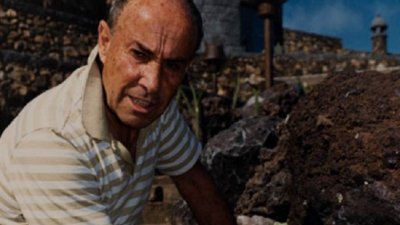
There are dates that belong to history. And there are dates that forever change the memory of a territory. September 25, 1992 was one of them for Lanzarote. That day César Manrique died. He was 73 years old. He was born in Arrecife on April 24, 1919. He was leaving the Foundation that bore his name, in Tahíche, and returning to Haría, where he had resided since 1988. It was a daily journey. But that day he did not reach his home. His vehicle suffered a traffic accident at the intersection of Tahíche with the road from Arrecife to Teguise and Haría. He was transferred to the General Hospital of Lanzarote and died shortly after. The news spread across the island. Lanzarote lost the man who for decades had contributed to transforming the way of looking at, representing, and protecting its territory.
The boy who learned to look at the island
César Manrique Cabrera was born in Arrecife on April 24, 1919, into a family linked to the Lanzarote capital. His childhood took place on an island very different from the current one. Tourism had not yet transformed the territory and a good part of life was linked to the sea, agriculture, and communication between towns. Among the landscapes that marked his early years was Famara. Family testimonies collected by the César Manrique Foundation recall those stays and the future artist's early relationship with the landscape.
That experience was not a minor episode. The volcanic nature of Lanzarote would later become one of the essential sources of his artistic language. Manrique grew up looking at an island that had not yet discovered the international tourist value of its volcanoes. The black mountains, the lava flows, the beaches, the jameos, the crops protected by stone walls, and the white houses were part of daily life. Years later, when others saw tourist resources in these elements, Manrique would also turn them into artistic material and arguments to defend island identity.
From landscape to artistic training
In 1939 he began his studies at the San Fernando School of Fine Arts in Madrid, where he later obtained a degree as a painting and drawing teacher. During the following decades, he developed a fundamentally pictorial career. His work evolved from figurative approaches towards abstraction and came into contact with contemporary artistic currents.
In 1964 he traveled to New York thanks to a grant from the Guggenheim Foundation. He lived there until 1966 and came into direct contact with some of the main trends in American art at that time. He exhibited at the Catherine Viviano gallery and got to know abstract expressionism, pop art, and other movements that would broaden his conception of art. But that international experience would end up having a particularly important consequence for Lanzarote: Manrique returned to the island with a much broader artistic vision and with the conviction that the territory could become a space for creation.
1966: the return that changed the island
In 1966 he returned definitively to Lanzarote. The island was entering a new economic phase. Tourism was beginning to gain importance and the first territorial transformations were starting to become visible. In this context, two decisive figures for the island's future coincided: César Manrique and José Ramírez Cerdá, president of the Cabildo of Lanzarote between 1960 and 1974.
Ramírez Cerdá promoted a strategy of tourism development and transformation of Lanzarote from the island institution. Manrique contributed an artistic and territorial conception based on the integration of architecture, landscape, and nature. The collaboration between the two, documented by the César Manrique Foundation, was fundamental to understanding the model that was developed during those years. The idea was not simply to build tourist attractions. It was about taking advantage of unique places on the island and turning them into spaces where human intervention was integrated into the landscape.
Jameos del Agua: when the volcano stopped being an obstacle
Jameos del Agua became one of the first great examples of this conception. The work began in the sixties and Manrique transformed a volcanic space into a complex where nature, architecture, lighting, vegetation, and art coexisted.
El Jameo Chico, El Jameo Grande, and later the auditorium were integrated into the volcanic tube. The result was not to hide nature, but to make human intervention dependent on it. The place became one of Lanzarote's main tourist symbols and also a practical demonstration of Manrique's conception of the relationship between art and nature.
Lava was not an obstacle. It was the starting point.
Tahíche: a house within the volcano
In 1968, he began building his home in Tahiche on land covered by lava flows from the Timanfaya eruptions of 1730-1736. The house utilized five natural volcanic bubbles located beneath the surface and incorporated them into the living spaces.
The result was a unique architecture in which contemporary forms coexisted with the local geology. Manrique did not build a conventional house on a conventional plot. He built by taking advantage of the existing landscape. The house became his residence and studio until 1988. It would later be transformed into the headquarters of the César Manrique Foundation.
Lanzarote. Unprecedented Architecture: Preserving Memory
There is another fundamental project for understanding Manrique's relationship with Lanzarote: Lanzarote. Unprecedented Architecture. The work began in 1966 and culminated with the publication of the book in 1974. Manrique traveled the island and documented numerous examples of traditional architecture through photographs. Houses, patios, ovens, cisterns, dovecotes, agricultural elements, and construction solutions adapted to the climate and territory were included in that work.
It was not solely about showcasing picturesque architecture. The project responded to the concern about the progressive disappearance of traditional ways of building. Manrique understood that Lanzarote's landscape was not solely formed by volcanoes. It was also composed of the constructions erected over generations by its inhabitants.
Mirador del Río: Architecture for Viewing
In the north of Lanzarote, on the Famara massif, another of his best-known interventions emerged. The Mirador del Río began construction in 1971 and was inaugurated in 1973. The project was carried out by César Manrique along with architects Eduardo Cáceres and Jesús Soto. The building was integrated into the terrain and was conceived as a place from which to contemplate the Chinijo Archipelago.
La Graciosa, Montaña Clara, Alegranza, and the ocean become the true protagonists there. The architecture functions as an intermediary. The landscape takes center stage.
Timanfaya: The Volcano as Identity
In the Montañas del Fuego, another of the major interventions associated with Manrique took place. The El Diablo restaurant was integrated into the volcanic landscape and made the site's own geothermal activity part of the experience.
The intervention contributed to consolidating a new way of presenting Timanfaya to the visitor. The territory should not be tamed to be attractive. Precisely its volcanic character constituted its main value. Lava, stone, fire, and the absence of vegetation were transformed into elements of a unique tourist and cultural experience.
Arrecife: heritage was also part of the work
Manrique's intervention was not limited to natural landscapes. It also reached Arrecife. At the Castillo de San José, he promoted the creation of the Lanzarote International Museum of Contemporary Art. The old 18th-century fortress was restored and transformed into a cultural space.
The collection brought together works by outstanding Spanish and international artists and turned the castle into one of the main contemporary art spaces on the island. In 1974, he also promoted El Almacén, a cultural space located in Arrecife. Its objective was to foster artistic and cultural activity in the capital. It was a less known dimension of his Lanzarote project: he did not want to limit the island's transformation to the creation of spaces for visitors. He also wanted to expand the cultural offerings for those who lived there.
The Cactus Garden: the last major intervention
In Guatiza is another of his essential works. The Cactus Garden was inaugurated in 1990 and became Manrique's last major intervention in the territory of Lanzarote.
The project recovered an old agricultural space and turned it into a garden specialized in cacti and succulent plants. The enclosure took advantage of the shape of an old quarry and was visually dominated by the Guatiza mill. Volcanic stone, plants, circular shapes, and architecture were once again combined in the same space.
It was, in a way, the culmination of a way of working that had begun decades earlier.
But tourist success began to worry him
Here appears one of the most important and least simplifiable aspects of Manrique's trajectory in Lanzarote. The artist had participated in the creation of a tourist image based on the uniqueness of the territory. But as tourism grew, so did urban pressure.
The César Manrique Foundation documents that Manrique expressed concern about this process from the 1960s onwards. His position evolved towards an increasingly active defense of the territory. The man who had helped turn Lanzarote into a tourist destination also began to warn of the risks of tourist growth that he considered incompatible with the conservation of the landscape.
"Lanzarote is dying"
In January 1986, El País published an extensive report on the situation in Lanzarote, which included Manrique's criticisms of the island's tourist and urban development. The headline used one of his most forceful expressions: "Lanzarote is dying."
The phrase reflects the concern that the artist had acquired regarding urban growth and the transformation of the coastline. His position was not against tourism as an economic activity. What he questioned was a model of growth that could end up destroying the landscape values on which Lanzarote's own image was based.
It was an evident paradox. And also one of the most important chapters of his legacy.
Los Pocillos: from artist to activist
In 1988, Manrique participated in mobilizations against certain tourist projects in the Los Pocillos area. His presence at those protests shows the extent to which his public role had changed.
He was no longer solely the artist who designed spaces to showcase Lanzarote. He was also one of the most visible faces in the defense of the territory. The César Manrique Foundation holds documentation about his participation in various protest actions and his criticisms of certain urban development projects. His activism ended up becoming an inseparable part of his public persona.
Haría: the final years
In 1988, Manrique moved his residence to Haría. There he restored a rural house and made it his final home and workshop. The move also had a personal dimension. After decades of intense public activity, Haría represented a more intimate space.
He continued to work. He continued to paint. He continued to intervene in projects. And he continued to publicly defend the territory. That house would be his last residence.
1992: The Foundation he left prepared for the future
The César Manrique Foundation was established in 1983 and began operating in 1992. The official inauguration took place on March 27 of that year, and it opened to the public on April 1.
Manrique converted his old house in Tahíche into the headquarters of an institution intended to preserve and disseminate his work, but also to promote the relationship between art and nature and to contribute to the defense of the natural environment and sustainable land management. It was a project that transcended his own artistic production. Manrique was creating an institution that could continue working when he was no longer around. He could not have known that he would only have six months.
SEPTEMBER 25, 1992
On September 25, 1992, he left the César Manrique Foundation in Tahíche. He was heading towards Haría. On the way, he suffered a traffic accident. The accident occurred near Tahíche and his vehicle was involved in a collision with another car.
Manrique was taken to the General Hospital of Lanzarote. He was 73 years old. He died shortly after. The news caused enormous shock on the island. The man who had turned many of its landscapes into internationally recognizable spaces had just died within the territory that had been the center of his life.
Lanzarote said goodbye to Manrique
The following day, César Manrique's last public journey through Lanzarote began. His coffin left the Insular Hospital of Arrecife and was accompanied by a crowd through different streets of the capital. The funeral was held in the church of San Ginés.
Afterwards, the body was transferred to Haría. He was buried there. The place he had chosen as his residence in his later years also became his final resting place. The island institutions declared several days of mourning and planned events on the island were suspended. Even a celebration planned at Jameos del Agua to mark World Tourism Day was canceled.
The island that had learned to show its landscapes to the world fell silent.
A year later, Lanzarote was declared a Biosphere Reserve
There is a particularly significant historical coincidence. Manrique died on September 25, 1992. In 1993, Lanzarote was declared a Biosphere Reserve by UNESCO.
It would not be correct to state that the declaration was a direct consequence of Manrique's work. The decision was UNESCO's and responded to a set of factors related to the territory, the population, economic activity, and environmental conservation. But the declaration came after decades in which Manrique had publicly defended a fundamental idea: Lanzarote should find a balance between economic development and territorial protection.
The island he had turned into his great project had just received international recognition directly related to the natural and cultural values he had helped to bring to the forefront.
The work that does not fit in a museum
César Manrique left behind paintings, sculptures, murals, gardens, viewpoints, and buildings. But his Lanzarote legacy does not fit into a catalog. It is in Jameos del Agua. In Timanfaya. In Tahíche. In Haría. In the Mirador del Río. In Guatiza. In Arrecife. In Castillo de San José. In El Almacén.
It is also in a certain way of building. In white walls. In stone walls. In protected crops. In the use of traditional architecture. And, above all, in an idea that ended up being part of Lanzarote's contemporary image: that the landscape should not be destroyed to generate wealth, but preserved precisely because it constituted one of the island's greatest riches.
The man who helped create the model and later warned of its risks
Manrique's story in Lanzarote contains a paradox that should not be hidden. He participated in the process that turned the island into an international tourist destination. But he was also one of its most forceful critics when he considered that certain projects endangered the territory.
He did not reject modernization. He did not reject tourism. He defended a certain way of developing them. His career shows how that concern grew until environmental defense became an essential part of his public activity.
That is why his legacy cannot be reduced to a collection of tourist sites. It also includes a position on how Lanzarote should grow.
Thirty-four years later
On September 25, 1992, César Manrique died. But his project did not disappear that day. Its creator disappeared. The work remained. Every time someone enters the Jameos del Agua. Every time they contemplate La Graciosa from the Mirador del Río. Every time they cross the Montañas del Fuego. Every time they visit the Cactus Garden. Every time they enter his old house in Tahíche. Every time they walk through the streets of Arrecife and find the traces of that cultural project. Every time someone observes a traditional Lanzaroteño house and understands that it is also part of the landscape.
Manrique continues there. Not as a statue. Not solely as a name. But as a question that Lanzarote still has to answer. What to do with the territory received? What to preserve? What to transform? What limits to accept? What future to build?
Manrique died before he could answer those questions for the Lanzarote of the 21st century. But he left a powerful enough idea for them to remain open. On September 25, 1992, César Manrique physically left Lanzarote. But Lanzarote did not leave César Manrique.
Because his most important work was not locked away in a room. It was not in a collection. It was not on a canvas. It was outside. Under the island's sky. Among volcanoes. Among jameos. Among walls. Among white houses. Between the ocean and the lava.
His last work was not a painting.
It was Lanzarote.
Documentary Sources
César Manrique Foundation: biography, work, activism, Foundation, Casa-Museo de Tahíche, Casa-Museo de Haría, Jameos del Agua, Mirador del Río, Castillo de San José, Cactus Garden and documentation on Lanzarote. Unpublished architecture. UNESCO, Man and the Biosphere (MAB) Programme, documentation of the Lanzarote Biosphere Reserve. Cabildo de Lanzarote, historical and cultural documentation on César Manrique and his interventions on the island. El País newspaper archive, especially information published in January 1986, August 1988, and September 1992 on César Manrique's career, activism, accident, and death. Historical documentation on José Ramírez Cerdá and the tourist development of Lanzarote during the 1960s and 1970s.



Add La Voz de Lanzarote as a preferred Google source.
Stay informed with the latest current news.